
Diagnostic dashboard to bridge gaps in Kenya’s healthcare system
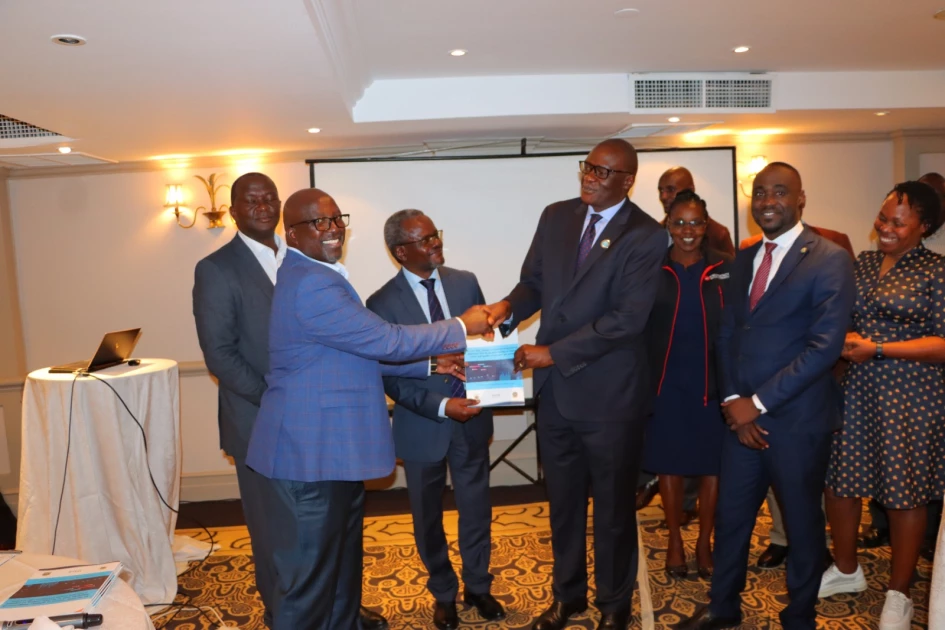
Dr. Patrick Amoth, Acting Director General for Health receiving a copy of the diagnostic report from JKUAT's Prof. Simon Karanja during the official launch of the report in Nairobi.

Audio By Vocalize
The researchers have developed a diagnostic dashboard, which consolidates a wealth of diagnostic-related data, offering an interactive and comprehensive overview of diagnostics in the country.
During the research period spanning from 2022 and 2023 the researchers collected extensive data from level 2 to 6 public health facilities in Kenya.
They meticulously tracked changes in diagnostic availability, capacity allocation, and quality indicators for critical areas such as maternal health, triage, communicable, and non-communicable diseases.
The project’s dashboard captures a wide range of data, from diagnostic service capabilities to the accessibility of health facilities by citizens.
This information is processed and visualized into user-friendly graphs, maps, and charts, revealing disparities in investments across different health facility levels and underscoring the need for equitable resource allocation within the health sector.
The diagnostic dashboard represents a significant stride toward a more advanced and effective healthcare system, enabling healthcare stakeholders to make informed decisions and enhance patient outcomes.
Dr. Jane Akinyi, a researcher at JKUAT, emphasized the study's significance in Kenya’s plan to achieve Universal Healthcare (UHC).
"We wanted to find out how realistic it is for the country to achieve UHC. For Kenya to reach UHC, we must first ensure excellence at the diagnostic level. Confirmatory tests are essential for appropriate therapy, promoting speedy and complete patient recovery while mitigating negative outcomes like antimicrobial resistance,” she said during official launch of the report in Nairobi.
The research, carried out under the Diagnostics for Universal Health Coverage (UHC) Tracker (Dx 4 UHC Tracker) project, was conducted in 3 counties: Kisumu, Nakuru, and Kilifi counties, over a 12-month period spanning 2022 and 2023 as a pilot project.
Dr. Leyla Abdullahi, Senior Policy Analyst at the African Institute for Development Policy (AFIDEP), which supported the project in knowledge translation, emphasized the collaborative aspect of the research, urging counties to leverage on the dashboard.
“Counties can leverage their technical working groups so that they can learn from each other as they utilize the diagnostics dashboard,” she said.
She encouraged all counties to seize every opportunity to share the tool and document lessons from its use, as it provides evidence at all levels to advocate for resources to address diagnostic gaps in Kenya.
Dr. Fredrick Oluoch, Director of Public Health and Sanitation for Kisumu County, highlighted the dashboard's utility and how policymakers can use it.
“They can use the platform to allocate resources strategically and direct funds where they are most needed. Administrators can also monitor the distribution of diagnostic equipment and human resources to ensure efficient use.”
Dr. Haji Masuko, a Family Physician in Kilifi County, emphasized the inseparable link between diagnostics and Universal Health Coverage.
"As counties roll out primary care networks (PCN) for UHC across Kenya, it should be clear that there is no UHC without diagnostics. Resources must be made available to support diagnostic services. Regulatory bodies should also support task shifting to address the human resource gap in different counties,” he said.
Professor Simon Karanja, Principal Investigator of the project and Chief Scientist of DHARC-JKUAT, said the study empowers the Ministry of Health and counties to bridge diagnostic gaps effectively across the country.
To further advance diagnostics, the researchers recommend that counties develop data repositories and enhance peer-to-peer learning.
The Dx 4 UHC Tracker project's inception can be traced back to a prior study by JKUAT researchers focused on optimizing diagnostic networks for maternal and child health in Nyeri and Kisumu counties.
This earlier study exposed critical gaps, with financing for diagnostic services emerging as a primary concern. To address these gaps and align efforts with Kenya's UHC rollout, the Tracker project was conceived.
Leave a Comment