
EACC raises alarm over forged academic credentials in public, private sectors
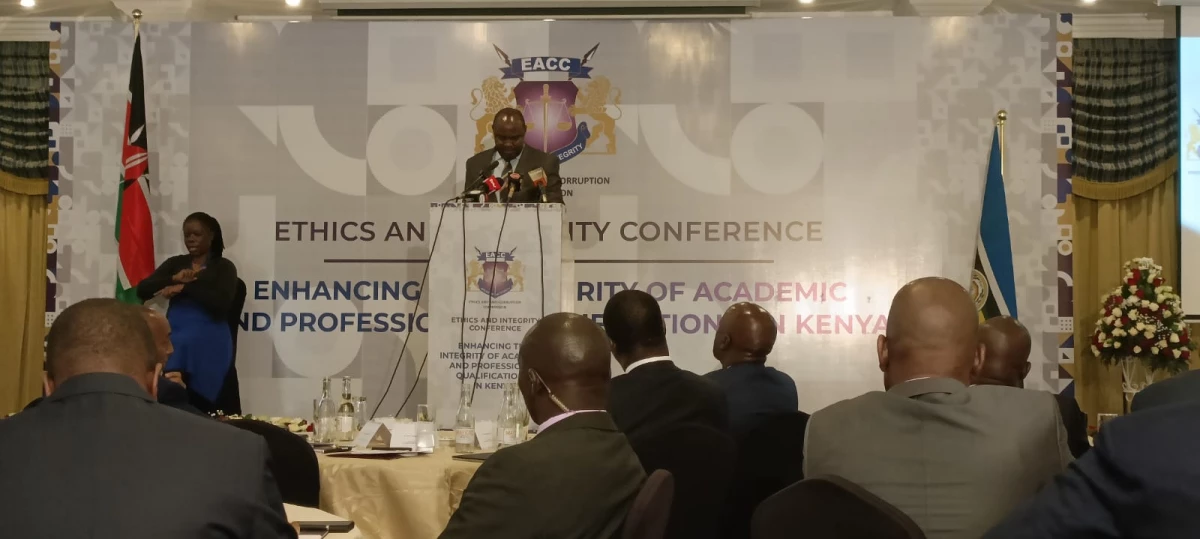
This disturbing trend was revealed at the 2025 Ethics and Integrity Conference, held at the Sarova Stanley Hotel in Nairobi, where top government and anti-corruption officials warned of the far-reaching consequences if the problem is not addressed quickly.

Audio By Vocalize
This disturbing trend was revealed at the 2025 Ethics and Integrity Conference, held at the Sarova Stanley Hotel in Nairobi, where top government and anti-corruption officials warned of the far-reaching consequences if the problem is not addressed quickly.
In his keynote address, Felix Koskei, EGH, Chief of Staff and Head of Public Service, warned that certificate forgery is a serious breach that jeopardizes Kenya's institutions' core values of integrity, competence, and meritocracy.
“This vice strikes at the heart of competence and integrity in our institutions,” Koskei said. “We must confront it decisively to safeguard our national objectives.”
According to data shared by the Ethics and Anti-Corruption Commission (EACC), the scale of the fraud is staggering. Since 2022, the commission has investigated 549 cases of forged academic and professional credentials.
Of these, 85 files have been forwarded for prosecution, resulting in 13 convictions and 7 acquittals. Beyond legal action, the EACC is also pursuing recovery of salaries and benefits obtained fraudulently by individuals who gained employment using fake documents.
A verification exercise conducted across 91 public institutions has so far unearthed 1,208 forged certificates from a sample of 53,000 cases submitted to the Kenya National Resources Region Council.
The investigation continues, but early findings show the most egregious fraud is concentrated in state corporations and senior government agencies, which account for approximately 70% of the reported forgeries, followed by public universities with 116 cases.
Koskei further revealed that 787 officers in tertiary institutions were found to have used fake documents to secure appointments, promotions, or resignations.
The forgery spans all levels of education, from secondary schools and TVETs to both local and international universities.
The 2023–2024 national values report also painted a dire picture: among 358 institutions that conducted certification audits for 168,000 officers, 859 individuals were confirmed to hold fake academic certificates, while 160 others possessed fraudulent professional credentials. Alarmingly, 24,000 officers had not been certified at all.
The scandal has far-reaching consequences—not only for governance and institutional credibility, but also for Kenya's youth, who face an alarming 67% unemployment rate.
"It is unacceptable that graduates with genuine first-class degrees struggle to find work while fraudsters thrive," Koskei said, pointing out the irony and injustice of the situation.
Kenya’s international image is also at stake. Dr. David Oginde, Chairperson of the EACC, warned that if unqualified individuals are exposed abroad—especially through the government’s ongoing labour export initiative—the nation’s reputation for excellence could be irreparably damaged.
“The problem of academic fraud may seem like a domestic issue, but its implications are global,” Dr. Oginde cautioned. “Kenya is globally recognized for its skilled workforce, and this reputation is now under threat.”
Only 49 institutions have reported such cases to the EACC or Public Service Commission, with only 43 providing supporting evidence, raising concerns about institutional complacency and potential complicity. Authorities are now pushing for greater accountability from employers, both public and private.
“We now want both public and private employers to be held accountable if they fail to verify academic documents before employment,” Koskei declared. “Employers are the gate of entry—we will deal with them.”
Chapter Six of Kenya’s Constitution outlines a Leadership and Integrity Code, which mandates that appointments to public office be based on personal integrity, competence, and suitability. Dr. Oginde reminded stakeholders that this code must guide all hiring decisions.
The conference, which featured prominent figures such as Public Service Commission Chair Ambassador Anthony Muchiri and Dr. Beatrice Inyangala, Principal Secretary for Higher Education and Research, concluded with a renewed commitment to integrity audits and annual ethics forums.
Join the Discussion
Share your perspective with the Citizen Digital community.
No comments yet
This discussion is waiting for your voice. Be the first to share your thoughts!