
El Nino: How the Met Dept became a punching bag for politicians despite issuing warnings for months
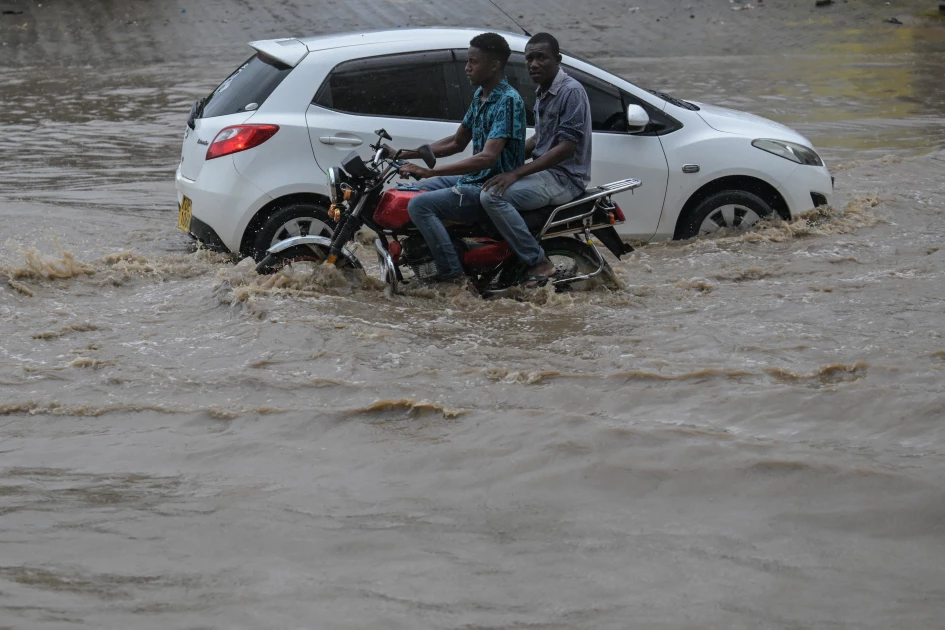
Motorbike riders wade through a waterlogged street after heavy rains in Mombasa on November 3, 2023. (Photo by SIMON MAINA / AFP)

Audio By Vocalize
As
the short-rain season in Kenya takes shape, several counties are plunged into
the deep waters of the devastating effects of heavy downpours and flooding.
The
world is experiencing a return of the El Nino phenomenon which is characterised
by excess rainfall and flooding in the East Africa
region.
Photographs and footage of submerged villages, cars and people wading in flooded city streets are making rounds online, and so are posts and news articles of people accusing the Kenya Meteorological Department of sabotaging El Nino preparedness efforts.
On Wednesday, Wajir Governor Ahmed Abdullahi appeared
on Citizen TV to criticise the Met Department, attributing the late
preparedness for mitigating the ongoing El Nino's devastating effects to
misinformation by the state agency.
Abdullahi who also serves as the Council of Governors
(CoG) vice chair, claimed that the Met Department gave inconsistent
updates, leading to a lack of urgency in preparedness efforts
“The early warning system that we rely on is the meteorological department that is giving mixed signs. When the media hypes the same, yes, it scared away a lot of pre-preparedness that we could have done,” the governor said.
Governor Abdullai joined a section of Kenyans who have been accusing the meteorological department and the government at large of failing Kenyans through their ‘inaccurate’ weather forecasts.
NINETY-NINE PER CENT LIKELIHOOD
At the start of May, the Food and Agriculture
Organization of the United Nations (FAO) warned El Nino will return this year following a three-year La Nina phase.
FAO said the phenomenon was
forecast to return in June, with dry weather conditions expected in key
cropping areas of Central America, Southern Africa and Far East Asia, while
excessive rainfall and possible flooding were foreseen in Near East Asia and
East Africa.
The Met Department would issue an update two
weeks later, warning that El Nino was expected in Kenya between October and December, with a
possibility of extending to January 2024.
Come August 30, the department addressed a
press conference warning of a 99 per cent likelihood of high rainfall across
parts of the country as El Nino returns.
In the warning, which was widely covered by mainstream
media, Met Director David Gikungu outlined the areas where heavy
continuous rainfall was expected and noted that the rains would begin in
September, peak in October and go on until January.
Late September, Deputy President Rigathi Gachagua shared an update acknowledging the Met Department’s warning, saying he met with governors, cabinet secretaries, and local and international partners “to put our heads together in order to avert disaster.”
After reports that there will be no El Nino
rains but above-average rainfall, Met’s Dr Gikungu gave an interview to Citizen
TV on October 2, reiterating that the El Nino rains will indeed happen as anticipated.
The department clarified the same on its social
media platforms.
‘NO EL NINO’
The confusion began when President William Ruto
on October 22 said the Met Department had scaled down its El Nino alert to
short rains, telling a church service in Nairobi’s Dagoretti area, "You
see the department has now said there will be no El Nino, we will only have
significant rains, which is even better for us to get to our farms and produce
more."
He even linked the rainfall Kenya is receiving
to the prayers he conducted at the Nyayo National Stadium in
February, saying they had paid off.
"There are those who criticised us when we prayed for rains
at Nyayo stadium. They said a whole president is praying for rain. Now see, we
have more rains than we have had in four years, that is God's doing," Ruto
said.
But the Met Department did not independently speak
on the purported scaling down of its earlier advisory.
Three weeks later, on November 10, Gachagua
made the Met Department boss apologise over the government’s miscommunication on
the matter after summoning him to address the current state of rains in the
country.
“I want to point out that as initially given in the forecast,
we have El Nino in this short rainy season 2023 and we do
apologize for the lack of communication or miscommunication because that was a
big mistake but we are sorry about that, but moving forward let us prepare
ourselves for enhanced rainfall as a result of El Nino
phenomena as we are in,” Dr Gikungu stated.
Gikungu further urged Kenyans to take caution
as the El Nino rains could continue up to the first quarter of 2024, after
which DP Gachagua thereafter said, “I think the matter is settled, El Nino it is.”
Now, some political leaders are criticising their
counterparts for confusing Kenyans with misleading information instead of letting
the Met Department issue weather advisories independently.
Among them is Kisii senator Richard Onyonka, who on Tuesday said
political leaders should leave the weatherman do their job instead of giving
contradicting information.
“Sometimes
science can be misinterpreted. I think as political leaders, we should just
leave the Meteorological Department alone. Let them make the mistakes and
correct them. Can politicians accept that our job is to politick and allow the
Meteorological Department to do its job?” the Senator told Citizen TV.
He
blamed President Ruto for the confusion, saying previous heads of state never
gave directives about the weather.
“I
don’t remember President Kibabi, Uhuru or Moi or indeed President Kenyatta
talking about the weather,” Onyonka said.
“It is
just the way we have the Ministry of Health; the Director of Medical Services
and the teams talk to the public, the way it was during COVID. That is how
systems run.”
According
to the Kenya Red Cross Society, over 52 people have lost their lives due to the
ongoing rains while more than 9 others have been injured.
The
humanitarian organisation says over 56,500 people have been hit
by the raging floods that have affected 19 counties.
Join the Discussion
Share your perspective with the Citizen Digital community.
No comments yet
This discussion is waiting for your voice. Be the first to share your thoughts!