
Empty plates in Dadaab as funding shortfalls push refugees to starvation
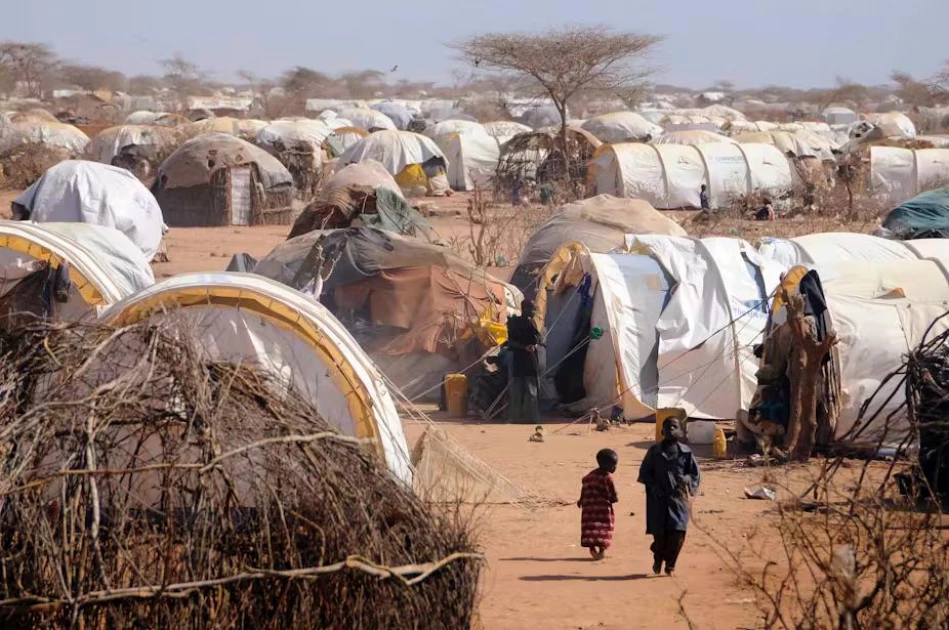
People move around the outskirts of Dagahaley settlement at Kenya’s Dadaab Refugee Camp. Reuters/Jonathan Ernst

Audio By Vocalize
According to recent research published in The Lancet medical journal, United States President Donald Trump’s decision to significantly reduce sums given by USAID to global humanitarian assistance programs may result in over 14 million preventable deaths worldwide in just five years.
Kenya’s refugee population bears a particularly disproportionate share of this statistic.
As a result of the funding cuts, the World Food Programme (WFP) on June 2025 announced the suspension of the ‘Bamba Chakula’ e-voucher leaving refugees in Kenya’s Dadaab camp at risk of starvation and social unrest.
In Kenya’s Dadaab refugee camp, Abdullahi Mire, founder of the Refugee Youth Education Hub (RYEH), is confronting vulnerabilities through education, livelihood programs, as well as informational campaigns to empower refugees.
Mire observes that the food crisis situation in the camp is worsening, as families stare at empty plates.
“Over the last three months, the number of food baskets given to refugees has been reduced by more than four times. People are lining up and dying in stampedes just trying to feed themselves, dehumanizing them in the process,” he says, referring to a case of 29-year-old Khadija Noor who died in April 2025, during a stampede at the Ifo1 and Ifo 2 Food Distribution Points.
From Crumbs to Nothing
Launched by the WFP, the Bamba Chakula initiative — a Swahili Sheng meaning “Get your food” — is an electronic voucher that enabled refugees to buy food from markets within the camps.
It allowed them to purchase alternative food options other than the traditional food handouts. However, the value of these e-vouchers had always been measly, and over time it began to decline.
“The Bamba Chakula program wasn’t even a big help. It was more of an organizational bandage, if I may say so. Realistically, how can someone survive on less than 8 dollars a month? It wasn’t much, but now, without it, families are worse off and are starving,” Mire stated bluntly.
Residents of Dadaab refugee camps have watched the value of Bamba Chakula e-vouchers continuously dwindle, from $6 per person every month in March, down to just $4 in May, before facing an abrupt cutoff in June.
“We were expecting it,” added Anab Gedi Mohammed, 35, born and raised in Dadaab. She is the founder of Halgan, a women’s refugee-led organisation.
“It was only Ksh.500, but you could use it for milk, vegetables, and other basic necessities. Now even that has been stopped, making life very difficult for us,” Anab sighed.
The food insecurity has resulted in early marriages among girls in the Garissa-based refugee camp.
“The lack of food on the table has driven many families to desperate measures with some marrying off their 16-year-old daughters to men in their 60s from outside Dadaab, offering money in exchange. Once the girl is pregnant, the man is nowhere to be seen,” Anab shares.
Having established three libraries in Dadaab and collected more than 150,000 donated books, Mire is an advocate for literacy and refugee education.
He describes how “adolescents are stuck between a rock and a hard place. They must hustle to find food for their families, particularly senior family members or pregnant mothers, which causes them to miss classes two or three times a week.”
Is there hope for the future?
In a bid to move away from decades of encampment since 1991, the Kenyan government, in collaboration with UNHCR, has implemented the Shirika Plan, whereby refugees and locals live and work together.
According to the Department of Refugee Services, the Shirika Plan is a “a multi-year initiative, [which] aims to promote the socioeconomic inclusion of refugees in Kenya by transforming camps into integrated settlements for both refugees and asylum seekers.”
What’s more, the program promises better access to education, healthcare, jobs, and environmental protections, all while promoting self-reliance.
For Mohammed Abdullahi Jimale, a 27-year-old refugee youth leader in Dadaab, the Shirika Plan offers a glimmer of hope, but only if it comes with real changes.
“I’ve spent my entire life in this camp. It’s the only home I’ve ever known,” he says. “I would ask the Kenyan government to allow refugees to work within the Kenyan border. If we are allowed to do business, move around, we could have a much brighter future outside of this open prison. We are hopeful that this plan will give us a chance to be self-reliant.”
Mire takes a similar stance, asserting that “the Shirika Plan looks good on paper, and it can be amazing if effectively carried out,” he says. “It’s all about social inclusion. If done right, it can turn Dadaab into a flourishing marketplace.”
However, for others like Anab, such hope is distant.
“They give us no free movement. It’s like being in an open prison,” she says.
Anab recalls being in a validation meeting for the implementation of the Shirika Plan, where her desire for free movement was met with dismissal.
Leave a Comment