

Ethiopia is at war with itself. Here's what you need to know about the conflict
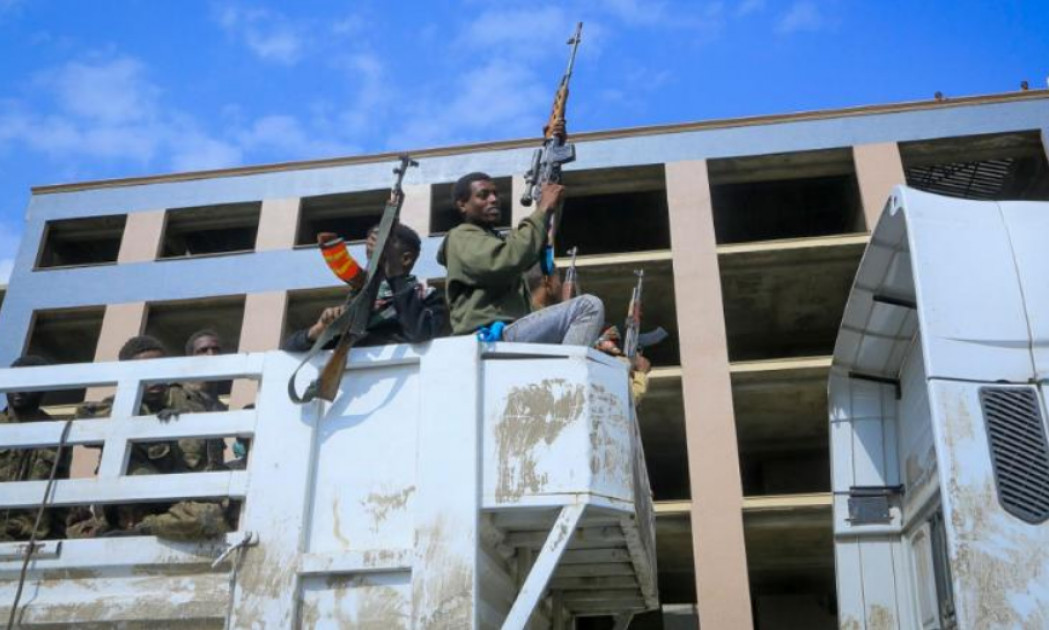
Tigrayan forces parade captured Ethiopian government soldiers and allied militia members in open-top trucks, as they are taken to a detention center in Mekele on October 22.

Audio By Vocalize
When Ethiopian Prime Minister Abiy Ahmed received
the Nobel Peace Prize in 2019,
he was lauded as a regional peacemaker. Now, he is presiding over a
protracted civil war that by
many accounts bears the hallmarks of genocide and has the potential to
destabilize the wider Horn of Africa region.
In November 2020, Abiy ordered a military offensive in
the northern Tigray region and
promised that the conflict would be resolved quickly. One year on, the fighting
has left thousands dead, displaced more than 2 million people
from their homes, fueled famine and given rise to a wave of atrocities.
Ethiopia was struggling with significant economic, ethnic and
political challenges long before a feud between Abiy and the region's former
ruling party, the Tigray People's Liberation Front
(TPLF), bubbled over into unrest.
But now, with escalating hostilities in other areas of
Ethiopia, fears are growing that the fighting in Tigray could spark a wider
crisis with the potential to pull Africa's second-most populous country apart.
How did the conflict start?
The Tigray conflict has its roots in tensions that go back
generations in Ethiopia.
The country is made up of 10 regions -- and two cities -- that
have a substantial amount of autonomy, including regional police and militia.
Because of a previous conflict with neighboring Eritrea, there are also a large
number of federal troops in Tigray. Regional governments are largely divided
along entrenched ethnic lines.
Before Abiy Ahmed came to power, the TPLF had governed
Ethiopia with an iron grip for decades, overseeing a period of stability and
economic growth at the cost of basic civil and political rights. The party's
authoritarian rule provoked a popular uprising that ultimately forced Abiy's
predecessor, Hailemariam Desalegn, to resign.
In 2018, Abiy was appointed by the ruling class to quell
tensions and bring change, without upending the old political order. But almost
as soon as he became prime minister, Abiy announced the rearrangement of the
ruling coalition that the TPLF had founded -- the Ethiopian People's
Revolutionary Front, or EPRDF, which was composed of four parties -- into a
single, new Prosperity Party, ostracizing the TPLF in the process.
In his drive for a new pan-Ethiopian political party, Abiy
sparked fears in some regions that the country's federal system -- which
guarantees significant autonomy to ethnically-defined states such as Tigray --
was under threat. Leaders in Tigray withdrew to their mountainous heartland in
the north, where they continued to control their own regional government.
Tensions boiled over in September 2020, when the Tigrayans
defied Abiy by going ahead with regional parliamentary elections that he had
delayed due to the coronavirus pandemic. Abiy called the vote illegal and
lawmakers cut funding to the TPLF leadership, setting off a tit-for-tat series
of escalations between the regional and the federal government.
On November 4, 2020, after accusing the TPLF of attacking a
federal army base outside Tigray's regional capital Mekelle and attempting to
steal its weapons, Abiy ordered a military assault against the group, sending
in national troops and fighters from the neighboring region of Amhara, along
with soldiers from Eritrea.
Abiy declared the offensive a success after just three weeks
when government forces took over Mekelle, and installed an interim
administration loyal to Addis Ababa. But a year on, it's far from over.
For months at the start of the conflict, Abiy denied that
civilians were being harmed or that soldiers from Eritrea had joined the fight.
But reports from international observers, human rights groups
and CNN proved both of those claims wrong.
Thousands of people have died in the fighting, by many
estimates, with reports of razed refugee camps, looting, sexual violence,
massacres and extrajudicial killings. Many more have fled to Sudan, in what the
United Nations has called the worst exodus of refugees from Ethiopia seen in
two decades. They describe a disastrous conflict that's given rise to ethnic
violence.
Ethiopia's government has severely restricted access to
journalists, and a state-enforced communications blackout concealed events in
the region, making it challenging to gauge the extent of the crisis or verify
survivors' accounts.
But evidence of atrocities began to leak out earlier this
year.
Separate investigations by CNN and Amnesty International in February uncovered evidence of
massacres carried out by Eritrean forces in the Tigrayan towns of Dengelat and
Axum late last year.
Another CNN investigation published in June revealed new details
of a massacre committed by Ethiopian soldiers in the Tigrayan town of Mahibere
Dego in January. The report identified one the perpetrators of the
massacre, geolocated human remains to the site of the attack.
In an exclusive report from Tigray in April, CNN captured
Eritrean troops -- some disguising themselves in old Ethiopian military uniforms
-- operating with total impunity in central Tigray, manning checkpoints and
blocking vital humanitarian aid to starving populations more than a month after
Abiy pledged to the international community that they would leave.
All actors in the conflict have been accused of carrying out
atrocities, but Eritrean forces have been linked to some of the most gruesome.
In addition to perpetrating mass killings and rape, Eritrean soldiers have also
been found blocking and looting food relief in multiple parts of Tigray.
Eritrea's government has denied any involvement in atrocities.
Ethiopia's government has pledged investigations into any wrongdoing.
The conflict, which erupted during the autumn harvest season
following the worst invasion of desert locusts in Ethiopia in decades, plunged
Tigray even further into severe food insecurity.
In September, the UN said that a "de facto humanitarian
aid blockade" was limiting its ability to access more than 5 million
people in Tigray -- or 90% of the population -- in need of humanitarian aid,
including 400,000 people facing famine conditions.
Later that month, the UN aid chief Martin Griffiths declared
that swathes of the war-torn region were in the throes of a
"man-made" famine and urged the Ethiopian government to facilitate
access.
The Ethiopian government has repeatedly rejected allegations that
it is blocking aid. Just days after Griffiths' comments, Ethiopia ordered seven
senior UN officials to be expelled from
the country, including from organizations coordinating relief efforts.
Less than a year before Abiy launched an assault on his own
people, he described war as "the epitome of hell" during his acceptance
speech for the Nobel Peace Prize. He was awarded the honor for his role in
ending a long-running conflict with neighboring Eritrea and for pushing
significant reforms in Ethiopia.
Eritrea was once a part of Ethiopia, but won independence in
1993 after a 30-year armed struggle. From 1998 to 2000, Ethiopia and Eritrea
fought a war that killed thousands on both sides, which led to a long,
dangerous stalemate and a total freeze in cooperation.
Once in power, Abiy moved quickly to normalize relations with
Eritrea, in part by accepting the ruling of an international commission on
boundaries between the two states.
Abiy also made significant moves towards domestic reforms,
raising hopes that he would bring about lasting change. As well as forging a
truce with Eritrea, he lifted a severe security law, released thousands of
political prisoners, moved to open up the telecommunications industry and
expand private investment.
But his reputation as a leader who could unite Ethiopia has
swiftly deteriorated, and his much-lauded peace deal with Eritrea appears to
have paved the way for the two countries to go to war with their mutual foe --
the TPLF.
Since the conflict began, ethnically-driven violence has
broken out into other parts of the country, including in Abiy's home region,
Oromia, the country's most populous region. In May, the Oromo Liberation Army
(OLA), an armed group, vowed to wage "total war" against Abiy's
government.
Despite promises to heal ethnic divides and pave the way for a
peaceful, democratic transition, Abiy has increasingly invoked the playbook of
repressive regimes: Shutting down internet and telephone services, arresting journalists and
suppressing critics. Abiy has also been criticized for fueling "inflamed" rhetoric amid
the conflict in Tigray, whose forces he has described as "weeds" and
"cancer."
This July, in the midst of the war, Abiy and his party won a
landslide victory in a general election that
was boycotted by opposition parties, marred by logistical issues and excluded
many voters, including all those in Tigray -- a crushing disappointment to many
who had high hopes that the democratic transition Abiy promised three years ago
would be realized.
Ethiopia's government declared a unilateral ceasefire in June,
when Tigrayan forces retook the regional capital Mekelle. But the TPLF
categorically ruled out a truce, and the fighting has spread beyond Tigray's
borders into the neighboring Amhara and Afar regions.
On November 2, almost exactly a year since that the conflict
in Tigray began, Ethiopian authorities announced a nationwide state of
emergency and called on citizens to take up arms to defend the capital.
A day later, a senior diplomatic source in Ethiopia told CNN
that fighters from the Tigray Defense Force (TDF) and the Oromo Liberation Army
(OLA) were on the outskirts of the capital.
The source added that the rebels had the firepower to be
inside the city within hours, if they chose to be, but would prefer to wait for
an agreement to be put in place.
The rapid advance of the fighters, who said they had seized
Dessie and Kombolcha, two key towns of on the road to Addis Ababa, has raised
concerns among Ethiopia's leaders that the capital could fall.
A government spokesperson disputed the capture of the towns,
but later released a statement accusing Tigrayan forces of executing 100 youths in
Kombolcha. The TPLF denied the allegation.
As the Tigray forces push the front line further south, the
government has intensified airstrikes on Mekelle and other cities in Tigray, in
an attempt to target them at the source of their alleged bases.
Abiy has urged citizens to take up arms and fight the Tigrayan
forces. "Our people should march ... with any weapon and resources they
have to defend, repulse and bury the terrorist TPLF," Abiy said in a
Facebook post Sunday.
Addis Ababa's city administration was instructing residents to
register their weapons and gather in local neighborhoods to
"safeguard" their surroundings, Reuters reported.
US Secretary of State Antony Blinken, who has condemned ethnic
cleansing in Tigray, said Washington was alarmed over reports of the TPLF
takeover of the towns. "All parties must stop military operations and
begin ceasefire negotiations without preconditions," he said on Twitter.
As the war and its impact on civilians deepens, world leaders
have voiced their concern about the Ethiopian government's restriction of aid
to Tigray and the role of Eritrean forces in exacerbating the crisis.
Senior Biden administration officials have warned that
Ethiopia will lose access to a lucrative US trade program due
to human rights violations unless it takes significant steps toward ending the
ongoing conflict and alleviating the humanitarian crisis by the start of 2022.
President Joe Biden has determined that Ethiopia is out of
compliance with the eligibility requirements of the African Growth and
Opportunity Act (AGOA) "for gross violations of internationally recognized
human rights," he said in a message to Congress on November 1.
The Ethiopian government must take "urgent action"
by January 1 in order to remain in the program, which grants eligible
sub-Saharan African nations duty-free access to the US market for thousands of
products.
The US administration is also preparing to issue sanctions
against parties to the conflict, under an executive order signed by Biden in September, according
to the officials.
US Special Envoy for the Horn of Africa Jeffrey Feltman has
said that "as the war approaches its one-year anniversary, the United
States and others cannot continue 'business as usual' relations with the
government of Ethiopia."
The State Department has previously announced visa
restrictions for Ethiopian and Eritrean government officials and the Biden
administration has imposed wide-ranging restrictions on economic assistance to
the country.
But it is not clear whether efforts by the US and other
countries to force Ethiopia's hand have made much of a difference.
Leave a Comment