

Fast-moving stars reveal supermassive black hole inside nearby galaxy
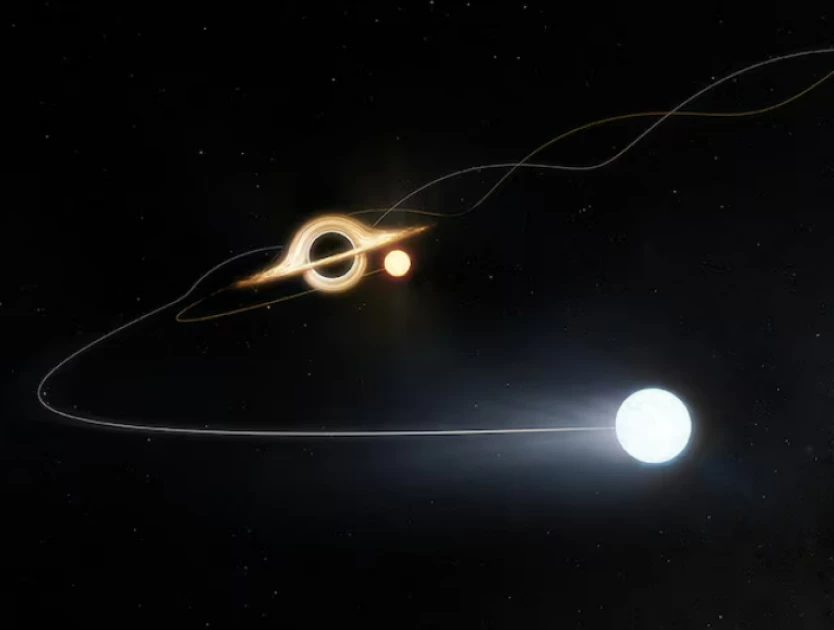
An artist's impression of a hypervelocity star ejected from the Large Magellanic Cloud, in this handout image released on March 6, 2025. CfA/Melissa Weiss/Handout via REUTERS THIS IMAGE HAS BEEN SUPPLIED BY A THIRD PARTY NO RESALES. NO ARCHIVES

Audio By Vocalize
The Large Magellanic Cloud is a dwarf galaxy
residing near our Milky Way, visible to the naked eye as a luminous patch
of light from Earth's southern hemisphere and named after Portuguese explorer
Ferdinand Magellan, who observed it five centuries ago. New research is now
providing a fuller understanding of the makeup of our galactic neighbor.
A study based on the trajectory of nine fast-moving stars
observed at the fringes of the Milky Way provides strong evidence for
the existence of a supermassive black hole inside the Large Magellanic Cloud.
Most galaxies are thought to have such a black hole at their core, but this
represents the first evidence for one within the Large Magellanic Cloud.
According to the researchers, data on the trajectory of
these stars indicates they were flung out of the Large Magellanic Cloud after a
violent close encounter with this black hole. Black holes are exceptionally
dense objects with gravity so strong that not even light can escape.
The Large Magellanic Cloud is located about 160,000
light-years from Earth, making it among the closest galaxies to the Milky Way.
That makes this the nearest supermassive black hole to us aside from the one
called Sagittarius A*, or Sgr A*, situated at the heart of the Milky Way.
Sgr A* is about 26,000 light-years from Earth. A light-year is the distance
light travels in a year, 5.9 trillion miles (9.5 trillion km).
Just as the Milky Way is much more massive than the Large
Magellanic Cloud, Sgr A* is much more massive than the newly identified black
hole, which is among the least massive of any supermassive black holes known.
Sgr A* has a mass roughly 4 million times greater than the sun's. This one has
a mass about 600,000 times greater than the sun's.
Sgr A*, in turn, is dwarfed by some supermassive black holes
detected in other large galaxies such as one with a mass 6.5 billion times
greater than that of the sun in a galaxy called Messier 87. That one and Sgr A*
are the only two black holes ever imaged by astronomers.
The new study focused on a class of stars called
hypervelocity stars. They are produced when a binary star system - two stars
gravitationally bound to each other - ventures too close to a supermassive
black hole.
"The intense gravitational forces tear the pair apart.
One star is captured into a tight orbit around the black hole, while the other
is flung outward at extreme velocities - often exceeding thousands of
kilometers per second - becoming a hypervelocity star," said Jesse Han, a
doctoral student in astrophysics at Harvard University and lead author of the
study being published in the Astrophysical Journal and made public on
Thursday.
The sun travels through space at about 450,000 miles per
hour (720,000 kph) while hypervelocity stars do so at several times that speed.
The researchers used data from the European Space Agency's
Gaia space observatory that has tracked more than a billion stars in our galaxy
with unprecedented precision.
There are 21 known hypervelocity stars in the Milky Way.
Astronomers have confidently identified the origins of 16 of them, tracking
seven of them back to Sgr A* at our galaxy's core and the other nine back to
the Large Magellanic Cloud.
"The only plausible explanation is that the Large
Magellanic Cloud harbors a supermassive black hole in its center as well,
analogous to Sgr A* in our galaxy," Han said.
"The Large Magellanic Cloud, given its mass and
structure, is totally expected to have a supermassive black hole of this mass.
We just needed to find the evidence for it," Han said. "It's fun and
exciting, but also something that really does make sense."
Until now, the closest known supermassive black hole from
beyond the Milky Way was the one inside the Andromeda galaxy, about 2.5 million
light-years from Earth. It is the nearest major galaxy to the Milky Way.
"The Large Magellanic Cloud is one of the best-studied
galaxies, yet this supermassive black hole's existence was only inferred
indirectly by tracing the origins of fast-moving stars. We have more work to do
to actually pinpoint the location of the black hole," said Caltech
astronomer and study co-author Kareem El-Badry.
Leave a Comment