

Five conditions Cheruiyot Kirui gave his guide before climbing Everest without supplemental oxygen

Audio By Vocalize
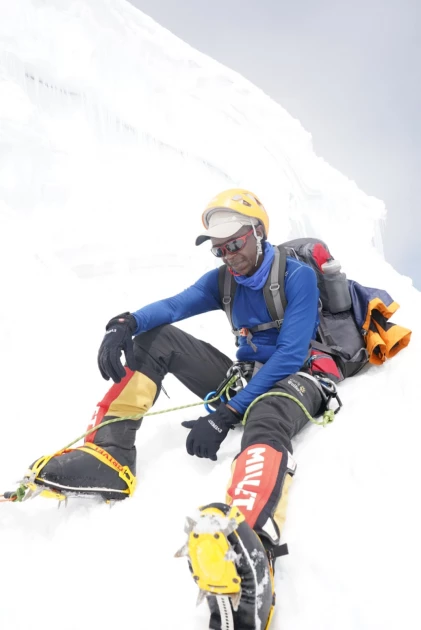
Kenyan climber Cheruiyot Kirui’s dream of summiting
Mount Everest was cut short this week after he died just metres away from the peak of the
world’s highest mountain.
Kirui, a banker with the local lender KCB, wanted
to summit Everest, which stands at 8,848.86 meters above sea level, without
supplementary oxygen.
He went missing with his guide, a Nepali
climber identified as Nawang Sherpa, on Wednesday, at Bishop Rock, located at
an altitude of 8,000 metres.
News that Kirui’s body was found was
announced on Thursday morning by the Nepali mountaineering news website Everest
Today. Sherpa’s fate remains
unknown.
At higher altitudes, Everest is nearly
incapable of sustaining human life and most mountaineers use supplementary
oxygen past 7,000 metres.
Past around 8,000 metres, famously known as
the ‘death zone’, the air is extremely thin, temperatures are below 0°C and the
high winds are powerful enough to blow a person off the mountain.
Climbers face high-altitude cerebral edema
(HACE), where one’s brain is starved of oxygen.
This results in brain swelling, causing
drowsiness, and trouble speaking and thinking. One might also experience
blurred vision and episodes of delusion.
However, a scan through the banker’s social
media accounts, where he gave followers updates about his mission, shows that
Kirui had made arrangements for Sherpa to ferry an emergency bottle of oxygen
to be used only under specific circumstances.
In a May 17 Facebook post, Kirui wrote
that he was open to using supplemental oxygen if “I go lights out or if I go
bananas.”
He also said he would use supplemental
oxygen if he was time-barred, saying, “Too much time in the death zone is
dangerous. If I'm not moving strongly or quickly enough then there's no point.”
“Unfavorable weather: If the weather turns
against our respected forecasters (as it happened on the 12th) and the exposure
is dangerous,” reads the post.
It adds: “Body limit reached: If the body
is fed up and can't handle the grind and I realize I'm not Superman.”
Kirui, who was climbing from the Tibet side
of the mountain to avoid traffic, also said “Hopefully we get to avoid it, but
if it leads to dangerous inactivity and exposure in the death zone then we'll
weigh our options.”
According to a 2016 report by National
Geographic, less than 200 people were known to have summited Everest without
oxygen by then.
Statistics from the Himalayan Database show
that as of January 2024, climbing Everest from the Nepal side, which is the
most popular, has a death toll of 217 while the Tibet side has recorded 110
deaths since 1953.
Sixty per cent of the deaths from the Nepal
side involved climbers without supplemental oxygen (130 climbers) while on the
Tibet side, 48 of those not using supplemental oxygen died, representing 44 per
cent of the total deaths.
“This attempt therefore looks a lot like a
shot in the dark, but we know where the darkness is, and our shot is aimed in
there. So, as I send my body and spirit up there, I'll sit with the rest of you
and wait in anticipation for the outcome. Naturally, the uncertainties add much
more to the thrill of this undertaking,” Kirui added in the Facebook post.
He added that because without oxygen one is
much more susceptible to frostbite compared to climbers on oxygen, he had taken
extra measures to battle the cold.
“Hands: A pair of
heated gloves and a pair of heated mittens with a spare set of batteries. Feet:
Two pairs of heated socks with a spare set of batteries,” he wrote, adding that
he had gotten medicine for both HACE and HAPE (high altitude pulmonary edema).
Leave a Comment