
For first time, Webb telescope discovers an alien planet
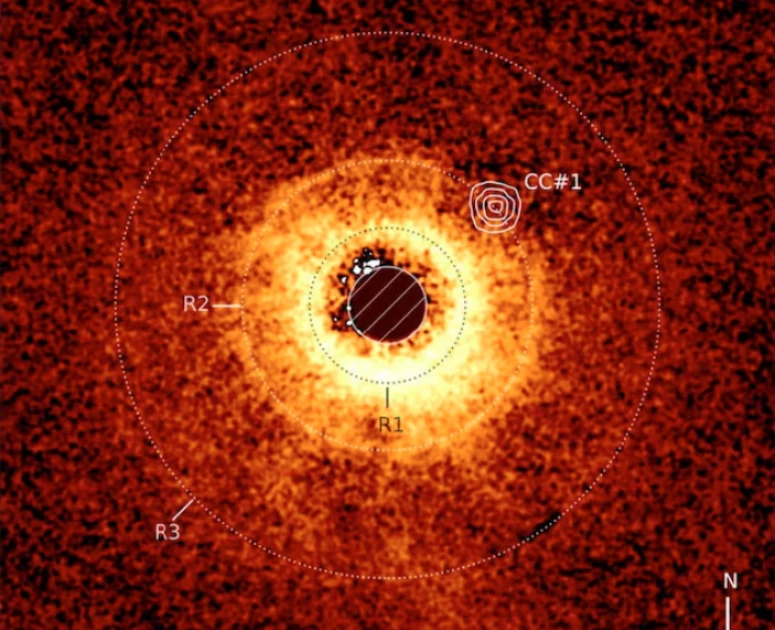
An image of the protoplanetary disk around the star TWA 7, recorded using the European Southern Observatory's Chile-based Very Large Telescope's SPHERE instrument, is seen with an image captured with the James Webb Space Telescope's MIRI instrument overlayed in this image released on June 25, 2025. The empty area around exoplanet TWA 7 B is shown in the R2 ring, CC #1. AM Lagrange et al/JWST/ESO/Handout via REUTERS

Audio By Vocalize
In addition to providing a trove of information about
the early
universe, the James
Webb Space Telescope, since its 2021
launch, has obtained valuable data on various already-known planets
beyond our solar system, called exoplanets.
Now, for the first time, Webb has discovered an exoplanet not previously known.
Webb has directly imaged a young gas giant planet roughly the size of Saturn, our solar system's second-largest planet, orbiting a star smaller than the sun located about 110 light-years from Earth in the constellation Antlia, researchers said. A light-year is the distance light travels in a year, 5.9 trillion miles (9.5 trillion km).
Most of the roughly 5,900 exoplanets discovered since the
1990s have been detected using indirect methods, such as through observation of
the slight dimming of a star's light when a planet passes in front of it,
called the transit method. Less than 2% of them have been directly imaged, as
Webb did with the newly identified planet.
While this planet is large when considered in the context of
our solar system, it is actually the least massive one ever discovered through
direct imaging, 10 times less massive than the previous record holder. This
speaks to the sensitivity of Webb's instruments.
This discovery was achieved using a French-produced
coronagraph, a device that blocks out the bright light from a star, installed
on Webb's Mid-Infrared Instrument, or MIRI.
"Webb opens a new window - in terms of mass and the
distance of a planet to the star - of exoplanets that had not been accessible
to observations so far. This is important to explore the diversity of
exoplanetary systems and understand how they form and evolve," said
astronomer Anne-Marie Lagrange of the French research agency CNRS and LIRA/Observatoire
de Paris, lead author of the study published on Wednesday in the journal Nature.
The planet orbits its host star, called TWA 7, at a distance
about 52 times greater than Earth's orbital distance from the sun. To put that
in perspective, our solar system's outermost planet, Neptune, orbits
about 30 times further from the sun than Earth. The transit method of
discovering exoplanets is particularly useful for spotting those orbiting close
to their host star rather than much further out, like the newly identified one.
"Indirect methods provide incredible information for
planets close to their stars. Imaging is needed to robustly detect and
characterise planets further away, typically 10 times the Earth-to-sun
distance," Lagrange said.
The birth of a planetary system begins with a large cloud of
gas and dust - called a molecular cloud - that collapses under its own gravity
to form a central star. Leftover material spinning around the star in what is
called a protoplanetary disk forms planets.
The star and the planet in this research are practically
newborns - about 6 million years old, compared to the age of the sun and our
solar system of roughly 4.5 billion years.
Because of the angle at which this planetary system is being
observed - essentially looking at it from above rather than from the side - the
researchers were able to discern the structure of the remaining disk. It has
two broad concentric ring-like structures made up of rocky and dusty material, and one narrow ring in which the planet is sitting.
The researchers do not yet know the composition of the
planet's atmosphere, though future Webb observations may provide an answer.
They are also not certain whether the planet, being as young as it is, is still
gaining mass by accumulating additional material surrounding it.
While this planet is the smallest ever directly imaged, it
is still much more massive than rocky planets like Earth that might be good
candidates in the search for life beyond our solar system. Even with its
tremendous capabilities of observing the cosmos in near-infrared and
mid-infrared wavelengths, Webb is still not able to directly image Earth-sized
exoplanets.
"Looking forward, I do hope the projects of direct
imaging of Earth-like planets and searches for possible signs of life will
become a reality," Lagrange said.
Join the Discussion
Share your perspective with the Citizen Digital community.
No comments yet
This discussion is waiting for your voice. Be the first to share your thoughts!