

Francis laid to rest as 400,000 mourn pope 'with an open heart'
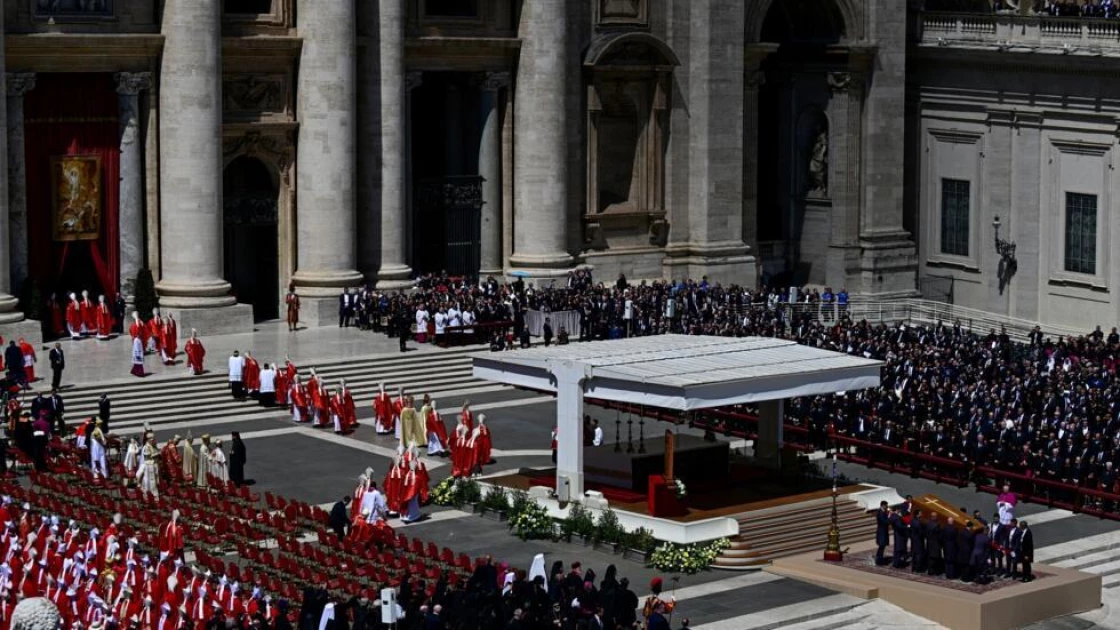
Pope Francis died aged 88 after a 12-year papacy © Tiziana FABI / AFP

Audio By Vocalize
Hundreds of thousands of mourners joined world leaders,
including US President Donald Trump, to bid farewell Saturday to Pope Francis,
a champion of the poor who strived to forge a more compassionate Catholic
church.
The Vatican said 400,000 people packed St Peter's Square and
lined the streets of Rome for the funeral of the first Latin American leader of
the world's 1.4 billion Catholics.
After a solemn funeral, the Argentine pontiff's plain wooden
coffin -- a testament to a life of humility -- was driven slowly to Rome's
Santa Maria Maggiore church, where he was interred in a private ceremony.
Cardinals marked his coffin with red wax seals before it was
lowered into a tomb set inside an alcove, according to images released by the
Vatican.
Guatemalan Maria Vicente, 52, holding a rosary, cried as she
watched the coffin being carried into Santa Maria Maggiore, the pope's
favourite Roman church.
"It made me very sad. It's touching that he left us
like that," she said.
Fourteen white-gloved pallbearers carried the coffin into
the church, as children placed baskets of flowers at the altar and a choir sang
prayers.
The marble tomb is inscribed with just one word:
"Franciscus", his papal name in Latin.
Trump was among more than 50 heads of state at the funeral.
He met several world leaders in a corner of the St Peter's basilica
before, notably Ukraine's President Volodymyr Zelensky, in their first
face-to-face meeting since their Oval Office clash in February.
Francis, who died on Monday aged 88, was "a pope among
the people, with an open heart", who strove for a more compassionate,
open-minded Catholic Church, said Cardinal Giovanni Battista Re who led the
service.
There was applause from the masses gathered under bright
blue skies as he hailed the pope's "conviction that the Church is a home
for all, a home with its doors always open".
Francis sought to steer the Church into a more inclusive
direction during his 12-year-long papacy, and his death prompted a global
outpouring of emotion.
Maria Mrula, 28, a student from Germany, said she drove 16
hours to be at the funeral.
"Giving to the poor and being with the poor",
Francis had inspired many, she said.
"The Church is alive," she said. "It was
great being here."
Italian and Vatican authorities mounted a major security
operation for the ceremony, with fighter jets on standby and snipers positioned
on roofs surrounding the tiny city state.
Red-robed cardinals and purple-hatted bishops sat on one
side of the altar in St Peter's Square during the funeral, with world
dignitaries sitting opposite.
In front of the altar lay the pope's simple cypress coffin,
inlaid with a pale cross.
The funeral set off nine days of official Vatican mourning
for Francis, who took over following the resignation of Pope Benedict XVI in
2013.
After the mourning, cardinals aged under 80 will elect a new
pope from among their number.
Many of Francis's reforms angered traditionalists, while his
criticism of injustices, from the treatment of migrants to the damage wrought
by global warming, riled many world leaders.
Yet the former archbishop of Buenos Aires's compassion and
charisma earned him global affection and respect.
"His gestures and exhortations in favour of refugees
and displaced persons are countless," Battista Re said.
He recalled the first trip of Francis's papacy to Lampedusa,
an Italian island that has become the initial port of call for many migrants
crossing the Mediterranean, as well as when the Argentine celebrated mass
on the border between Mexico and the United States.
Trump's administration drew the pontiff's ire for its mass
deportation of migrants, but the president has paid tribute to "a good
man" who "loved the world".
Making the first foreign trip of his second term, Trump sat
among leaders, many of them keen to bend his ear over a trade war he unleashed,
among other subjects.
The White House on Saturday said that the president had a
"very productive" meeting with Zelensky before the funeral.
Kyiv published a photo of the encounter, the two men sitting
face to face in red and gold chairs in the basilica, as well as another showing
Zelensky huddled with Trump, Britain's Keir Starmer and French President
Emmanuel Macron.
In the homily, Battista Re highlighted Francis's incessant
calls for peace, and said he had urged "reason and honest
negotiation" in efforts to end conflicts raging around the world.
"'Build bridges, not walls' was an exhortation he
repeated many times," the cardinal said.
Trump's predecessor, Joe Biden also attended the funeral,
alongside UN Secretary General Antonio Guterres, Germany's Olaf Scholz, Italy's
Giorgia Meloni, and Lebanon's Joseph Aoun.
Israel -- angered by Francis's criticism of its war in Gaza
-- sent only its Holy See ambassador. China, which does not have formal
relations with the Vatican, did not send any representatives.
Italian mourner Francesco Morello, 58, said the homily about
peace was a "fitting, strong and beautiful message".
Of the world leaders gathered, Morello noted: "He could
not bring them together in life but he managed it in death."
Francis died of a stroke and heart failure less than a month
after he left the hospital where he had battled pneumonia for five weeks.
The Church's 266th pope loved nothing more than being among
his flock, taking selfies with the faithful and kissing babies, and made it his
mission to visit the peripheries, rather than mainstream centres of
Catholicism.
His last public act, the day before his death, was an Easter
Sunday blessing to the world, ending his papacy as he had begun it -- with an
appeal to protect the "vulnerable, the marginalised and migrants".
The Jesuit chose to be named after Saint Francis of Assisi,
saying he wanted "a poor Church for the poor", and lived at a Vatican
guesthouse rather than the papal palace.
Catholics around the world held events to watch the
proceedings live, including in Buenos Aires, where Francis was born as Jorge
Bergoglio in the poor neighbourhood of Flores in 1936.
"The pope showed us that there was another way to live
the faith," said Lara Amado, 25, in the Argentine capital.
Francis's admirers credit him with transforming perceptions
of the Church and helping revive the faith following decades of clerical sex
abuse scandals.
He was considered a radical by some for allowing divorced
and remarried believers to receive communion, approving the baptism of
transgender believers and blessings for same-sex couples, and refusing to judge
gay Catholics.
But he also stuck with some centuries-old dogma, notably
holding firm on the Church's opposition to abortion.
Francis strove for "a Church determined to take care of
the problems of people and the great anxieties that tear the contemporary world
apart", Battista Re said.
"A Church capable of bending down to every person,
regardless of their beliefs or condition, and healing their wounds".
Leave a Comment