
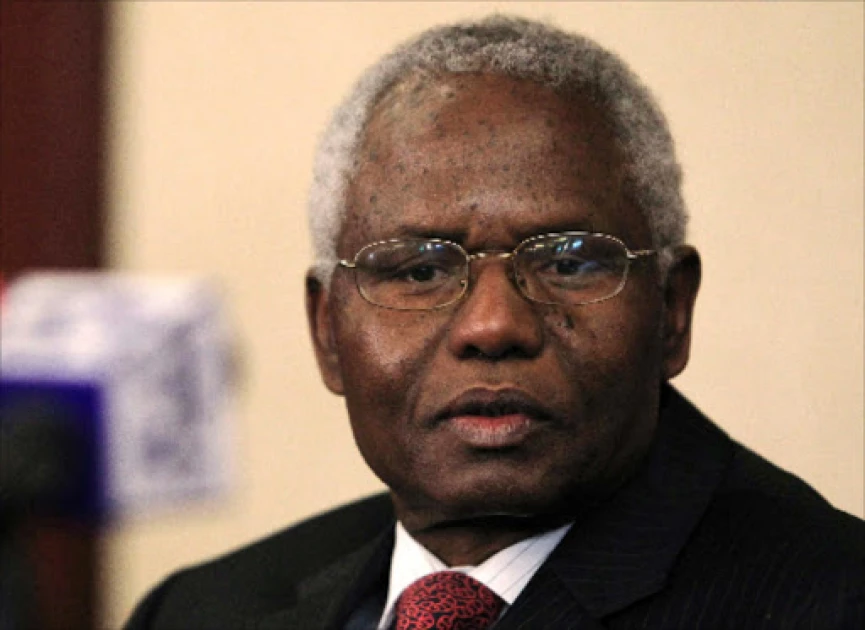
Francis Muthaura on decision to hurriedly swear in President Kibaki in 2007

Audio By Vocalize
I first heard of Kibaki in 1960. He was always in the news as the Kanu executive officer. We were in high school then and some of the names that we used to admire included Kibaki, Tom Mboya and Dr Julius Gikonyo Kiano.
But I first met Kibaki in 1967 when I was in Nyeri High School while in Form V and as a member of the Economics Club. Kibaki – as the minister for Commerce- had already launched a campaign “Buy Kenyan, Build Kenya” and we liked the concept. He was very impressed with our club.
My First Impression.
My initial impression of Kibaki was that of a sharp, knowledgeable and confident politician. When I joined the Provincial Administration in 1972, Kibaki was already a Finance minister and was deemed one of the best ministers.
My First Admiration.
I came to admire him during the budget of 1975. This is the time he said that the soft options have ended. He wanted to protect local industries. It was he who came up with import substitution policies that helped the local industrial sector expand.
My first official meeting.
I first met and interacted with Kibaki officially as a Government officer in 1986 when I was working as a diplomat. Kibaki had come to an OAU (Organisation of African Unity) meeting in Addis Ababa. I was to brief him as Vice- President and he was together with foreign affairs minister Elijah Mwangale. I was to brief him on issues that were to be discussed by the Council of Ministers. What surprised me that time was that he was alone and he had not come with any staff from Nairobi. I found this strange and did not ask him why he was alone.
When I almost lost my job for meeting Kibaki.
I was appointed Kenyan Ambassador to the European Economic Community (he served in Brussels, Belgium from 1988 – 1993) and one day by accident I met Kibaki as I was heading home to see my ailing father. This time Kibaki was the Chairman of Democratic Party (DP) and he was leading a (parliamentary) delegation from Washington DC. I went to his cabin and wanted to greet him as the Kenyan ambassador in Brussels. Somebody reported me to Nairobi that I was about to join DP and that my father was not sick. That time I almost lost my job and some security agents were sent to my rural home to verify whether my father had been sick. I did not meet him again until October 1999 when he came to attend President Julius Nyerere’s funeral when I was the East African Community Secretary General.
The Transition from Kanu.
As a Permanent Secretary in the Ministry of Environment in 2002, I was preparing to go home after Kanu was removed from power. I thought we were winding up and I called Dr Sally Kosgey (then head of civil service and secretary to the Cabinet) asking her whether we should resign. She told us to hold on. The same day I called her, I heard an announcement that I had been appointed the PS Ministry of Provincial Administration and Internal Security. My minister was Dr Chris Murungaru. But after only one month, I was transferred to Office of the President as Permanent Secretary, Head of the Public Service, and Secretary to the Cabinet.
Until this time I had not met Kibaki since our meeting in Arusha. This was a surprise because I was a senior member of Moi’s Government.
My Initial Meeting as PS.
When I met him Kibaki after I was appointed to OP, he told me he was very happy to work with me and that I was free to go and see him in State House any time I wanted. This surprised me because I had not known him much. Again, I had been in the previous Government.
Working with Kibaki.
Kibaki is a very detailed man. There are times I would go to ask him a question and get embarrassed. What I found interesting about him is that he insists on written briefs before any meeting. He also wants all the original letters plus any other attachments. And once you give him these documents, you have to have copies because it is very difficult to retrieve written materials from him. So, every time I went to see him, I carried two copies.
Again if you are going to brief him, you have to be clear and straightforward. He doesn’t like to be taken round.
Line of Authority.
In any briefing, Kibaki doesn’t talk about other people. He hates gossip and respects line of authority. He will always be happy to be briefed by his minister and permanent secretary. That way, he can hold people accountable. I realized Kibaki becomes impatient if he doesn’t get an answer to a query. Those who worked with him know one rule- never go back to him without an answer or with a shoddy answer. Although he doesn’t exhibit emotions you will see that he becomes impatient.
Food Security and Education – The Hardest brief.
This was one of the hardest briefs. We could brief him for hours assuring him that all was well but he never got satisfied with our answers. This was the most difficult brief I ever faced. He always had his figures and we would go on and on. Another brief that would keep us on our toes was on education. The President used to monitor the enrollment of children. He took it personally for he knows the value of education. He used to tell us: “primary school education haitoshi...(its not enough)”
Working with PSs and other executives.
Kibaki is a believer in delegation of authority. Once he has given an assignment he wants to see results. I found out that he won’t give you direction on whom to employ or work with. He gives all the executives a free hand to make decisions. That is why we even came up with appraisals to enhance performance.
Appointments with the President.
Kibaki is very particular with appointments booked. He does not do them on a first-come first-served basis. He accepts them on the basis of importance and on the weight of the brief. A lot of people made this mistake and thought that we were shielding the President. For instance, a minister for Finance and Foreign Affairs would get to Kibaki very easily. He has absolutely no time for casual talk and gossip.
What annoys Kibaki.
Kibaki can get really disturbed when people are not honest. I think it is because he is an honest person and that is why he gets uneasy when people distort facts. The good thing is that he won’t show it in public but he can lose his temper when he hears people distort issues when addressing the public.
How to make Kibaki happy.
Kibaki does not get excited easily. But if you want to see him happy, just go and complete a good project. He was for instance passionate about the Lamu port and always said that it would open the economy of this country.
Is he indecisive?
a) Referendum results.
Kibaki is the first President to commit Kenyan troops to go to war. What can be more decisive? That did not surprise me because I have seen Kibaki make other decisions. I remember during the Referendum of 2005 and he was in Othaya when the counting was concluded. I called him and told him we are devastated and asked him to come to Nairobi in the morning to accept defeat. Initially, he had planned to return in the afternoon. I was very demoralized and I remember him telling me: “You should not be too low. That matter is concluded.” Kibaki appeared to be in high spirits and that helped us a lot. He came to Nairobi that morning and addressed the Nation. I was happy about that.
b) When ODM group was kicked out of Cabinet.
Immediately after Kibaki addressed the Nation after losing the referendum, he asked me to call a leaders meeting of various parties allied to PNU to forge the way ahead. That meeting was chaired by Vice President, Moody Awori and others in the meeting were Simeon Nyachae, and George Saitoti. One of the options on the table was to dissolve the Cabinet and we went to him with that as the verdict. We did not know how he would react. When he was told about that option he simply said, “Yes, we are doing that..!”
c) Koffi Annan Talks.
Another time that Kibaki was confronted with a difficult decision was during the post-election violence negotiations.
At one point, it was difficult for the two parties to agree. His side had refused to agree on a 50-50 formula and he took it over himself. He told them: We cannot talk indefinitely. (That was on February 28 and the Cabinet was finally sworn- in in April.)
The 2007 Elections – That lonely night at State House.
I was the only person with Kibaki that night as we were watching the results trickling in. At one point, Raila opened a gap of 1 million votes. We were seated in a room in State House watching TV. The gap continued to widen and I told the President that our field officers have told us not to worry since the PNU strongholds had not announced their results yet. But the gap of 1 million votes was worrying. I started counseling Kibaki to see whether I could offer him some help. I told him that this was like a repeat of 2005 and that people have just ganged up against Mt Kenya region. I told him that his record of performance as President in both infrastructural development is all there to be seen. Kibaki did speak much. He just told me: “There is everything to show.”
Stabilising the Nation.
When the votes from PNU strongholds started trickling in, the ODM side started talking of rigging. I told Kibaki that we need to talk to the media for the stability of the country. It was a very tense moment and he said, “go and talk to them.” Kibaki told me that the media was key to holding the country together and we had a meeting with media owners and senior editors. We returned to State House and there was an overnight recount at KICC which all parties had agreed to abide to. These were the results that enabled Electoral Commission Chairman Samuel Kivuitu to announce the results.
Kibaki was prepared to accept defeat.
I was with him all this time and Kibaki was prepared to accept defeat. There was no time he said that he won’t accept the results.
Hurried Swearing in.
I remember I was with Raphael Tuju, Chief Justice Evans Gicheru and Attorney General Amos Wako when we made the decision to swear-in Kibaki that day. Initially, we had thought of having an elaborate ceremony but due to the crisis that was developing we thought that a power vacuum would encourage power struggle. And since the Electoral Commission had announced the results, we invited diplomats to State House to come and witness the swearing in. It was not at night. But that was the best way to save the country.
The Half Cabinet decision.
For one week, Kibaki operated without a Cabinet. There was a lot of pressure on him with VIPs and Heads of State calling to help resolve the crisis. In private and public the President had said he wanted an all embracing Cabinet in order to restore peace. We advised him to pick a skeletal cabinet to help him absorb the pressure. He needed a Minister for Foreign Affairs, a Finance minister and a Special Programmes minister. Kibaki agreed to this proposal. We were not giving PNU prime jobs. Those were jobs to help us deal with the crisis.
Did he panic?
All this time, Kibaki did not show signs of panic. He knew that at the end of the day the buck stops with him. He never failed when he was required to make a decision. The good thing with Kibaki is that if you give him advise, he owns it and would never apportion blame if it fails. One thing he knew was that the security of the country was intact. It is sad we lost people, but at no time was the Kenyan nation under threat. The international community blew the crisis out of proportion.
At the Cabinet.
At the Cabinet, Kibaki would not rush things. He allows everybody to be heard. If somebody is not happy with a particular paper it will have to be brought again until everybody is in agreement. He will allow comments to improve a particular paper. Inside the Cabinet, it is hard to know who is from which side of the Coalition. It is a very democratic cabinet.
Sourced from Mwai Kibaki, 50 years of national service
Join the Discussion
Share your perspective with the Citizen Digital community.
No comments yet
This discussion is waiting for your voice. Be the first to share your thoughts!