

Freed from Canada, Huawei executive Meng Wanzhou hailed as hero upon return to China

Audio By Vocalize
Huawei executive Meng Wanzhou, who spent
nearly three years in house arrest in Canada, returned home late Saturday,
ending a prolonged extradition fight with the United States and
sparking an outburst of national pride in China, where her release has been
portrayed as a diplomatic victory for Beijing.
Meng, who was wanted by US federal
prosecutors for fraud charges related to alleged Iran sanction violations,
was arrested in Vancouver in December
2018. Beijing has called it a political arrest by the former Trump
administration, and repeatedly demanded she be released.
Her legal battle strained
relations between China, the United States and Canada, especially after
Beijing detained two Canadians following Meng's arrest — a move widely
interpreted as political retaliation.
On Friday, Meng was allowed to go
home after reaching an agreement with the US Department of Justice to
defer her prosecution until late 2022, after which point her charges could be
dropped. Hours after her release, the two Canadians detained by China, Michael
Kovrig and Michael Spavor, were also freed.
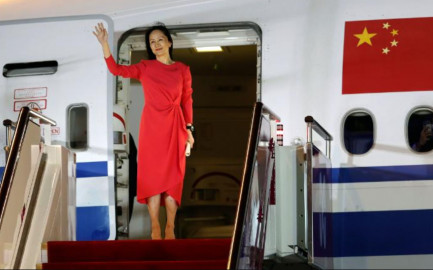
On Saturday evening, the southern Chinese
city of Shenzhen, where the tech giant Huawei is headquartered, rolled out a
red carpet welcome for Meng, who arrived on a flight chartered by the Chinese
government.
Wearing a red dress, Meng emerged from the
plane without a face mask and waved to a crowd of more than 100 people waving
Chinese flags and shouting "welcome home."
"I'm finally back home!" Meng said
in a brief speech to those assembled on the tarmac, expressing gratitude to her
"great motherland," the ruling Communist Party and, specifically,
Chinese President Xi Jinping.
"As an ordinary Chinese citizen who had
suffered this plight and been stranded abroad for three years, there was never
a moment where I did not feel the care and warmth of the Party, the motherland
and the people," said Meng, who is the daughter of Huawei's
founder, Ren Zhengfei.
"Chairman Xi cares about the safety of
every Chinese citizen, and he also keeps my situation on his mind. I am deeply
moved."
Meng ended her speech vowing to uphold the
leadership of Xi and the party, and pledging loyalty to her country.
"Where there is a Chinese flag, there is
a beacon of faith," she said emotionally. "If faith has a color, it
must be China red."
While Meng had repeatedly called herself an
"ordinary Chinese" in the speech, the grand reception for her was
anything but ordinary.
As her plane descended toward the airport, it
was greeted by a special message from the control tower: "Here is
China's Shenzhen Baoan Airport. The motherland is forever your most powerful
support. Welcome back, Ms. Meng Wanzhou!"
Inside the arrival hall, hundreds of people
gathered to welcome Meng. Holding national flags, flowers and banners, the
crowd erupted in national pride, shouting slogans including "long
live the motherland" and belting out patriotic songs.
Downtown, Shenzhen's tallest
skyscrapers lit up with the message: "Welcome home Meng
Wanzhou!"
And on China's internet, news about Meng's
journey home riveted public attention and dominated discussions. Internet users
tracked her flight across the Arctic Ocean, and tens of millions of people
tuned in to watch state media's online livestream of her arrival
(some ran on for six hours straight.)
Many called her a national hero, and hailed
her return as a symbol of China's victory over the West.
"The reason why (Meng's return) has
drawn so much attention is that this is a diplomatic coup for China, and a
manifestation of China's strength," said one of the top
comments on Weibo, China's Twitter-like platform.
In a commentary, Communist Party
mouthpiece People's Daily described Meng's homecoming as "a major victory
of the Chinese people."
The commentary called Meng's case an act of
"political persecution" by the US to "crack down on China's
high-tech enterprises" and disrupt the country's progress.
"China does not stir up trouble, but it
is also not afraid of trouble," it said. "Not a single force can
shake the status of our great motherland. Not a single force can stop the
advancing steps of China!"
The US case against Meng centered on whether
she had misled banking giant HSBC about Huawei's relationship with an Iranian
subsidiary, Skycom, which the US alleges could have put the bank at risk of
sanctions violations.
State media
reports highlighted that Meng pleaded not guilty, but left out
her admission to the court that she had misrepresented Huawei's relationship
with Skycom to HSBC.
"In entering into the deferred
prosecution agreement, Meng has taken responsibility for her principal role in
perpetrating a scheme to defraud a global financial institution," acting
US Attorney Nicole Boeckmann said in a statement Friday -- which went largely
unreported by Chinese state media.
Also conspicuously absent was any mention of
the release of the two Canadians, Kovrig and Spavor. Some social media posts
about their fate were also censored in China.
The two Michaels landed in Calgary, Alberta,
before 6 a.m. Saturday local time, a couple of hours before Meng touched down
in Shenzhen. They were welcomed on the tarmac by Canadian Prime Minister Justin
Trudeau.
"You've shown incredible strength,
resilience, and perseverance," Trudeau said in a Twitter post.
"Know that Canadians across the country will continue to be here for you,
just as they have been."
Spavor, an entrepreneur with business ties to
North Korea, and Kovrig, a former Canadian diplomat, were detained in China in
December 2018, nine days after Meng was arrested while changing planes in
Vancouver.
Beijing has repeatedly denied taking the two
Canadians as political hostages, but observers and legal experts outside of
China say the timing of their legal proceedings suggested otherwise.
Their hearings — held separately behind
closed doors in March — were announced the day before the first high-level
meeting between US and Chinese officials since Joe Biden came to office. And in
August, just as Meng's extradition hearings entered their final stages in
Vancouver, Spavor was sentenced to 11 years in prison for spying and illegally
providing state secrets overseas. In the end, even their releases were timed
just hours apart.
Leave a Comment