

Gitaru Interchange nears completion, set to transform traffic flow in Nairobi corridor
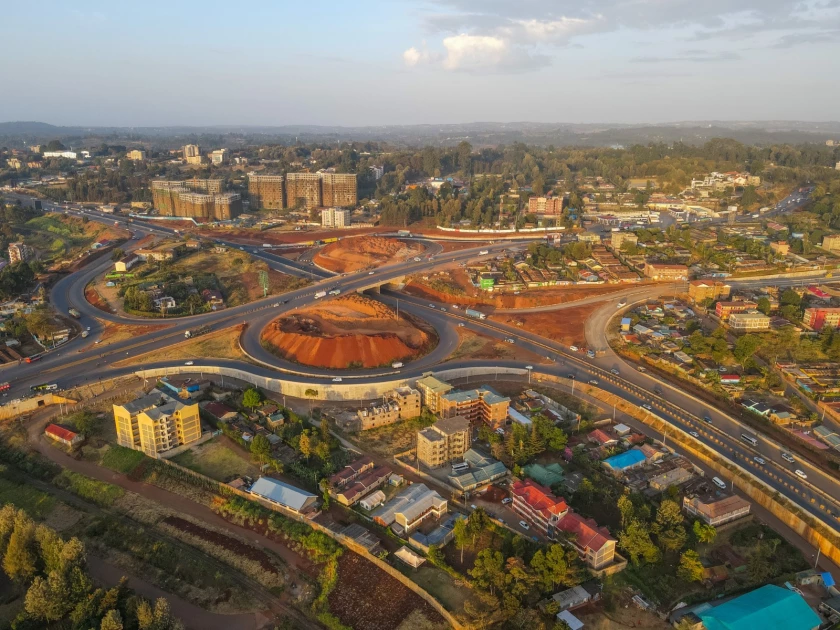
A drone shot captures the four cloverleaf loops of the nearly completed Gitaru Interchange.

Audio By Vocalize
Rising above one of the country’s busiest junctions, the structure curves into four sweeping loops, its cloverleaf design slowly redefining how traffic flows through the corridor.
Work on the interchange is now about 85 per cent complete, with engineers putting the finishing touches on the looping ramps that connect the Nairobi–Nakuru Highway with both the Southern and Western Bypasses.
When finished, the interchange will form a seamless gateway linking Nairobi with Central Kenya and the Rift Valley.
The design itself carries a curious inspiration, one rooted not in concrete or steel, but in nature.
“One fun fact about the Gitaru interchange is the distinctive design inspired by a small, common plant that you all know, the four-loop cloverleaf, often regarded as a weed and known by different names across Kenyan languages and Sheng,” explains Kenya National Highways Authority Director General Eng. Luka Kimeli.

A side-by-side pictorial showing a loop from the ongoing works at the Gitaru Interchange and the four-loop cloverleaf weed.
Much like the plant it mirrors, the loops spread outward in four directions, guiding traffic without interruption.
The design allows vehicles to merge and diverge continuously, eliminating the stop-and-go congestion that once defined the Gitaru junction.
“The interchange will allow continuous traffic flow, reduce travel time, as well as ease congestion,” Kimeli adds, noting that the project is currently about 85 per cent complete and expected to be finished by December 31, 2026. Along the way, construction has already created employment for more than 1,100 people.
Yet the road to this point has not been linear. At one stage, the project itself stalled.
“The Gitaru Interchange had stalled due to funding constraints, but securitisation enabled us to resume this critical project,” Kimeli says, explaining that the government turned to innovative financing to revive delayed infrastructure works.
“In line with the President’s directive, the government is completing stalled road projects regardless of when they began or which administration started the road project because the government is perpetual, and leaving unfinished projects from previous administrations punishes Kenyans.”
Residents like George Larama, a business owner and longtime Gitaru resident who lives around the junction, say the project has begun to reshape everyday travel.
“If you go to Mombasa Road, it is easy. And those who go towards Ruaka, it is easier because the road is good. Then, when this elevation ends, joining the road towards Nairobi will be easy because it was a big circuit,” he says.
Before construction began, navigating the area often meant long detours. Drivers heading to Nairobi would sometimes travel as far as Zambezi just to find a turning point.
“The road is going to be expanded, and it would be a good idea that would help even the locals while making short-distance trips,” Larama adds.
For traders like him, improved roads mean more than convenience. They change the rhythm of work and opportunity.
Larama supplies chicks between Gitaru and Nairobi, journeys that once required careful planning and early departures.
“It’s easy now going to Nairobi, no matter what time you wake up… In the past, when there were no good roads, people used to think it was risky to wake up at 2 AM or even 3 AM, but now, even at nine, you just take the road and go to Nairobi. And you arrive early,” he says.
Beyond the immediate relief for commuters, the interchange promises wider economic ripple effects, while for freight transporters moving goods along the Northern Corridor, it also means more reliable logistics.
Fully funded by the Government of Kenya, the project forms part of the wider A104 highway rehabilitation programme.
Innovative financing, including the securitisation of road maintenance revenues, has accelerated construction even as the government works to address Ksh.175 billion in inherited pending bills owed to contractors.
Under the Bottom-Up Economic Transformation Agenda, the Gitaru Interchange is expected to unlock new growth along the corridor, connecting communities and businesses while reshaping movement across the region.
Like the cloverleaf that inspired it, the interchange spreads outward in loops, not just of road and traffic, but of opportunity, linking journeys, livelihoods and the expanding edges of Nairobi.
Leave a Comment