

Haiti Mission: The change of guard and how the Kenya-led force flopped
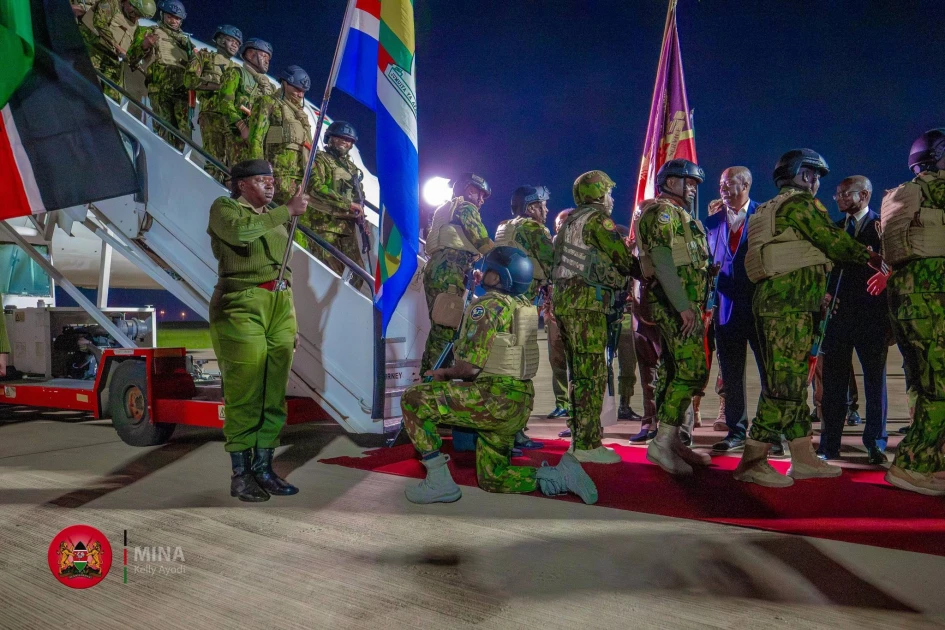
Kenyan officers under the Multinational Security Support Mission (MSS) arrive from Haiti on March 17, 2026.

Audio By Vocalize
As of March 2026, the United Nations reported that nearly 1.4 million people have been forced to flee their homes, especially in the capital, Port-au-Prince, where gang violence is rampant.
On March 16, 2026, William O’Neill, a UN Designated Expert on Human Rights in Haiti, told journalists that the crisis had caused unprecedented suffering.
Recent reports from the global body indicate that at least 26 gangs control up to 90 per cent of the Haitian capital city and its surrounding areas.
“Around half of all gang members are children, under the age of 18,” according to the United Nations report.
The Caribbean nation not only suffers from a humanitarian crisis, but also a political crisis since the mandate of its transitional governing council ended in February 2026.
Headed by businessman Laurent Saint-Cyr, the 9-member transitional presidential council, on February 7, handed over powers to Prime Minister Alix Didier Fils-Aime.
Political uncertainty has marred Haiti since the assassination of President Jovenel Moïse in 2021 by armed assailants. The country’s hope of conducting elections later this year remains uncertain.
Kenyans pack boots, Chadians enter Haiti
In a bid to restore peace in the Caribbean nation, the United Nations Security Council on October 2, 2023, authorised the Multinational Security Support (MSS) mission to Haiti. Kenya was designated to lead the MSS, with support from Guatemala, El Salvador, Jamaica, the Bahamas, and Canada.
On September 30, 2024, the Security Council reviewed the resolution 2699 (2023), by prolonging the MSS mandate for one year and boosting personnel from 1000 to 2500.
Come October 2025, the UN security body upgraded the mission to a Gang Suppression Force (GSF), to have a maximum of 5,500 uniformed personnel, including police officers and soldiers, serving for an initial period of 12 months. This would bring an end to the MSS mission, where Kenya’s Godfrey Otunge served as the force commander.
Kenyan troops have packed their boots as the first and second contingents touched down in Nairobi in December 2025 and March 2026, respectively.
As the Kenyan troops gradually leave the Caribbean nation, they hand the baton to Chadian troops who will now take the primary role under the UN-backed GSF.
The first contingent from Chad is expected to begin deploying in April 2026 and is currently training in the United States of America.
"It will not be immediate but will give time for the new forces to arrive and familiarise themselves,” Roberto Alvarez, foreign minister of the Dominican Republic, said as quoted by Reuters.
According to Alvarez, the gradual withdrawal of Kenyan troops is to allow Chadians time to arrive and familiarise themselves with Haiti, as GSF is expected to reach full capacity of 5,500 by October 2026.
Chad, the new leader in Haiti peace restoration, had earlier pledged to support the now-defunct MSS. The GSF mandate should expire in September 2026, unless the UN Security Council votes to renew it.
Kenyan troops return home… minus 3
On Tuesday, March 17, 2026, a second contingent of police officers touched down at the Jomo Kenyatta International Airport (JKIA) in Nairobi.
Received by officials in the security sector, including Principal Secretary Raymond Omollo, Inspector General Douglas Kanja and National Security Advisor Monica Juma, the officers were visibly relieved to be back home.
PS Omollo welcomed the troops home, hailing their selfless call of duty in the ‘historic deployment’.
“In a foreign land, under difficult and often dangerous conditions, alongside the Haitian National Police, they upheld the highest standards of professionalism, discipline and courage, flying the Kenyan flag with distinction,” said Omollo.
The first contingent arrived on December 9, 2025, and more officers are set to return in the coming weeks.
Kenya sent nearly 980 officers to Haiti, but three were killed on the battlefield. Benedict Kabiru, Kenedy Mutuku and Samuel Kitwai died on the battlefield in efforts to suppress notorious gangs in Haiti.
PS Omollo recognised the loss, saying, “We also honoured the memory of the three gallant officers who paid the ultimate price in the line of duty. Their sacrifice will forever remain etched in our national conscience, and we continue to stand firmly with their families.”
However, as the troops return home, and Mutuku and Kitwai lie at their final resting places in Kenya, the family of Kabiru is yet to find consolation on their loss.
In March 2025, Kabiru was killed in an ambush by Haitian gangs at Savien, in Pont-Sondé. He was among the officers ambushed by the gang while on a rescue mission in Haiti.
The Kenyan police would then dispute reports on Kabiru’s death, saying he was only missing and a search was on to find him.
Months later, in September 2025, President Ruto confirmed Kabiru’s death, prompting security forces to report the same to his family.
Nearly one year later, the officer’s family awaits the repatriation of his body, which is said to have been taken away by armed forces. The family moved to court seeking that the state be compelled to provide information.
There are no clear answers on the fate of Kabiru.
How the Kenyan mission fell short
The General Otunge-led MSS mission faced challenges in Haiti and had not succeeded in restoring calm at the time its mandate came to an end.
As of March 2026, the UN reports that 16,000 people have been killed since January 2022, and powerful gangs continue to control vast areas of territory and infrastructure in the country.
The high crime rates have been abetted by trafficked arms, irregular roads, clandestine airstrips and drugs. Kidnapping, homicide and sexual violence continue to be reported.
But what ailed Kenya-led MSS, a mission that was determined to restore calm in the Caribbean nation?
A number of UN member states said MSS lacked the critical support of being a “UN mission”. Dependent on contributions from member states, the mission faced underfunding, insufficient personnel, and limited operational capacity.
This not only made it difficult to contain gangs, but also subjected Kenyan soldiers to safety risks.
During the United Nations General Assembly (UNGA) held in New York, President William Ruto told delegates that Kenyan officers lacked international assistance during the mission, forcing them to operate incapacitated while battling the dangerous Haitian gangs.
Then, Ruto said second-hand vehicles issued by the United States, which were in poor condition, exposed MSS troops to danger in the middle of gang-infested terrains.
“We have been operating at a 40% capacity. Initially, it was expected that 2500 security personnel would be made available; unfortunately, they were not made available,” Ruto told delegates in New York.
“It was also expected that we would have armoured carriers, logistical support to be able to make this mission a success,” Ruto added, also flagging second-hand vehicles that broke down a lot.
Regardless, the Kenyan Head of State expressed Kenya’s willingness to support the mission as “Haiti’s security situation had improved significantly since the deployment.”
“When we first stepped into Haiti, the airport had been surrounded by gangs. Today, the airport is operational, the presidential palace is secure, and schools and hospitals have reopened,” Ruto said.
The Kenyan leader further advocated for a seamless transition from MSS.
“We will not walk away from Haiti in haste. If we do not transition properly, we may lose what we have achieved,” he said.
Before the deployment, the mission faced challenges back home when the High Court blocked the deployment of police to Haiti in January 2024. A ruling by Justice Chacha Mwita indicated that the plan was unconstitutional and illegal because the National Security Council lacks the authority to deploy police officers outside the country. Justice Chacha Mwita noted that the law allows deploying military and not police to foreign peacekeeping missions.
The government of Kenya was able to bypass the loophole and subsequently dispatch contingents of police officers gradually.
On receiving the second contingent of Kenyan troops, PS Omollo said Kenya remains committed to supporting the mission transition by working alongside Haiti and the international community to sustain the gains made in the Caribbean nation.
New hopes for GSF
As the Kenyan troops pack their boots to leave Haiti, the international community remains hopeful that the new GSF would support peace restoration.
When the Security Council announced the GSF mandate, US ambassador to the UN Mike Waltz said the mission, which is five times bigger than MSS, showed the "international community was sharing the burden."
The UN, however, reports that the Humanitarian conditions continue to deteriorate in Haiti as funding shortfalls are limiting the reach of life-saving assistance.
The Haitian transitional presidential council failed to contain gang violence, and its term was marked by food insecurity, corruption accusations and political infighting.
There are hopes that political stability would be the foundation of Haiti’s recovery as it would enable aid distribution, infrastructure development and proper formation of the police body.
Leave a Comment