
59 people killed by heavy rains in South Africa, roads swept away
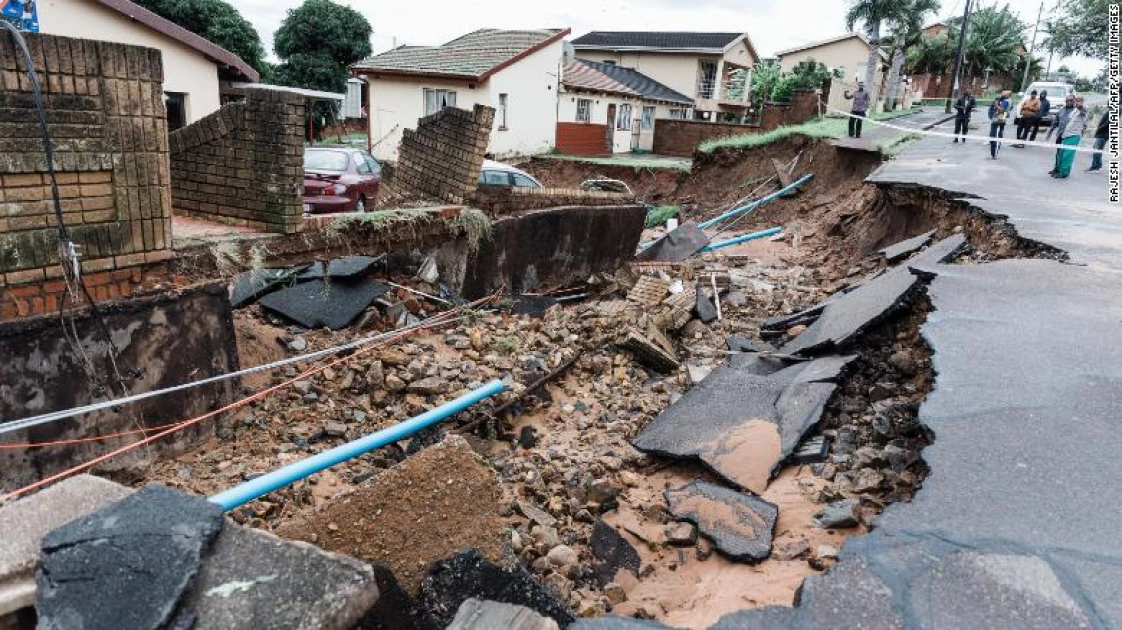
Road destroyed by floods in South Africa

Audio By Vocalize
Heavy rains and floods have battered the eastern coast of South Africa,
killing at least 59 people, damaging roads and destroying houses, prompting
authorities to urge residents to stay at home.
The floods hit the province of KwaZulu-Natal, which includes the coastal
city of Durban, where roads cracked and gave way to deep fissures, and a huge
stack of shipping containers collapsed into muddy waters, news agency images
show. A bridge near Durban was swept away, leaving people stranded on either
side.
KwaZulu-Natal has experienced extreme rainfall since Monday, in what the
provincial government called "one of the worst weather storms in the
history of our country" in a statement posted to Facebook, where it also
gave the death toll.
"The heavy rainfall that has descended on our land over the past
few days, has wreaked untold havoc and unleashed massive damage to lives and
infrastructure," it said.
Teams have been evacuating people in areas that had experienced
"mudslides, flooding and structural collapses of buildings and
roads," Sipho Hlomuka, a member of the Executive Council for Co-operative
Governance and Traditional Affairs in KwaZulu-Natal, said on Twitter Tuesday.
"The heavy rains have affected power lines in many municipalities
with technical teams working around the clock to restore power," Hlomuka
added.
Power stations have been flooded and are inaccessible in the hard-hit
eThekwini municipality, Mayor Mxolisi Kaunda told reporters, while water mains
were also damaged.
The local government has asked private and religious institutions to
assist with emergency relief operations, and have requested help from the South
African National Defense Force to provide aerial support, he said.
The extreme weather comes just months after heavy rainfall and floods
hit other parts of southern Africa, with three tropical cyclones and two
tropical storms over just six weeks from late January. There were 230 reported
deaths and 1 million people affected.
Scientists from the World Weather Attribution (WWA) project -- which
analyzes how much the climate crisis may have contributed to an extreme weather
event -- found that climate change made those events more likely.
"Again we are seeing how the people with the least responsibility
for climate change are bearing the brunt of the impacts," WWA's Friederike
Otto, from the Grantham Institute for Climate Change and the Environment at
Imperial College London, said Tuesday, referring to the earlier storms in
southern Africa.
"Rich countries should honor their commitments and increase
much-needed funding for adaptation, and for compensating the victims of extreme
events driven by climate change with loss and damage payments," she added.
The extreme weather events in southern Africa come as tensions mount
between some developed and developing nations over who should pay for the
damage and impacts of the climate crisis. This is expected to be a major
sticking point at the next international climate negotiations, the COP27
conference in Sharm el-Sheikh, Egypt in November.
Scientists have warned that the world must try to cap global warming to
1.5 degrees Celsius above temperatures before industrialization, around 200
years ago, to stave off some irreversible impacts of climate change. The Earth
is already around 1.2 degrees warmer.
In southeastern Africa, warming of 2˚C is projected to bring an increase in the frequency and intensity of heavy rain and flooding, and an increase in the intensity of strong tropical cyclones, which are associated with heavier rainfall.
Join the Discussion
Share your perspective with the Citizen Digital community.
No comments yet
This discussion is waiting for your voice. Be the first to share your thoughts!