
High Court Judge Muteti decries judicial officer shortage
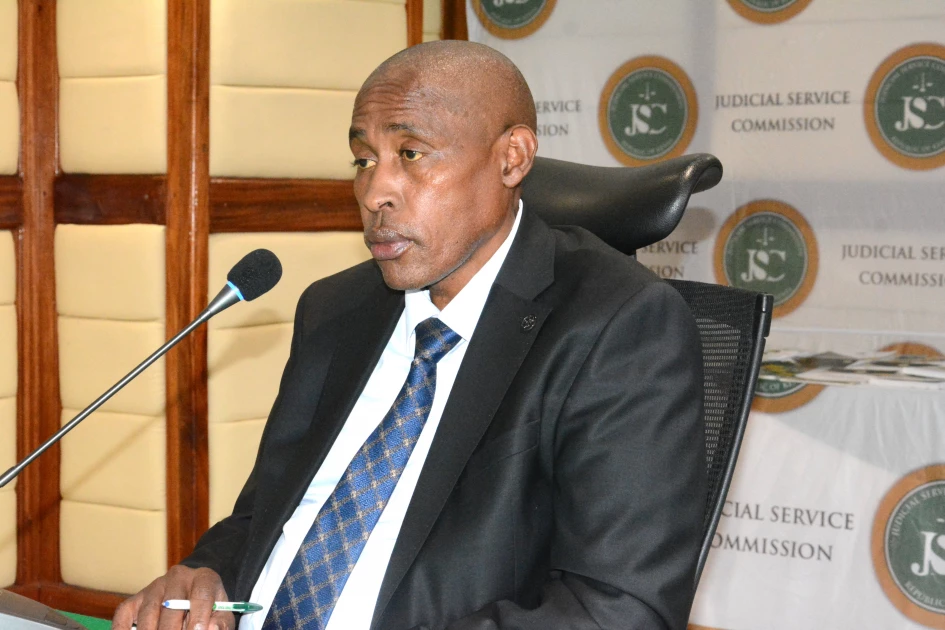
High Court Judge Justice Alexander Muteti. Photo: JSCKenya

Audio By Vocalize
High Court Judge Alexander Muteti has
raised concern over the chronic shortage of judicial officers, warning that
without adequate staffing, justice will remain elusive for many Kenyans.
Speaking during an event to mark the Day of
Delayed Justice, Justice Muteti described the current state of affairs as
unsustainable, citing that only 96 High Court judges are tasked with handling a
staggering number of cases.
"Sixty-three years after independence,
how do you run a judiciary with just 96 judges?" he posed.
He revealed that each High Court judge is
currently managing up to 450 cases annually — a load he said significantly
hinders the timely delivery of justice.
"At that rate, a judge will do very little in a year," Muteti observed during the event organised by the International Justice Mission.
While acknowledging that technology has
played a role in easing the burden, he insisted it cannot replace the need for
sufficient human resources. He noted that although efforts are underway to
recruit at least 20 more judges, the number is grossly inadequate.
"That’s just a drop. If you don’t have
the numbers, then you don’t have a solution,” he said.
Justice Muteti praised the adoption of
virtual courts, which now account for nearly 70 percent of proceedings, as a
crucial innovation. He challenged the Office of the Director of Public
Prosecutions (ODPP) to embrace remote testimony from witnesses to further
reduce delays.
"Time has come that you don’t have to
transport witnesses to Nairobi or any court to testify," he said.
"Why not log in from your offices and let them testify remotely? It
removes delays and frustrations."
The judge also urged collaboration between the Independent
Policing Oversight Authority (IPOA) and the
Witness Protection Agency in cases involving police brutality and extrajudicial
killings.
"If IPOA investigates cases and your
witnesses are roaming around in town, you will fail. Witnesses must be
protected to give evidence freely," he said. “Many are afraid of
testifying against police officers; those are real-life challenges we must
address.”
At the same event, IPOA Chairperson Ahmed
Isaack Hassan echoed Justice Muteti’s concerns, citing deep-rooted resistance
within the police service.
“The police force has not fully accepted
civilian oversight,” Hassan said. “We still have a long way to go. Having
civilian investigators is in itself a challenge, and we face a lack of
cooperation in many instances.”
He said IPOA often encounters only
temporary cooperation, and only when a case has gained substantial public
attention.
"You will see temporary openness when
the matter is of public interest, but that fades
quickly," Hassan noted.
Join the Discussion
Share your perspective with the Citizen Digital community.
No comments yet
This discussion is waiting for your voice. Be the first to share your thoughts!