
How Siscom is turning cloud infrastructure into a shared asset for Kenya’s tech revolution

Audio By Vocalize
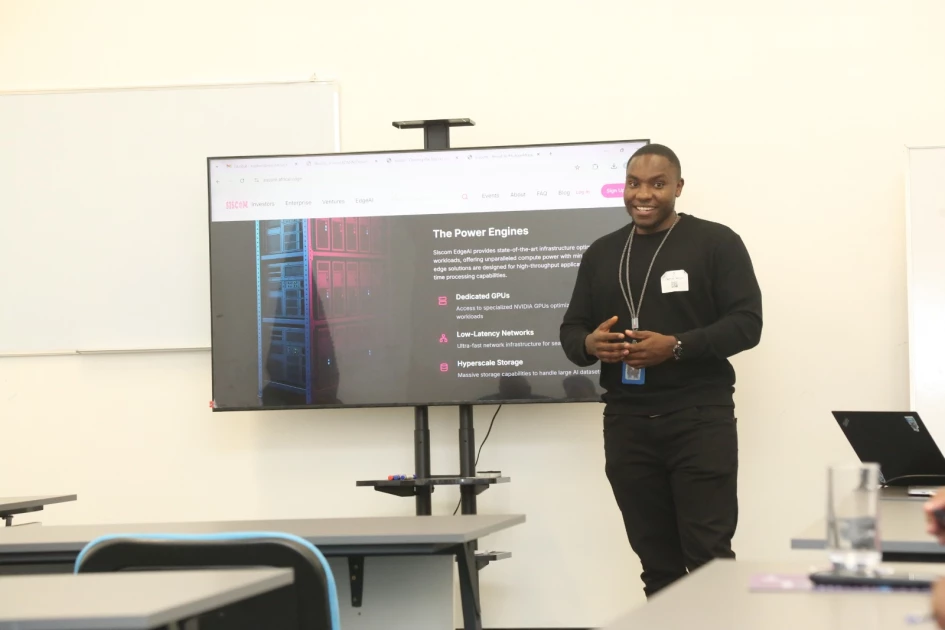
In a sleek innovation hub tucked away in Nairobi’s Westlands, Kenya’s digital future is quietly getting a radical upgrade. Here, a bold new idea is taking root, one that doesn’t just ask Kenyans to use technology, but to own it.
Siscom, a rising force in tech infrastructure, is
flipping the script with its latest venture, Siscom Nodes, an initiative that
allows everyday citizens to invest directly in the servers powering everything
from social media and streaming to e-commerce and artificial intelligence.
“What if ordinary Kenyans could own a slice of the
infrastructure powering social media, streaming, e-commerce, and even AI?” asks
Derrick Gakuu, Siscom’s Chief of Strategy during an interview with Citizen
Digital. The answer lies in Siscom Nodes, a platform that allows individuals,
retail investors, private capital, family offices and even institutions like
SACCOs and investment firms to invest from as little as $150 (about Ksh 20,000)
to $15,000 in high-performance servers housed in Tier 3 data centers across
Kenya.
For years, Kenya’s “Silicon Savannah” has been
celebrated for innovation, especially mobile money and a thriving startup
ecosystem, but the country remains a net consumer of technology rather than a
producer. The missing piece? Infrastructure.
“Kenya has an annual funding gap of $900 million in
cloud infrastructure. That number is expected to hit $3 billion by 2030,” Gakuu
explains. “The sad truth is that we’ve built amazing apps but never invested in
the roads, the cloud, the compute, the clusters—that keep them running.”
This gap has real consequences. Startups in Kenya
pay up to 60% more for cloud services than those in the U.S., China, or India,
a disparity that the World Bank and International Finance Corporation say
contributes to the high failure rate of African tech startups.
Siscom’s model flips the script by mobilizing local
capital to build the digital backbone Africa needs. “We asked ourselves—what if
cloud infrastructure could be crowd-owned?” says Nashon Mbithi, Siscom’s
Partnerships Lead. “Just like you’d invest in a matatu on Uber or a rental
apartment, you can now invest in compute clusters and earn from their usage.”
Investors buy into physical “nodes” that Siscom
leases to startups, banks, AI labs, developers, and soon government AI
initiatives. Returns come from leasing fees and are paid quarterly, much like
traditional asset investments. Siscom handles all technical management,
compliance, hosting, and demand sourcing.
“We make it easy. You don’t need to know how to
manage a server. You just own it, like real estate. We do the heavy lifting,”
Gakuu says.
The initiative arrives at a critical moment as
Kenya grapples with data sovereignty concerns and government plans to create
one million digital jobs. “America leads the digital world because it has over
5,000 data centers. Kenya has fewer than 20. If we don’t close that gap now,
we’ll always be digital tenants, not landlords,” Gakuu warns.
Siscom estimates its model could generate 10,000
direct jobs in technical fields such as engineering and data analysis, and up
to one million indirect jobs for developers, AI specialists, and creatives. It
also promises to inject hundreds of millions of dollars into local tech
productivity by lowering cloud costs.
Globally, investment in AI and digital
infrastructure is surging. The IFC recently committed $100 million to African
data center firm Raxio, while Microsoft and UAE-based G42 are investing $1
billion in a regional hyperscale data center in Kenya. But Siscom executives
emphasize the importance of local ownership.
“This is about access and equity,” Mbithi says.
“For the first time, a university student with Ksh 20,000 or a chama can co-own
the tech powering fintech, e-learning, agri-tech—you name it.”
Looking ahead, Siscom is preparing to launch
Kenya’s first locally owned GPU cluster, a specialized node designed for AI
training and machine learning research. “We’re already seeing explosive demand
from fintechs, health tech, and even creative AI platforms,” Gakuu says. “Our
dream is to build an AI Factory, 100% locally funded, where Kenyan researchers
don’t have to go abroad to build the future.”
The firm plans to onboard customers from fintech,
e-commerce, government, AI research, and digital media sectors, while exploring
additional edge nodes across East Africa.
Siscom’s bold vision is clear: Africa doesn’t need
to be saved—it needs to be banked on. And for the first time, through
investments as low as $150, Kenyans can bank on themselves by owning the cloud.
Join the Discussion
Share your perspective with the Citizen Digital community.
No comments yet
This discussion is waiting for your voice. Be the first to share your thoughts!