

India will surpass China as world’s most populous country by mid-year, U.N says
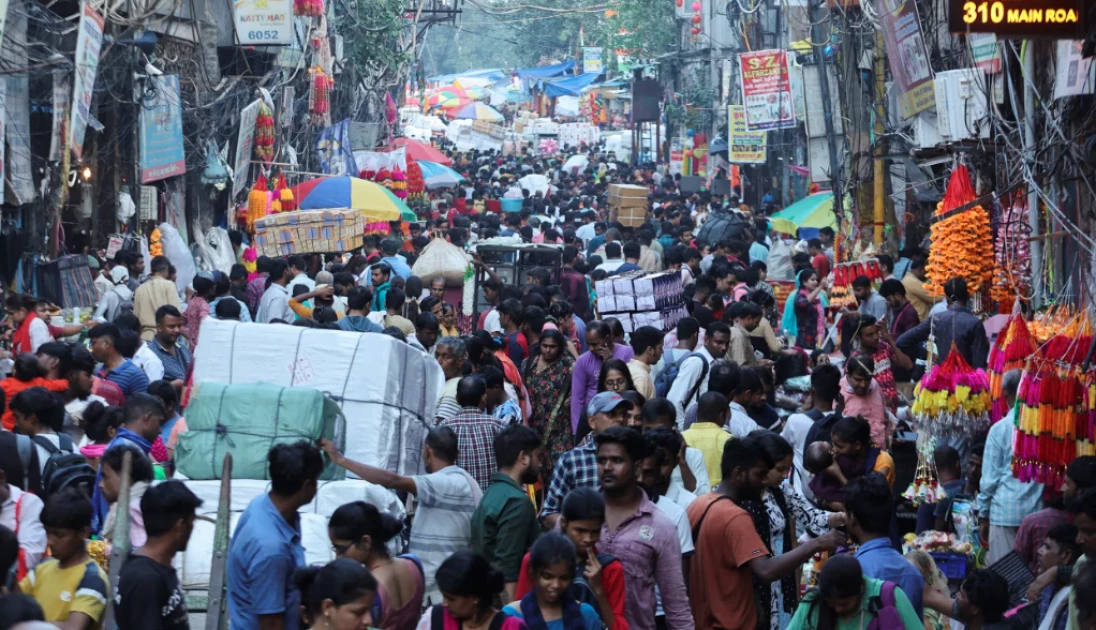
People shop at a market ahead of Diwali, the Hindu festival of lights, in Delhi's old quarters in October 2022.

Audio By Vocalize
India
is set to surpass China as the world’s most populous nation, with almost 3 million more
people by the middle of this year, data released by the United Nations on
Wednesday showed.
Based on the
projections, India’s population by mid-year will reach 1.4286 billion, compared
to China’s 1.4257 billion – 2.9 million fewer – according to the United Nations
Population Fund’s (UNFPA) “State of World Population Report” for 2023.
UN officials
have said it is not possible to determine the exact date for the shift, due to
“uncertainty” about the data coming from China and India. India’s last census
was in 2011 and most recent, scheduled in 2021, was delayed during the Covid-19
pandemic.
The
United States is a very distant third, with an estimated population of 340
million, the data, which reflects information available as of February, showed.
By 2050,
eight countries will account for half the projected growth in global
population: The Democratic Republic of the Congo (DRC), Egypt, Ethiopia, India,
Nigeria, Pakistan, the Philippines and Tanzania, according to the UNFPA report.
China has
held the distinction of most populous country since at least 1950, when the UN population records began.
China
and India together will account for more than a third of the estimated global
population, which is expected to hit 8.045 billion by mid-year, the UN report
said. But, contrary to public perception, population growth has been slowing in
both countries – particularly in China, which recorded a population decline for the first time in six
decades last year.
China’s
population fell in 2022 to 1.411 billion, down some 850,000 people from the
previous year, according to China’s National Bureau of Statistics (NBS). The
birth rate also fell to a record low of 6.77 births per 1,000 people, down from
7.52 a year earlier and the lowest level since the founding of Communist China
in 1949.
India overtaking China will have
significant economic implications for both Asian giants. Along with the
flagging population data, China also reported one of its worst economic growth
numbers in nearly half a century last year, underscoring the steep challenges
the country faces as its labor force shrinks and the ranks of the retired
swell.
India’s
working-age population stands at more than 900 million, according to 2021 data
from the Organization for Economic Cooperation and Development. This number is
expected to hit more than 1 billion over the next decade, according to the
Indian government.
But these
numbers could become a liability if policymakers do not create enough jobs,
experts warned. Already, data show a growing number of Indians are not even
looking for work, given the lack of opportunities and low wages.
India’s
labor force participation rate, an estimation of the active workforce and
people looking for work, stood at 46%, which is among the lowest in Asia,
according to 2021 data from the World Bank. By comparison, the rates for China
and the United States stood at 68% and 61% respectively in the same year.
“India is
sitting on a time bomb,” Chandrasekhar Sripada, professor of organizational
behavior at the Indian School of Business, told CNN earlier this year. “There
will be social unrest if it cannot create enough employment in a relatively
short period of time.”
Individual
rights at risk?
In its
report, UNFPA said that while reaching the milestone of 8 billion people on the
planet was a reminder that more people are living longer, healthier lives,
concerns over the number had increased anxiety among governments and led more
to adopt policies aimed at influencing fertility rates. In particular, it
pointed to governments trying to influence fertility rates through family
planning targets and policies, which can fuel gender-based forms of
discrimination.
In India,
when some states proposed a two-child policy in 2021, including financial
incentives for sterilization and penalties, such as lost benefits, commentators
pointed to the harmful impacts of similar policies. “Sex-selective abortion,
preference for male children, denying the paternity of female children,
prenatal sex determination, and violence against women for giving birth to girl
children will be on the rise,” one commentator is quoted in the report as
saying.
The
national government made clear in several forums that it opposed coercion in
family planning, including in parliament, where it said it did not support such
policies, the report added.
Some of
those harmful effects were seen in China as a result of its one-child policy, which the country ended in 2015 after 35
years, allowing families to have two children.
“The
relationship between reproductive autonomy and healthier lives is an
uncontested truth: As women are empowered to make choices about their bodies
and lives, they and their families thrive — and their societies thrive as
well,” UNFPA’s executive director, Natalia Kanem, said in her foreword to the
report.
But, she
added, that was not the message most heard at the news of the 8 billion
milestone last year.
“Instead,
many headlines warned of a world teetering into overpopulation, or that whole
countries and regions were ageing into obsolescence. Somehow, when the human
numbers are tallied and population milestones passed, the rights and potential
of individuals fade too easily into the background.”
Leave a Comment