
Inside President Ruto, Governor Sakaja's Ksh.80B plan to fix Nairobi
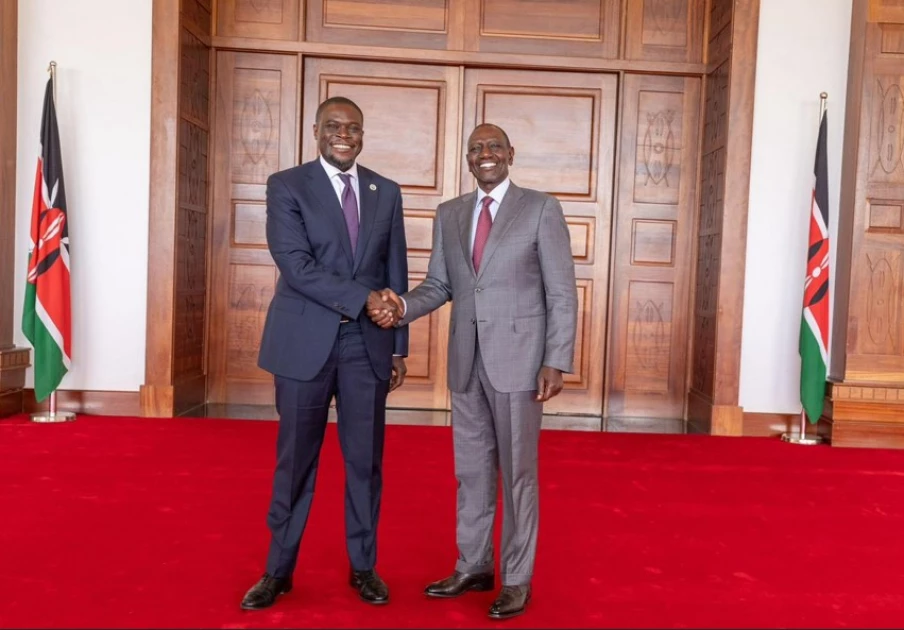
President William Ruto and Nairobi Governor Johnson Sakaja shake hands at State House, Nairobi on February 17, 2026.

Audio By Vocalize
The
cooperation agreement between the National Government and Nairobi City County
Government becomes the second time City Hall has sought the intervention of the
central government since the advent of devolution.
While
City Hall is granted constitutional autonomy on self-administration - and
Article 187 of the law envisioning transfer of functions - the scope of the
collaboration agreement seemingly paints an administration unable to carry out
its role, seeking support, and sheltering under Article 189 of the Constitution,
which spells out cooperation between the two levels of governments.
The agreement shall be directed towards strengthening the performance of county
functions and improving its quality and efficiency.
While
former President Uhuru Kenyatta in 2020 turned to the military for remedial
measures, bringing in now retired Major-General Mohamed Badi to administer the
county after former Governor Mike Sonko handed over key functions, the format
President William Ruto will take remains unknown despite downplaying any
NMS-style like takeover.
On
the financing mechanism, though the framework envisions a joint agreement for
financing of all programmes, questions abound over the county’s financial
viability as the richest, with own source revenue collections hitting the
highest in the FY 2024/25, fetching more than Ksh.12.1 billion. President Ruto however
decried the constitutional financial architecture for the devolved units,
prescribing a substitution.
The
parties shall jointly agree on the modalities for financing all programmes and
projects undertaken pursuant to this agreement, including the sources of
funding.
“The
fiscal and operational framework of the county’s financing was not designed for
a capital city of this scale and responsibility. Nairobi carries national,
regional and global obligations, but is funded largely through the same formula
as other counties,” said the President.
Nairobi
Governor Johnson Sakaja added: “In the 13 years of devolution, Nairobi City
County has not had the opportunity to benefit and leverage from its uniqueness
as a capital city to get special attention to get support and resources for its
people.”
While
City Hall has been bedeviled by a mix of maladministration and failures in
financial management, the cooperation agreement which comes six years after former Governor Mike Sonko’s outing at State House, symbolizes low faith in its
leadership.
The
National Government is to inject additional Ksh.80 billion funding to Nairobi
County under the new deal aimed at strengthening the performance of county
functions, and improving service delivery to the capital city.
In
the deal, a steering committee has been established to be chaired by Prime
Cabinet Secretary Musalia Mudavadi while Governor Sakaja will be the vice
chair. The steering committee shall be meeting quarterly.
Others
that will sit in the steering committee include Interior CS Kipchumba Murkomen,
his Treasury counterpart John Mbadi as well, CSs in charge of Lands, Environment,
Energy, Water and two attorneys.
The
deal has also established an implementation committee that will be chaired by Governor
Sakaja.
“This
is not a transfer of functions…I have no interest in running Nairobi, let
Sakaja and his people do their work,” President Ruto stated.
The
deal signed Tuesday will see the National Government inject additional funding
amounting to Ksh.80 billion, four times more than what it received in the
current financial year.
Ksh.3.7
billion will be used to modernise street lighting in the capital city, Ksh.1.5
billion to purchase transformers for last mile connectivity in Nairobi, a total
of Ksh.5 billion for water treatment and supply to the ballooning population in
Nairobi.
Ksh.9
billion has been allocated in the deal for a 27km sewer line in the northern
corridor, with Ksh.4 billion set to be used for waste management.
The
collaboration agreement will also cover security, with the deal seeking to have
Nairobi Metropolitan Police Unit that will collaborate with city askaris to
restore order in the capital city.
The
deal reads in part; “the agreement shall become effective fourteen days from
the date of execution and shall remain in force for an initial period of 24
months from the date of execution subject to renewal.”
The
document now goes to the County Assembly of Nairobi to facilitate public
participation within the next 14 days.
Parties
may terminate this agreement mutually or a party may terminate this agreement
by giving six months’ notice to the other party.
The national government and county government have insisted that it is not a transfer of function but a collaboration.
Join the Discussion
Share your perspective with the Citizen Digital community.
No comments yet
This discussion is waiting for your voice. Be the first to share your thoughts!