

Iran retaliates for Israeli attack with missile strikes
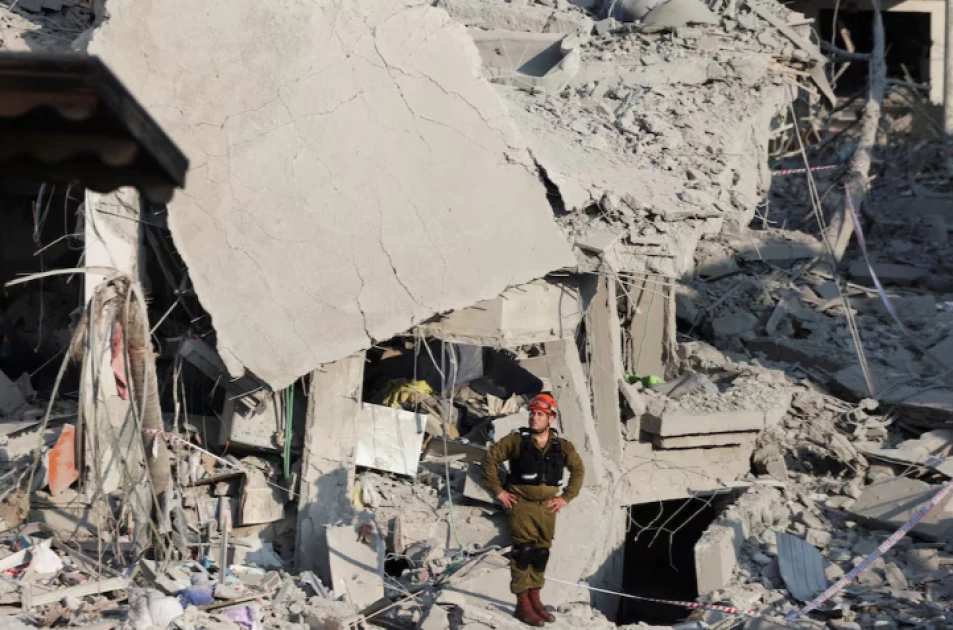
A rescue personnel works at an impact site following missile attack from Iran on Israel, in Rishon LeZion, Israel, June 14, 2025. REUTERS/Ronen Zvulun

Audio By Vocalize
Iran and Israel traded missiles and airstrikes on Saturday,
the day after Israel launched a sweeping air offensive against its
old enemy, killing commanders and scientists and bombing nuclear sites in a
stated bid to stop it from building an atomic weapon.
In Tehran, Iranian state TV reported that around 60 people, including
20 children, had been killed in an attack on a housing complex.
In Israel, air raid sirens sent residents into shelters as
waves of missiles streaked across the sky and interceptors rose to meet them,
killing at least three people. An Israeli official said Iran had fired around
200 ballistic missiles in four waves.
U.S. President Donald Trump has lauded Israel's strikes and
warned of much worse to come unless Iran quickly accepts the sharp downgrading
of its nuclear programme that the U.S. has demanded in talks that had been due
to resume on Sunday.
But with Israel saying its operation could last weeks, and
urging Iran's people to rise up against their Islamic clerical
rulers, fears have grown of a regional conflagration dragging in outside
powers, with global economic and financial repercussions.
The United States, Israel's main ally, helped shoot down
Iranian missiles, two U.S. officials said.
Iranian fire still struck residential districts in Israel,
however, and Defence Minister Israel Katz said Iran's leadership had crossed a
red line.
"If (Supreme Leader Ayatollah Ali) Khamenei continues
to fire missiles at the Israeli home front, Tehran will burn," he said in
a statement.
Iran had vowed to avenge Friday's Israeli onslaught,
which gutted Iran's nuclear and military leadership and damaged
atomic plants and military bases, killing 78 people, including civilians, according to Iran's U.N. envoy.
Tehran warned Israel's allies that their regional military
bases would come under fire too if they help shoot down Iranian missiles, Iranian
state television reported.
Iran's own ally, the Yemeni Houthi group, fired missiles at
Israel on Friday night, but at least one appeared to go astray, killing five
Palestinians, including three children,n in the Israeli-occupied West Bank, the
Palestinian Red Crescent said.
However, 20 months of war in Gaza and a conflict in Lebanon
last year have decimated Tehran's strongest allies, Hamas in Gaza and Hezbollah
in Lebanon, reducing its ability to project power across the region, along with
its options for retaliation.
Gulf Arab states that have long mistrusted Iran but fear
coming under attack in any wider conflict have urged calm as worries about
disruption to the Gulf region's crucial oil exports boosted the price of
crude by about 7% on Friday.
Iran's overnight fusillade included hundreds of ballistic
missiles and drones, an Israeli official said. Three people, including a man
and a woman, were killed and dozens wounded, the ambulance service said.
In Rishon LeZion, south of Tel Aviv, emergency services
rescued a baby girl trapped in a house hit by a missile, police said. Video
showed teams searching through the rubble of one home.
And in the western suburb of Ramat Gan, near Ben Gurion
airport, Linda Grinfeld described her apartment being damaged: "We were
sitting in the shelter, and then we heard such a boom. It was awful."
The Israeli military said it had intercepted
surface-to-surface Iranian missiles as well as drones, and that two rockets had
been fired from Gaza.
With Iran's air defences heavily damaged, chief of staff
Tomer Bar said "the road to Iran has been paved".
In preparation for possible further escalation, reservists
were being deployed across Israel. Army Radio reported units had been positioned
along the Lebanese and Jordanian borders.
In Iran, explosions were heard overnight across the capital,
state media reported. Fars News agency said two projectiles had hit Mehraband
airport, located inside the capital, which is both civilian and military.
State television reported that a 14-storey housing complex,
Shahid Chamran, had been flattened by a missile. It said 60 people had been
killed, though there was no immediate official confirmation.
Israel's military did not immediately comment on that
report.
Iran's U.N. envoy Amir Saeid Iravani said 78 people had been
killed in Israel's strikes on Friday and more than 320 wounded, most of them
civilians.
Israel sees Iran's nuclear programme as a threat to its
existence, and said the bombing campaign was designed to avert the last steps
to production of a nuclear weapon, even though U.S. intelligence says it has
seen no sign that this is imminent.
Israeli U.N. envoy Danny Danon called the strikes "an
act of national preservation".
A military official on Saturday said Israel had killed nine
Iranian nuclear scientists, and that the damage to the nuclear facilities at
Esfahan and Natanz would take "more than a few weeks" to repair.
Tehran insists the programme is entirely civilian in line
with its obligations under the nuclear Non-Proliferation Treaty (NPT) and that
it does not seek an atomic bomb.
However, it has repeatedly hidden parts of its programme
from international inspectors, and the International Atomic Energy Agency has
reported it in violation of the NPT.
Israel, which is not an NPT signatory and is widely
understood to have developed a nuclear bomb, has said it cannot let its main
regional foe gain atomic weapons.
Iranian talks with the United States to resolve the nuclear
dispute have stuttered this year.
Tehran implied that it would not attend the round that was
scheduled for this weekend in Oman, albeit without definitively refusing.
"The other side (the U.S.) acted in a way that makes
dialogue meaningless. You cannot claim to negotiate and at the same time divide
work by allowing the Zionist regime (Israel) to target Iran's territory,"
state media quoted foreign ministry spokesperson Esmaeil Baghaei as saying.
"It is still unclear what decision we will make on Sunday
in this regard."
Pope Leo appealed "to responsibility and to
reason".
"The commitment to building a safer world free from the
nuclear threat must be pursued through respectful encounters and sincere
dialogue to build a lasting peace, founded on justice, fraternity, and the
common good," he said.
"No one should ever threaten the existence of another.
It is the duty of all countries to support the cause of peace."
Leave a Comment