
Israel and US launch strikes on Iran
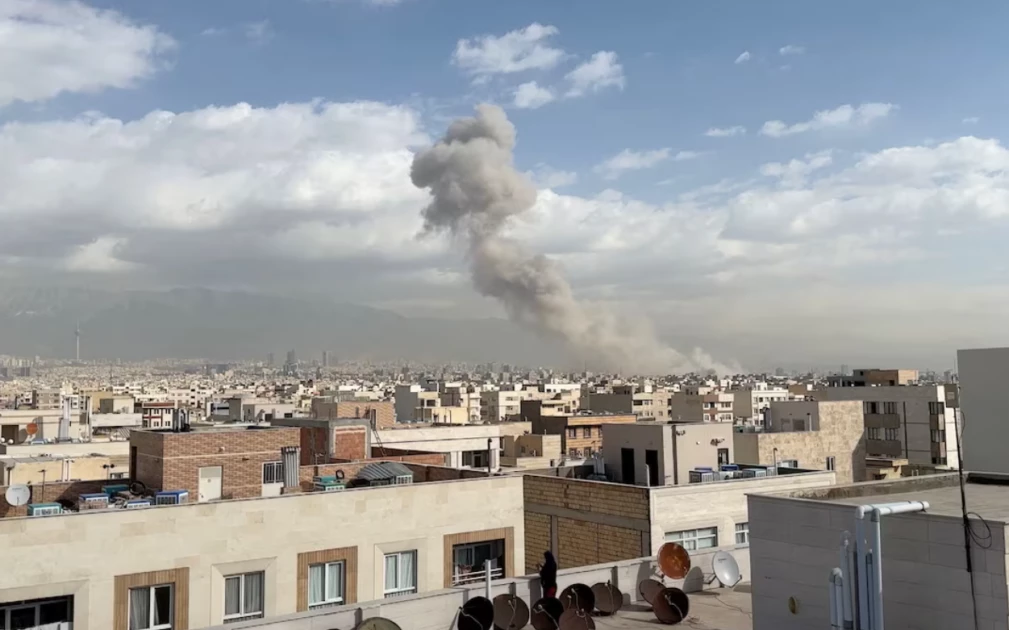
Smoke rises following an explosion, after Israel's Defence Minister Israel Katz said Israel had launched a pre-emptive attack against Iran, in Tehran, Iran February 28, 2026 in this screen grab taken from video. WANA (West Asia News Agency) via REUTERS

Audio By Vocalize
Israel launched a
"pre-emptive" attack against Iran on Saturday, and a major United
States attack is underway, plunging the Middle East into a renewed military
confrontation and further dimming hopes for a diplomatic solution to Tehran's
nuclear dispute with the West.
The U.S. military
initiated a series of strikes against targets in Iran, two U.S. officials told
Reuters, speaking on condition of anonymity. The scope of the air and sea
operations was not immediately clear. The campaign is expected to last for
multiple days, said a U.S. official.
Iran was preparing
a crushing retaliation, an Iranian official told Reuters.
President Donald
Trump, who built up a vast U.S. military presence in the region to force Tehran
to make concessions in nuclear talks, said in a recorded message shared on
Truth Social that the U.S. launched a "massive and ongoing" operation
against the Islamic Republic, vowing to ensure Tehran will not obtain a nuclear
weapon.
On the issue of
Iran's ballistic missile programme, which was a significant sticking point in
negotiations, Trump said Iran was developing long-range missiles that threaten
the United States and others and threatened to raze their missile industry.
"Our
objective is to defend the American people by eliminating imminent threats from
the Iranian regime," Trump said.
A source told
Reuters that Iran's supreme leader, Ayatollah Ali Khamenei, was not in Tehran
and had been transferred to a secure location.
The attack follows
a 12-day air war in June between Israel and Iran and repeated U.S.-Israeli
warnings that they would strike again if Iran pressed ahead with its nuclear
and ballistic missile programmes.
"The State of
Israel launched a pre-emptive attack against Iran to remove threats to the
State of Israel," Defence Minister Israel Katz said.
Israel launched
the attack against Muslim-majority Iran during Ramadan, the holy Muslim month
of fasting observed from dawn to sunset. The strike also came ahead of the
Jewish holiday of Purim, which traditionally commemorates the salvation of Jews
from annihilation in ancient Persia and which begins on Monday.
MONTHS OF PLANNING
WITH US, ISRAEL SAYS
An Israeli defence
official said the operation had been planned for months in coordination with
Washington, and that the launch date was decided weeks ago.
Explosions were
heard in Tehran on Saturday, Iranian media reported, and sirens sounded across
Israel around 0815 a.m. local time in what the military said was a proactive
alert to prepare the public for the possibility of an incoming missile strike.
The Israeli
military announced the closure of schools and workplaces, with exceptions for
essential sectors, and a ban on public airspace. Israel closed its airspace to
civilian flights, and the airports authority asked the public not to go to any
of the country's airports.
The U.S. and Iran
renewed negotiations in February to try to resolve the decades-long dispute
through diplomacy and avert the threat of a military confrontation that could
destabilise the region.
Israel, however,
insisted that any U.S. deal with Iran must include the dismantling of Tehran's
nuclear infrastructure, not just stopping the enrichment process, and lobbied
Washington to include restrictions on Iran's missile programme in the talks.
Iran said it was
prepared to discuss curbs on its nuclear programme in exchange for lifting
sanctions but ruled out linking the issue to missiles.
Tehran also said
it would defend itself against any attack. It warned neighbouring countries
hosting U.S. troops that it would retaliate against American bases if
Washington struck Iran.
In June, the U.S.
joined an Israeli military campaign against Iranian nuclear installations, in
the most direct American military action ever against the Islamic Republic.
Tehran retaliated
then by launching missiles toward the U.S. Al Udeid air base in Qatar, the
largest in the Middle East.
Western powers
have warned that Iran's ballistic missile project threatens regional stability
and could deliver nuclear weapons if developed. Tehran denies seeking atomic
bombs.
Join the Discussion
Share your perspective with the Citizen Digital community.
No comments yet
This discussion is waiting for your voice. Be the first to share your thoughts!