
Israel intensifies Gaza City strikes as many residents refuse evacuation
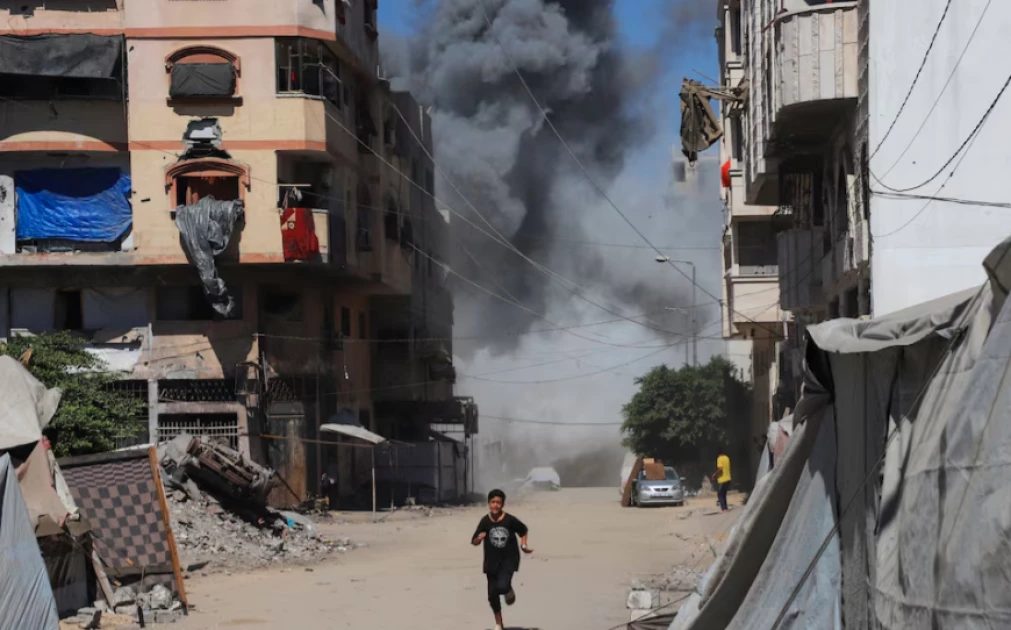
A boy runs as smoke rises from an evacuated residential building, which was housing displaced Palestinians, after it was hit by an Israeli air strike, in Gaza City, September 12, 2025. REUTERS/Ebrahim Hajjaj

Audio By Vocalize
Israeli strikes killed at least 40 Palestinians in the
Gaza Strip on Friday, local health authorities said, most of them in Gaza City,
where many residents are staying put despite Israeli evacuation
orders because they have nowhere
safe to go.
Israel has stated its intention to take full control of the ruined city, where about a million people are sheltering, as part of its plan to wipe out the militant group Hamas, and has been intensifying its attacks.
"The explosions never stopped since yesterday,"
said father-of-two Adel, 60, who lives in Gaza City close to the Beach refugee
camp. He did not wish to give his full name for safety reasons.
"Many families left their homes, and that is what the
occupation wants," he told Reuters via a chat app. "By these
bombardments, they are telling people, 'You either leave your area or die
there'."
The army said it had completed five waves of air strikes on
Gaza City this week, targeting more than 500 sites, and that it had destroyed
reconnaissance and sniper sites, buildings containing tunnel openings and
weapons depots.
In a statement, it said it would "continue to intensify
the pace of strikes in a focused manner, based on precise intelligence, with
the aim of hitting Hamas' infrastructure".
Palestinian health authorities said several deadly strikes
had hit targets in the south of the territory, where some of those fleeing the
bombardment of Gaza City have been heading.
Amjad Al-Shawa, head of the Palestinian NGOs Network, which
liaises with the U.N. and international aid groups, told Reuters an estimated
10% of people in Gaza City had left since Israel announced its plan to take
control a month ago.
The Israeli army said it had started expanding an area of
the southern Gaza Strip it calls "Crossing 147" in order to increase
the volume of aid entering a designated humanitarian zone. This was in
preparation to receive the population leaving the northern area, it said.
"It should be emphasised that upon completion, the
crossing's intake capacity will rise to 150 trucks per day - triple the current
level, thereby enabling increased entry of aid, with an emphasis on food,"
the army said in a statement.
The U.N. and many foreign governments, including those of
countries traditionally allied with Israel, have condemned the Gaza City
evacuation order, called for a ceasefire, and sharply criticised conditions in
the humanitarian zone.
Israel's military assault on Gaza has killed more than
64,000 people, mostly civilians, according to local health authorities, caused
a hunger crisis and wider humanitarian disaster, and reduced much of the
enclave to rubble.
The territory's health ministry has said at least 411
people, including 142 children, have died of malnutrition and starvation in the
enclave.
The war was triggered by Hamas-led attacks launched from
Gaza on southern Israel on October 7, 2023, in which 1,200 people, mostly
civilians, were killed, and 251 taken hostage, according to Israeli tallies.
On Friday, Israeli police said an attacker from a
Palestinian area of the West Bank had been arrested after carrying out a
stabbing attack on guests of a hotel at a kibbutz near Jerusalem.
Join the Discussion
Share your perspective with the Citizen Digital community.
No comments yet
This discussion is waiting for your voice. Be the first to share your thoughts!