

Israel says attacks on Iran are 'nothing' compared with what is coming
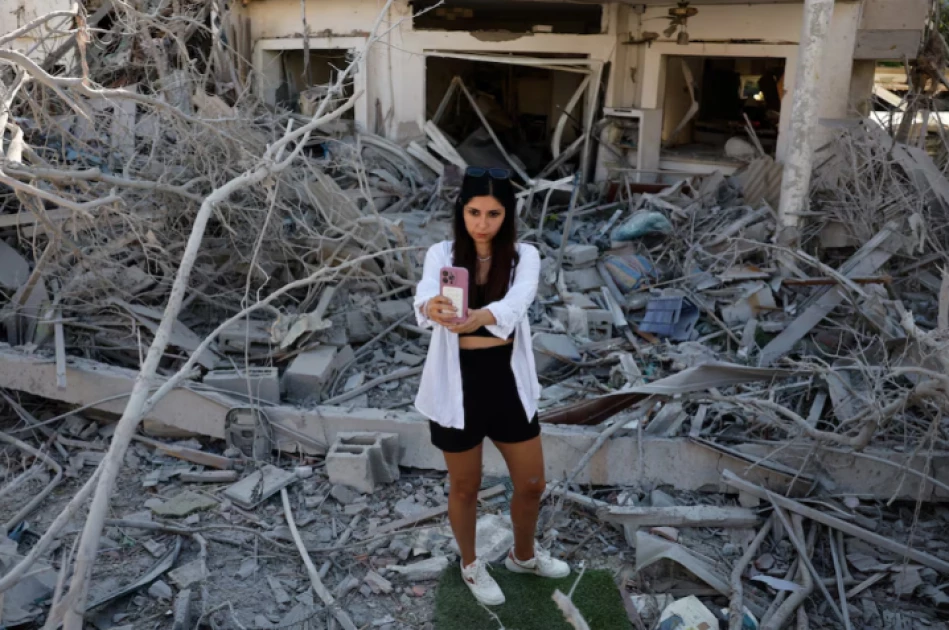
A woman uses her phone at an impact site following missile attack from Iran on Israel, in Rishon LeZion, Israel, June 14, 2025. REUTERS/Ammar Awad

Audio By Vocalize
Iran and Israel traded missiles and airstrikes on Saturday,
the day after Israel launched a sweeping air offensive against its
old enemy, killing commanders and scientists and bombing nuclear sites in a
stated bid to stop it from building an atomic weapon.
Israeli Prime Minister Benjamin Netanyahu said Israel's
strikes had set back Iran's nuclear programme possibly by years but rejected
international calls for restraint, saying the attack would be intensified.
"We will hit every site and every target of the
Ayatollahs' regime, and what they have felt so far is nothing compared with
what they will be handed in the coming days," he said in a video message.
In Tehran, Iranian state TV reported that around 60 people,
including 20 children, had been killed in an attack on a housing complex, with
more strikes reported across the country. Israel said it had attacked more than
150 targets.
In Israel, air raid sirens sent residents into shelters as
waves of missiles streaked across the sky and interceptors rose to meet them.
At least three people were killed overnight. An Israeli official said Iran had
fired around 200 ballistic missiles in four waves.
U.S. President Donald Trump has lauded Israel's strikes and
warned of much worse to come unless Iran quickly accepts the sharp downgrading
of its nuclear programme that the U.S. has demanded in talks that had been due
to resume on Sunday.
But with Israel saying its operation could last weeks, and
urging Iran's people to rise up against their Islamic clerical
rulers, fears have grown of a regional conflagration dragging in outside
powers.
The United States, Israel's main ally, helped shoot down
Iranian missiles, two U.S. officials said.
"If (Supreme Leader Ayatollah Ali) Khamenei continues
to fire missiles at the Israeli home front, Tehran will burn," Israeli
Defence Minister Israel Katz said.
Iran had vowed to avenge Friday's Israeli onslaught,
which gutted Iran's nuclear and military leadership and damaged
atomic plants and military bases.
Tehran warned Israel's allies that their military bases in
the region would come under fire too if they helped shoot down Iranian
missiles, state television reported.
However, 20 months of war in Gaza and a conflict in Lebanon
last year have decimated Tehran's strongest regional proxies, Hamas in Gaza and
Hezbollah in Lebanon, reducing its options for retaliation.
Gulf Arab states that have long mistrusted Iran but fear
coming under attack in any wider conflict have urged calm as worries about
disruption to the region's crucial oil exports boosted the price of crude by
about 7% on Friday.
Lawmaker and military general Esmail Kosari said Iran was
reviewing whether to close the Strait of Hormuz, the exit point for oil shipped
from the Gulf.
Iran's overnight fusillade included hundreds of ballistic missiles
and drones, an Israeli official said. Three people, including a man and a
woman, were killed and dozens wounded, the ambulance service said.
In Rishon LeZion, south of Tel Aviv, emergency services
rescued a baby girl trapped in a house hit by a missile, police said, but later
on Saturday Tel Aviv beaches were busy with people enjoying the weekend.
In the western suburb of Ramat Gan, near Ben Gurion airport,
Linda Grinfeld described her apartment being damaged: "We were sitting in
the shelter, and then we heard such a boom. It was awful."
The Israeli military said it had intercepted
surface-to-surface Iranian missiles as well as drones, and that two rockets had
been fired from Gaza.
In Iran, Israel's two days of strikes destroyed residential
apartment buildings, killing families and neighbours as apparent collateral
damage in strikes targeting scientists and senior officials in their beds.
Iran said 78 people had been killed on the first day and
scores more on the second day, many of them when a missile brought down a
14-storey apartment block in Tehran.
State TV said 60 people were believed to have been killed
there, though the figure was not officially confirmed.
It broadcast pictures of a building flattened into debris
and the facade of several upper storeys lying sideways in the street, while
slabs of concrete dangled from a neighbouring building.
"Smoke and dust were filling all the house and we couldn't
breathe," 45-year-old Tehran resident Mohsen Salehi told Iranian news
agency WANA after an overnight air strike woke his family.
Fars News agency said two projectiles had hit Mehrabad
airport, located inside the capital, which is both civilian and military.
With Iran's air defences heavily damaged, Israeli Air Force
chief Tomer Bar said "the road to Iran has been paved".
In preparation for possible further escalation, reservists
were being deployed across Israel. Army Radio reported units had been
positioned along the Lebanese and Jordanian borders.
Israel sees Iran's nuclear programme as a threat to its
existence, and said the bombardment was designed to avert the last steps to
production of a nuclear weapon.
A military official on Saturday said Israel had caused
significant damage to Iran's nuclear facilities at Natanz and Isfahan, but had
not so far taken on another uranium enrichment site, Fordow, dug into a
mountain.
The official said Israel had "eliminated the highest
commanders of their military leadership" and had killed nine nuclear
scientists who were "main sources of knowledge, main forces driving
forward the (nuclear) programme".
Tehran insists the programme is entirely civilian in line
with its obligations under the nuclear Non-Proliferation Treaty (NPT) and that
it does not seek an atomic bomb.
However, it has repeatedly hidden some part from international
inspectors, and the International Atomic Energy Agency on Thursday reported
it in violation of the NPT.
Iranian talks with the United States to resolve the nuclear
dispute have stuttered this year.
The next meeting was set for Sunday but Iranian Foreign
Minister Abbas Araqchi said on Saturday that continuing the talks while
Israel's "barbarous" attacks lasted was unjustifiable.
Leave a Comment