
Japan's strict gun laws make shootings rare
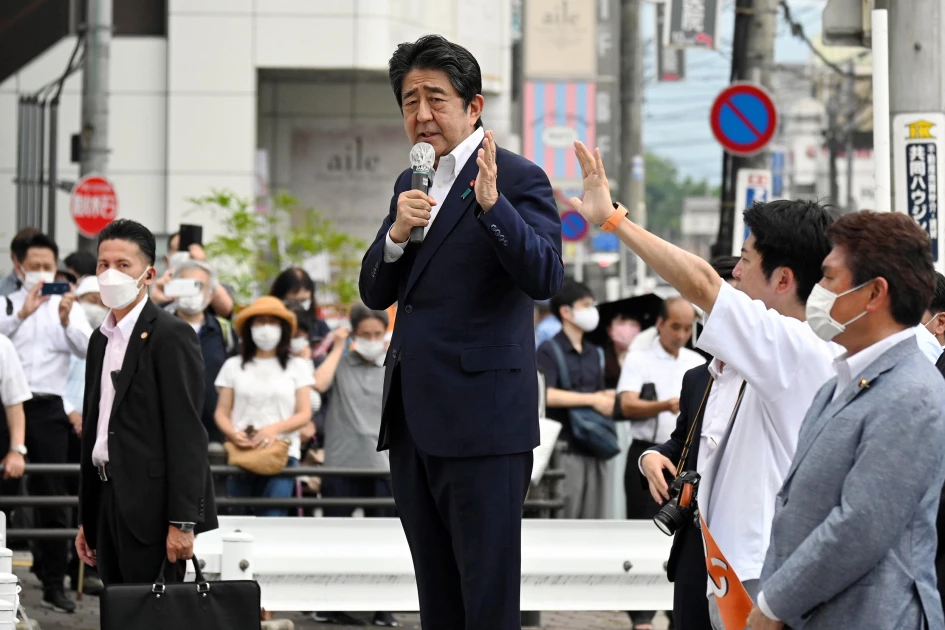
Former Prime Minister Shinzo Abe makes a street speech before being shot in front of Yamato-Saidaiji Station on July 8, in Nara, Japan. PHOTO/COURTESY: CNN

Audio By Vocalize
The assassination of former Japanese Prime
Minister Shinzo Abe has shocked Japan, a country with one of the world's lowest
rates of gun crime due to its strict laws on gun ownership.
Abe was shot dead on Friday in the city of
Nara while delivering a campaign speech and remains in critical condition
undergoing emergency treatment, Prime Minister Fumio Kishida said.
In 2018, Japan, a country of 125 million
people, only reported nine deaths from firearms -- compared with 39,740 that
year in the United States, according to data compiled by the Sydney School of
Public Health at the University of Sydney.
Nancy Snow, Japan director of the
International Security Industrial Council, said the shooting would change Japan
forever.
"It's not only rare, but it's really
culturally unfathomable," she told CNN. "The Japanese people can't
imagine having a gun culture like we have in the United States. This is a
speechless moment. I really feel at a loss for words."
According to Japanese public broadcaster NHK,
citing the police, the suspect in Friday's shooting is a local man in his 40s,
who used a handmade gun.
Under Japan's firearms laws, the only guns
permitted for sale are shotguns and air rifles -- handguns are outlawed. But
getting them is a long and complicated process that requires effort -- and lots
of patience.
To qualify for a firearm license, potential
buyers must attend an all-day class, pass a written test and a shooting-range
test with an accuracy of at least 95%. They also must undergo a mental health
evaluation and drug tests, as well as a rigorous background check -- including
a review of their criminal record, personal debt, involvement in organized
crime and relationships with family and friends.
After obtaining a gun, the owner must
register their weapon with police and provide details of where their gun and
ammunition is stored, in separate, locked compartments. The gun must be
inspected by the police once a year, and gun owners must retake the class and
sit an exam every three years to renew their license.
The restrictions have kept the number of
private gun owners in Japan extremely low.
In 2017, only an estimated 377,000 guns were
held by civilians in Japan, in a country of 125 million people. That was 0.25
guns per 100 people, compared to about 120 guns per 100 people in the US,
according to the Small Arms Survey, a project of the Graduate Institute of
International and Development Studies in Geneva.
The last known public shooting of a
politician in Japan was in 2007, when the mayor of Nagasaki, Iccho Ito, was
shot at least twice in the back at point-blank range by an alleged gangster. He
died after suffering cardiac arrest.
Since then, Japan has furthered tightened its
gun controls, imposing heavier punishments for gun offenses committed by
members of organized crime gangs.
Under the revision, possessing a gun as part
of an organized crime syndicate can lead to up to 15 years in prison;
possessing more than one gun is also a crime, which carries a prison term of up
to 15 years. Discharging a gun in a public space, meanwhile, can result in a
life sentence.
Join the Discussion
Share your perspective with the Citizen Digital community.
No comments yet
This discussion is waiting for your voice. Be the first to share your thoughts!