

Jenga Mama: Programme changing lives of women in Kajiado stitch by stich

Audio By Vocalize
On a bright sunny afternoon in Kimana town, Kajiado County, the
once-fiery rays of the sun mellow into a warm golden glow. Inside a modest
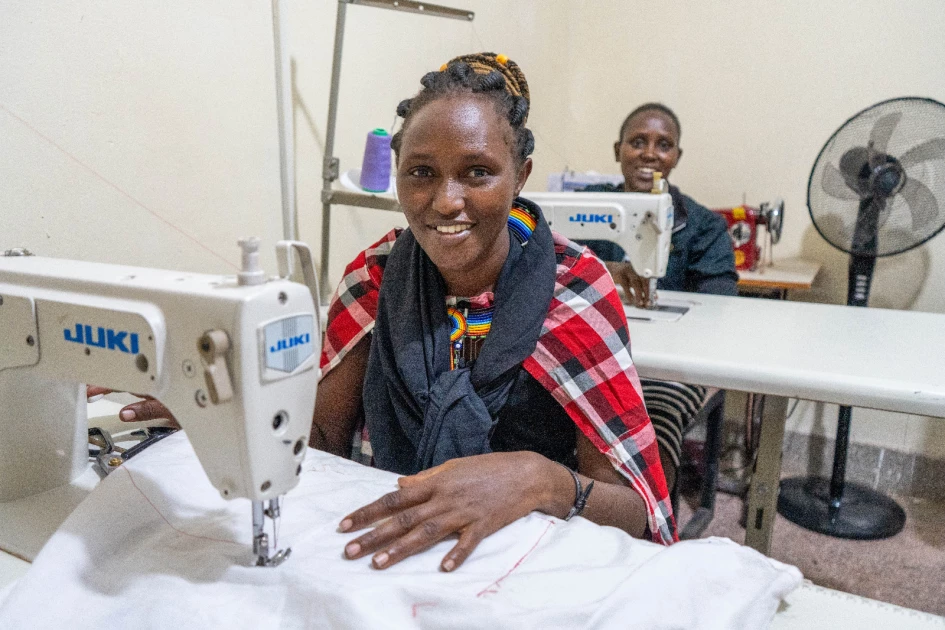
12-by-8-foot fashion design shop, Esther Semeyian is fully engrossed in her
work, racing against time to finish a client’s order.
She is one of four women working in the compact space, each with her own
electric sewing machine and shelves stacked with personal supplies. A shared
ironing area sits on one side, while two manual sewing machines stand at the
entrance—on standby for power outages, which are not uncommon in the area.
Her journey here has been anything but easy. After getting pregnant in
Form 2, her future looked bleak. With no formal education, a child to care for,
and little family support, marriage seemed the only option—an escape route that
has led many young girls from her community into lives of struggle and despair.
Yet, Semeyian hails from a region that is the envy of the world—a humble
village in Oloitokitok, near the Kenya-Tanzania border, nestled at the foot of
the mighty Mount Kilimanjaro. On a clear day, the snow-capped peak of Africa’s
tallest mountain, towering at 5,895 meters, is visible from her home.
Her village lies within the expansive Amboseli ecosystem, a woodland
savannah teeming with wildlife—gazelles, giraffes, elephants, buffaloes, and a
variety of bird species. The surrounding community conservancies, which
complement Amboseli National Park’s 394 km², are essential to the region’s
biodiversity.
“Amboseli is so small. It cannot survive without these community
conservancies,” explains Guyo Adhi, a conservation expert with the
International Fund for Animal Welfare (IFAW).
Thousands of tourists visit the area each year, drawn by the majestic
landscapes and roaming wildlife. Yet, for the communities living here, life can
be harsh—especially for young women facing the triple threat of early
pregnancy, child marriage, and lack of employable skills.
Semeyian’s turning point came in 2024, when she joined the Jenga
Mama initiative, launched by IFAW. The programme seeks to rescue and
empower women from conservation areas by equipping them with vocational
training and entrepreneurial support.
Through Jenga Mama, Semeyian enrolled at Namelok Vocational Training
Institute, where she studied Fashion and Design. Motivated by a desire to
rewrite her story, she excelled and graduated among the top of her class.
With IFAW’s support, Semeyian and three other graduates opened the Jenga
Mama Fashion House in Kimana town. By sharing the space, they are able to
reduce operational costs and support one another both personally and
professionally.
“If you have a problem—whether personal or work-related—you can always
ask your friend for help,” says Semeyian.
“Through this work, I can support my child and also help my parents back
at home,” she adds, her face lighting up with pride.
Her dream is to expand the business and eventually stand on her own,
growing the Jenga Mama Fashion House into a full-fledged brand.
During our visit, we were joined by members of the Kenya-Chinese Women
Association (KCWA), a group of long-term residents in Kenya who are deeply
aware of the challenges faced by women in Maasai communities.
Moved by the initiative’s impact, KCWA partnered with IFAW to further
support the women by donating sewing machines and offering mentorship.
“We know it’s very hard for Maasai women without an income. Sometimes
it’s even difficult to get Ksh.10 from their husbands,” said Sherry Xie, Vice
Chairlady of KCWA.
KCWA is also working to help the women improve the quality of their
products and explore new markets.
“Maasai traditional garments and souvenirs are highly recognizable and
in demand globally—but they must meet international quality standards,” Sherry
explains.
She calls on the government and tourism stakeholders to consider
establishing a permanent, world-class tourism collection market in Nairobi.
“Maasai is good, but what we have now is not permanent and not big
enough,” she adds.
Thanks to initiatives like Jenga Mama and partnerships with groups like
KCWA, women like Semeyian are not only transforming their own lives but also
preserving their culture and protecting the natural ecosystem that surrounds
them.
Leave a Comment