
June 25, 2024: The day Kenyan Gen Zs shocked the world

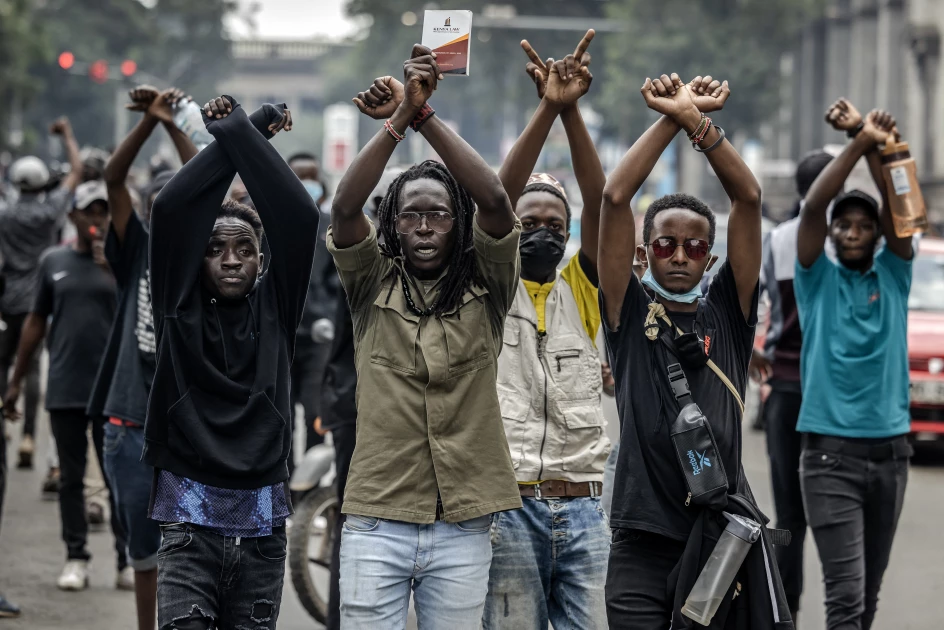
Protesters make signs with their arms in front of Kenya police officers during a demonstration against tax hikes as Members of the Parliament debate the Finance Bill 2024 in downtown Nairobi, on June 18, 2024. Kenyan police fired tear gas and arrested dozens of demonstrators on June 18, 2024 as hundreds of people gathered near the Parliament building to protest tax hikes. (Photo by LUIS TATO / AFP)

Audio By Vocalize
The adrenaline still hangs fresh along the alleys and walkways of Nairobi, the courage is still plastered on the towering buildings, and the unity remains a canopy hovering above Kenya’s capital.
Exactly 24 months and the Kenyan Gen Zs dominate every
conversation, even in Nairobi’s dark backstreets, which only hide secrets kept
by people who have borne the brunt of life’s merciless hand.
Their name has caused tremors in State offices and has
forced the political status quo to spruce up its conduct and demanded a keen
stare from the global eye.
Their force, emblematized by bravery, rage and distaste for
a rogue regime, shocked the world as they chose to fight the Finance Bill 2024,
which proposed unsavory tax increments.
It started with comments on social media on particular
clauses in the Bill that proposed tax increments on essential goods and
services, potentially leading to a higher cost of living and reduced disposable
income.
A public upheaval slowly and unpreventably brewed as hashtags
- #RejectFinanceBill, #OccupyParliament and #RutoMustGo – made rounds online.
As MPs geared up for the voting of the Bill on June 25,
protesters had already started occupying the streets across the nation. Those
in Nairobi had one goal – breaching Parliament.
Prior to this, protests had already rocked the streets from
June 18 as youthful Kenyans called out the state over the proposed punitive
deductions.
I was assigned to cover the procession and by 11 am, the
streets had turned grey and foggy from tear gas. The haze masked the crowds all
donned in black and some strapped their hands or heads with the Kenyan flag.
Under the searing heat, the youth roared anti-government
chants, calling for the rejection of the Finance Bill.
“It is time we end this culture of impunity. We are in the
streets to fight for a better tomorrow and a greater future for our country.
Ruto must go and that Finance Bill should not pass whatsoever,” a protester
said.
They charged into Kenyatta Avenue, immune to the teargas
blasts and the bowsers that attempted to drench the verve and vim of the
vibrant youth.
“Ruto must go, Ruto must go…Down, down, Finance Bill…Bunge!
Bunge! Bunge! (Parliament! Parliament! Parliament!” they chanted.
By 12pm crowds were spilling into the CBD from its four
corners and officers relentlessly lobbed teargas canisters, but they were
outnumbered. I would liken it to bringing a fork to a swordfight.
Officers were pushed back down City Hall way as protesters
marched like a battalion, chanting in thunder and their faces inked with
toothpaste to repel tear gas from striking their eyes.
As the melee ensued, MPs were chanting “YESs” and “NOs” in Parliament as they voted for the Bill they knew had caused
clamor a few meters from the August House.
Outside Parliament, officers had stopped lobbying the slew
of canisters and they opted for an alternative means. Guns.
I had taken shelter at the Holy Family Basillica sitting
opposite Parliament premises and all I could hear was gunshots ringing from a
distance.
We had gotten wind that police officers were using rubber
bullets and injured protesters streamed in the cathedral’s parking where two
ambulances acted as a medical stop for many.
A total of 204 MPs voted yes for the Bill, while 115 opposed
it.
This seemingly sparked more rage and National Assembly
Speaker Moses Wetangula had barely spent five minutes after declaring the
victory when the protesters felled a part of Parliament fence and they marched
in the House.
Officers, standing at a distance outside the House, along
Parliament Way, and others inside its compound, also started opening live rounds
at protesters killing some on the spot.
The MPs were hiding in basement bunkers under Bunge Towers
until an evacuation was organised.
To exit the complex some legislators, including Senate
Speaker Amason Kingi, were put in ambulances as protesters were hurling stones
at MPs' vehicles.
Our media car was also caught up in the stone pelting while
we left as protesters thought we were ferrying MPs. We luckily escaped
unscathed save for my colleague Ben Kirui who was hit by a darting stone at the
back of his head.
Later that evening, President William Ruto termed the
invasion of parliament a "treasonous" act and an "existential
threat".
He also bowed to national pressure and declined to sign the
Finance Bill 2024, rejecting it in its totality.
The incident left the world puzzled and more so, it left the
corridors of power in Kenya frozen, questioning, pondering. The State had never
experienced such a perplexing protest, one that managed to breach State
buildings.
Missing persons,
abductions, denial
The protests, despite achieving its main agenda, resulted to a deadly aftermath as some Kenyans who took part in the demonstrations remained missing and calls for their continued to persist.
A very memorable case is one for Denzel Omondi who went
missing a day after the protests and his body was retrieved from a dam in Juja
a week later.
His family believes that he was abducted and killed as a
postmortem report revealed that he died by drowning.
Similar abductions were subsequently witnessed at the end of
2024 as Kenyans who posted dissenting views against the State were captured by
men identifying as police and some were released after public uproar.
Government officials and security agencies have maintained
that they have not deployed any officers to apprehend or abduct anyone.
Likewise, human rights groups have said that about 60
persons were killed with the youngest being a 12-year-old.
Kenya Human Rights Commission has documented at least 82 cases
of alleged forced disappearances, 1,376 arbitrary arrests between June 18 and November
20, as well as 610 injuries ranging from deep fractures, bullet wounds, soft
tissue injuries, and inhalation of tear gas.
Twenty-five cases of injuries to police were also
documented.
It remains clear that Kenya witnessed a political awakening
of generational proportions as the protests also succeeded in reshaping
Kenya’s public discourse.
Since the demonstrations, the administration has focused
more on addressing substantive issues such as the high cost of living,
widespread youth unemployment, excessive taxation and police excesses and
brutality.
This has even seen the Treasury adopting a zero-based
budgeting approach in formulating the 2025/2026 budget to avoid mishaps that
took Kenyans to the streets a year ago.
Gen Z who were previously dismissed as politically
disengaged, emerged as a formidable force, organising protests through digital
platforms, rallying support from civil society, and earning a seat at the
national dialogue table.
This has forced the State to be on its toes as a majority of
its actions is actively and swiftly dissected online, sealing room for crooked
governance.
Anniversary
procession
Kenyan youth have planned to take to the streets today in
honour of the fallen heroes while also calling out the State over its frail
leadership.
Police have said they are fully prepared to ensure the
safety of protesters and those not demonstrating.
“Let’s restrict ourselves to peaceful demonstrations; not
demonstrations which are going to interfere with other people who may not be
part of the demonstrators,” Nairobi Regional Police Commander George Seda told
reporters last week.
Amid rumours that there will be the infiltration of hired goons by political players, twelve embassies in Kenya have urged President William Ruto’s government to respect citizens’ right to peaceful assembly and to express themselves.
Join the Discussion
Share your perspective with the Citizen Digital community.
No comments yet
This discussion is waiting for your voice. Be the first to share your thoughts!