

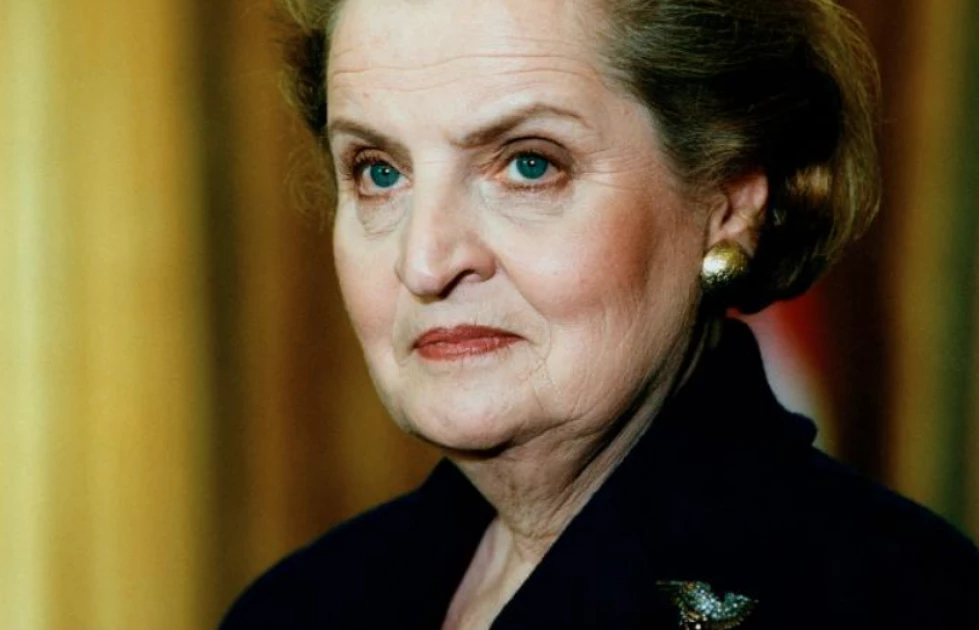
Madeleine Albright, first female U.S secretary of state, dies

Audio By Vocalize
Madeleine
Albright, the first female US secretary of state and who helped steer Western
foreign policy in the aftermath of the Cold War, has died. She was 84 years
old.
The
cause was cancer, Albright's family said in a statement Wednesday.
Albright
was a central figure in President Bill Clinton's administration, first serving
as US ambassador to the United Nations before becoming the nation's top
diplomat in his second term. She championed the expansion of
NATO, pushed for the alliance to intervene in the Balkans to stop
genocide and ethnic cleansing, sought to reduce the spread of nuclear weapons,
and championed human rights and democracy across the globe.
"Few
leaders have been so perfectly suited for the times in which they served,"
Clinton said in a statement. "As a child in war-torn Europe, Madeleine and
her family were twice forced to flee their home. When the end of the Cold War
ushered in a new era of global interdependence, she became America's voice at
the UN, then took the helm at the State Department, where she was a passionate
force for freedom, democracy, and human rights."
She
was a face of US foreign policy in the decade between the end of the Cold War
and the war on terror triggered by the September 11, 2001, attacks, an era
heralded by President George H.W. Bush as a "new world order." The
US, particularly in Iraq and the Balkans, built international coalitions and
occasionally intervened militarily to roll back autocratic regimes, and Albright --
a self-identified "pragmatic idealist" who coined the term
"assertive multilateralism" to describe the Clinton administration's
foreign policy -- drew from her experience growing up in a family
that fled the Nazis and communists in mid-20th century Europe
to shape her worldview.
She
saw the US as the "indispensable
nation" when it came to using diplomacy backed by the use of
force to defend democratic values around the world.
"We
stand tall and we see further than other countries into the future, and we see
the danger here to all of us," she told NBC in 1998. "I know that the
American men and women in uniform are always prepared to sacrifice for freedom,
democracy and the American way of life."
Perhaps
most notable were her efforts to bring about an end to violence in the Balkans,
and she was crucial in pushing Clinton to intervene in Kosovo in 1999 to
prevent a genocide against ethnic Muslims by former Serbian leader Slobodan Milosevic.
She was haunted by the earlier failure of the Clinton administration to end the
genocide in Bosnia.
The
breakup of communist Yugoslavia into several independent states, including
Serbia and Montenegro, Slovenia, Croatia, Bosnia-Herzegovina and Macedonia, in
the 1990s generated savage bloodshed unseen on the continent since World War
II. The term "ethnic cleansing" became synonymous with Bosnia, where
Serb forces loyal to Milosevic tried to carve out a separate state by forcing
out the non-Serb civilian population.
The
Clinton administration did not intervene until the massacre at Srebrenica in
1995, when Serbs killed 8,000 Muslim men and boys, which led to the US-brokered
Dayton Peace Plan. But when Milosevic then tried to move his ethno-nationalist
plan to Kosovo,
the Clinton administration gathered a
coalition to stop him doing there what he had gotten away with
in Bosnia.
Albright
accused Milosevic of creating "a horror of
biblical proportions" in his "desire to exterminate a group
of people" -- Kosovo's Muslim majority. She came under heated criticism in
Washington at the time, with some calling the NATO airstrikes "Albright's
War" while others accused her of misjudging Milosevic's resolve. To that
end, Albright said in 1999, "I take full responsibility along with my
colleagues for believing that it was essential for us not to stand by and watch
what Milosevic was planning to do," adding that "we cannot watch
crimes against humanity."
Ultimately,
the US-led coalition did stop Serbian aggression, and Kosovo declared
independence in 2008.
The
effort contrasted with the Clinton administration's opposition to international
action to stop the 1994 genocide in Rwanda. At the time that Albright was
representing the US at the United Nations, the Clinton administration, haunted
by the military fiasco in Somalia a year earlier, argued for withdrawing the
majority of UN troops from the country in the early days of the
genocide. The ensuing planned slaughter of primarily ethnic Tutsis, as well as
some moderate Hutus by Hutu extremists, would leave at least 800,000 dead.
Years
later, Albright would call it her
"greatest regret from that time."
Late
in Clinton's second term, Albright also participated in unsuccessful talks to
foster peace between
the Israelis and Palestinians, which were followed by a second explosion of
violence in the region. She was also part of the effort to coax North
Korea to abandon its nuclear program by engaging with Kim Jong Il, an effort
that was abandoned by George W. Bush.
Albright's
tenure as secretary of state also saw the al-Qaeda bombings of
US embassies in Kenya and Tanzania, which killed 224 people. She called the
attack the "toughest day" of her tenure but would reject criticism
that it should have prompted tougher US action against the terror group that
would later carry out the 9/11 terror attacks.
"It
would have been very hard, pre-9/11, to have persuaded anybody that an invasion
of Afghanistan was appropriate," Albright told the
9/11 Commission in 2004. "I think it did take the megashock,
unfortunately, of 9/11, to make people understand the considerable
threat."
When
pressed by the commission about the argument that the Clinton administration
lacked actionable intelligence, Albright said "we used every single tool
we had in terms of trying to figure out what the right targets would be and how
to go about dealing with what we knew."
But
she also expressed frustration about the reluctance to push ahead with military
force against al Qaeda and Osama bin Laden.
"From
my perspective, the Pentagon did not come forward with viable options in
response to what the president was asking for," Albright said.
Born
Marie Jana Korbelova, the daughter of a Czechoslovakian diplomat, in Prague in
1937, Albright escaped then-Czechoslovakia with her family 10 days after the
Nazi invasion. Her experience growing up in communist Yugoslavia and then
fleeing to the US made her a lifelong opponent of totalitarianism and fascism.
She was raised Roman Catholic, though she later converted to Episcopalian, and
learned later in life about her family's Jewish heritage.
Albright
graduated from Wellesley College in 1959 and was married to Joseph Albright
from 1959 until 1983, when they divorced. They had three children, twins Anne
and Alice in 1961 and Katharine in 1967. She attended Columbia University for
her master's degree and Ph.D., which she completed in 1976 before launching on
a decades-long career in government service and foreign affairs work under
different Democratic politicians and causes.
Albright
was aware of her role as a trailblazer and often spoke of the challenges of
being the first woman to lead the State Department.
"I
think that there were real questions as to ... whether a woman could be
secretary of state. And not just in terms of dealing with the issues, but in
terms of dealing with the people, especially in hierarchical societies. ... I
found, actually, that I could do that," she told CNN in 2005. "And
people, I think, now can understand that is perfectly possible for a woman to
be secretary of state, and I am delighted that there is second one," a reference
to then-Secretary of State Condoleezza Rice.
Throughout
her career, Albright was known for wearing
brooches or decorative pins to convey her foreign policy
messages. When she found out that the Russians had bugged the State Department,
she wore a large bug pin when she next met with them. When Saddam Hussein
referred to Albright as
a snake, she took to wearing a gold snake pin; when she was called a witch, she
proudly brandished a miniature broom. When she slammed as
"completely un-American" acting Director of US Citizenship and
Immigration Services Ken Cuccinelli's suggestion that only immigrants who can
"stand on their own two feet" are welcome in the United States,
Albright wore a Statue of Liberty pin.
Following
her tenure as secretary of state, Albright served as chairwoman of the National
Democratic Institute for International Affairs in Washington from 2001 to her
death, and she taught at Georgetown University. She was also a prolific author,
penning several books, including a memoir in 2003 entitled "Madam
Secretary." She also worked in the private sector for a time.
In
2012, Albright received the Presidential Medal of Freedom from President Barack
Obama, who said her
"toughness helped bring peace to the Balkans and paved the way for
progress in some of the most unstable corners of the world."
Throughout
her retirement, Albright continued working for democracy around the world and
speaking about US policy, leveling particularly harsh criticism toward
President Donald Trump, whom she called "the most undemocratic president
in modern American history."
In
a New York Times
op-ed written last month just before Russia's invasion of
Ukraine, Albright argued that Russian leader Vladimir Putin would be making
"a historic error" and warned of devastating costs to his country.
"Instead
of paving Russia's path to greatness, invading Ukraine would ensure Mr. Putin's
infamy by leaving his country diplomatically isolated, economically crippled
and strategically vulnerable in the face of a stronger, more united Western
alliance," Albright wrote.
Asked
by USA Today in August 2020 how she defined courage, Albright replied,
"it's when you stand up for what you believe in when it's not always easy
and you get criticized for it."
"It took me a long time to find my voice. But having found it, I'm not going to shut up," Albright said. "I'm going to use it to the best of my ability in terms of making sure that democracy is our form of government and that those around the world that want to live in a democracy have a possibility to do so."
Leave a Comment