Marsabit’s bold leap: Innovation and sustainability hub unveiled in North Horr
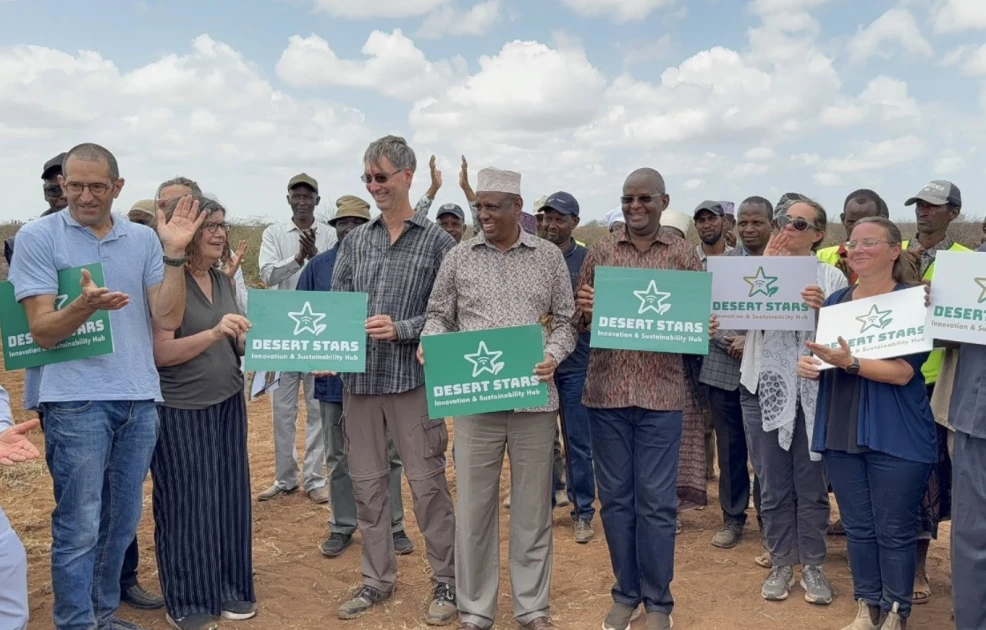
When leaders, elders, and community members gathered for the ground-breaking ceremony, the atmosphere carried hope.

Audio By Vocalize
In Turbi, North Horr, a small settlement located 600 kilometres from Nairobi, something remarkable is taking shape. For this windy, dusty region long battered by the harsh realities of climate change—prolonged droughts, sudden floods, and the loss of livestock that sustain entire households—livelihoods have remained painfully fragile.
But now, a visionary project is coming up: The Desert Stars Innovation and Sustainability Hub.
Its impact reaching far beyond Marsabit County, the
hub is expected to unlock opportunities for young people from the entire Northern
region and beyond, a much-needed beacon of hope in this region.
In addition, the Hub is expected to train livestock
farmers and agropastoral communities on smart farming methods to overcome the
ravages of climate change.
When leaders,
elders, and community members gathered for the ground-breaking ceremony, the
atmosphere carried hope.
“We are breaking
ground for possibilities. We
are striking the rock so that water may flow for a new generation—not in pipes
alone, but in skills, ideas, jobs, and hope,” said Marsabit Governor Mohamud M. Ali.
North Horr Member of
Parliament Wario Adhe, the
visionary behind the project, called the Hub a leap of imagination for a region
hungry for new pathways.
“This is about
inspiring my people that we can dream big,” he told the crowd. “The Hub will
create job opportunities for our young people and equip our farmers to adopt
smart farming practices that cushion them from climate change. A bold new North
Horr will emerge.”
A Hub born from
the desert’s challenges
The Desert Stars
Hub is built around two ideas that are quietly transforming some of the
toughest environments in the world: innovation and sustainability.
Under its
innovation pillar, the Hub will introduce digital literacy, Artificial
Intelligence, the Internet of
Things, and other emerging technologies—tools that can connect a young person
in Turbi to opportunities across the world.
It will nurture
small enterprises, digital jobs, and new thinking rooted in both technology and
the northern frontier’s culture of resilience.
But it is the
sustainable agriculture pillar that may prove most transformative. With the
support of Ben Gurion University of Israel—a global leader in dryland
agriculture—the Hub will train learners in precision farming, water-harvesting
science, smart livestock systems, and data-driven agriculture adapted to ASAL
environments.
“Israel is as dry as this region. Perhaps even drier.
However, through innovation, we have found a way to feed ourselves and millions
of people across the world. This is a success story that can be replicated
here,” said Prof Yaron Ziv from School of Sustainability and Climate Change,
University of Ben Gurion in Negev (BGU), Israel.
Prof. Yaron led a multidisciplinary delegation of
experts in ecology, life sciences, climate change, soil science and dryland
agriculture from BGU who are keen to assist communities in Marsabit to thrive
within their environment.
The Desert Stars is also expected to benefit from
Israel’s globally recognised leadership in technology and innovation. Representing
this ecosystem during the ground-breaking ceremony was Itai Bass, VP Business
Development of CommuniTake Technologies, a leading provider of mobility
management and cybersecurity technologies across the world.
Mr. Bass also attended in his capacity as a
representative of Rotary Afeka AvivTek Club, Israel, the only Rotary Club dedicated
exclusively on innovation and technology in the world.
“This innovative idea deserves our support. I will not
only rally my tech community to support this but also my network of Rotary
International across the world as we seek to exchange knowledge, technology and
best-practices,” said Mr Bass.
For pastoralist
communities who have lost herds to drought, “climate-smart” is not a buzzword.
It is survival. Graduates from the Hub are expected to design solutions for
livestock disease surveillance, disaster preparedness, rangeland restoration,
and environmental stewardship.
Adano Wario, a local pastoralist farmer who lost over
80 percent of his livestock herd during the recent drought dubbed the worst in
40 years, is optimistic that the Hub will equip farmers like him with knowledge
to cope the vagaries of climate change.
“This is exactly what our region needs - innovative
ideas that will enable communities to survive and thrive,” he said.
The Hub’s location
along the Marsabit–Moyale highway is no accident. It sits at a crossroads of
communities—Boran, Gabra, Rendille, and others—places where livelihoods often
intersect and sometimes collide.
“I am glad that
this Hub is strategically located in Turbi to serve all corners of
Marsabit—North Horr, Moyale, Saku, and Laisamis,” Governor Mohamud noted. “When
livelihoods grow across boundaries, the incentive to protect peace grows with
them.”
Leave a Comment