

Modern slavery: The human cost of Kenya’s Gulf labour pipeline
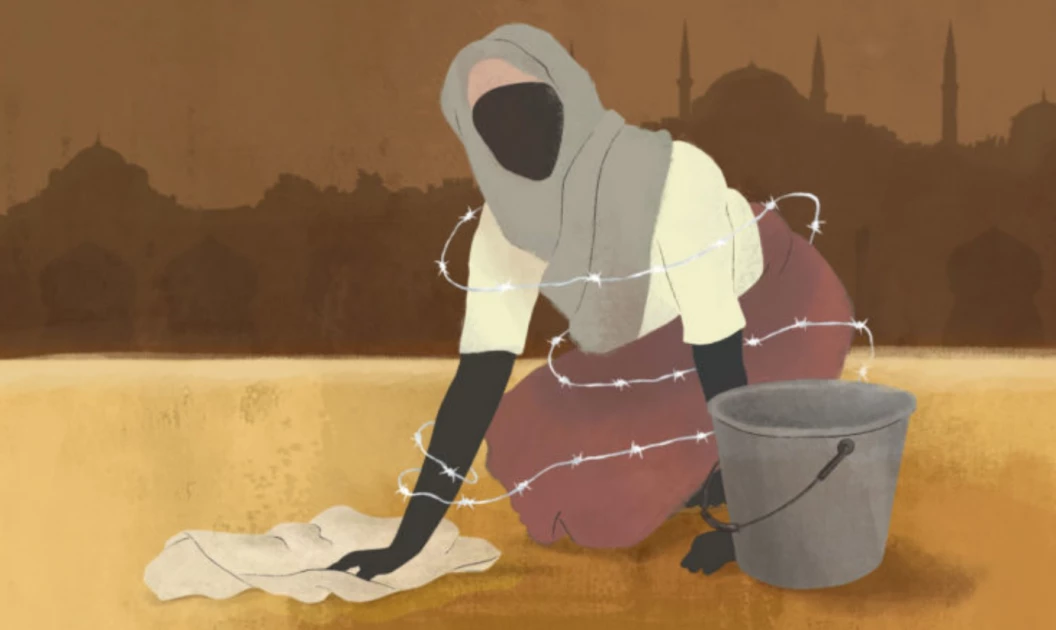
An AI-generated representation of a perceivably enslaved domestic worker.

Audio By Vocalize
Grace Achieng, a
31-year-old mother of one, left her home in Kayole, Nairobi, Kenya, hoping to
secure a teaching profession in the Gulf. To her surprise, she ended up becoming
a domestic worker. The agents who promised her a professional teaching job were
nowhere to be found. Immediately after her arrival at the Gulf, her passport
and personal documents were confiscated, depriving her rights to ownership.
Grace’s story is just one of the many.
At least 274 Kenyan
workers, most of whom are women, have died in Saudi Arabia over the past five
years despite being a young workforce in non-dangerous jobs. Thousands of
Ugandan and Kenyan women travel to Saudi Arabia each year to take up domestic
jobs such as housekeepers and nannies. But many are returning with stories of
unpaid wages, detention, beatings, starvation, and sexual assault. Others have
returned in coffins.
An estimated 50
million people– almost the population of Kenya – are trapped in slavery,
according to the landmark report by the Global Commission on Modern Slavery and
Human Trafficking.
“On my arrival at
Sharjah International Airport in Dubai, I was met by a woman who I thought was
my potential employer; to my disbelief, she was an agent, and she was
responsible for assigning me a home where I was going to work as a domestic
worker,” Grace narrates.
“She rudely
suggested that if I didn’t want the job, she could gladly get me a ticket back
to Kenya. My heart sunk in regret, to imagine I left my home and my son without
a bread winner. I had to swallow all my pride and take up the job.”
Her paper of declaration stated that she went to Saudi Arabia to cook, clean, and take care of children. She was forced to recite these words from a paper held on one hand by the agent and a camera recording her on the other hand without her consent.
A 2022 study by the Global Fund to End Modern Slavery (GFEMS) revealed that an estimated 98.24% of Kenyan migrant workers in the Gulf Cooperation Council (GCC) countries have experienced forced labor. This includes various forms of abuse such as wage theft, excessive working hours, and restrictions on movement, often under the restrictive "kafala" system that ties workers to a single employer and limits their ability to leave or change jobs.
Nasreen Sheikh
survived modern slavery in a sweatshop in Kathmandu, where she spent up to 15
hours a day standing at a textile machine at the age of 10. She escaped and
became an anti-modern slavery activist, social entrepreneur, and author.
“I know first-hand
the impact of this devastating crime on people’s lives –stripping them of their
humanity and destroying their livelihoods. The scale of suffering caused by
contemporary forms of slavery is reminiscent of the genocides of the last
century. The world cannot stand by and watch while millions endure such
abuses,” says Sheikh. “Faceless casualties are generated every day through the
purchasing decisions of unconscious consumption, and the blind eyes of a global
economic system.”
In April 2025, the
Global Commission on Modern Slavery and Human Trafficking warned that millions
of lives are at risk, as it urged the global community to take action to
eradicate modern slavery and human trafficking in its first landmark report.
Former UK Prime
Minister, Baroness Theresa May, who chairs the Global Commission, has called
the failure to eradicate modern slavery and human trafficking a moral stain on
humanity, affecting an estimated 50 million people worldwide. Despite
commitments to eradicate modern slavery and human trafficking by 2030 as part
of the United Nations Sustainable Development Goals, the world is at risk of
failing to meet this objective.
“Suicide thoughts
ran across my mind countless of times. A lot of people depended on me to make
to make ends meet; my mother, my son and my younger siblings. I could not
afford to fail them. I worked long hours without food or sleep, my body was fatigued
and my menstrual state was sick,” Grace recounts.
“I decided to quit and move into another home. I knew for sure the treatment would not be different, but at least it would also not be the same. I did not know my passport would be confiscated and I would be sold to my employer. I was subjected to physical abuse anytime I tried to speak up for my rights. The owned me.”
Philemon Yang,
President of the 79th Session of the UN General Assembly, says: “We must take a
stronger stand against modern slavery and human trafficking. The launch of the
Global Commission’s report will contribute to the dialogue and deliberations
around this critical issue. Together, we must forge the diverse partnerships
that are critical to our success. By uniting to drive transformative change, we
can confront the challenges that enable exploitation to flourish.”
Grace managed to
escape her employers and secure her papers, during which time she lived off her
friends' support until she secured another job. She has plans to return home, to
Kenya, once her income allows her to.
“I will highly advise young girls from Kenya to be very vigilant with agents who sell to them Gulf countries like heaven, It is better to do your research before you board a plane that will sell off your human rights and dignity,” she advises.
Leave a Comment