

More evidence links a virus to multiple sclerosis, study finds
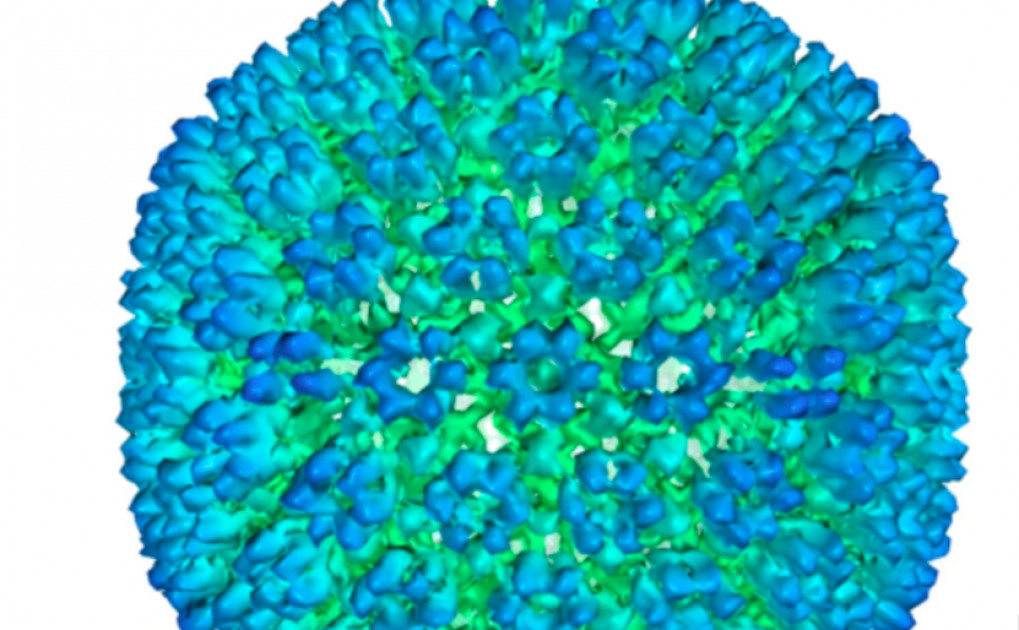
This image provided by US Department of Health and Human Services shows an illustration of the outer coating of the Epstein-Barr virus, one of the world’s most common viruses.

Audio By Vocalize
There's more evidence that one of the world's
most common viruses may set some people on the path to developing multiple
sclerosis.
Multiple sclerosis is a potentially disabling
disease that occurs when immune system cells mistakenly attack the protective
coating on nerve fibers, gradually eroding them.
The Epstein-Barr virus has long been
suspected of playing a role in the development of MS. It's a connection that's
hard to prove because just about everybody gets infected with Epstein-Barr,
usually as kids or young adults, but only a tiny fraction develop MS.
On Thursday, Harvard researchers reported one
of the largest studies yet to back the Epstein-Barr theory.
They tracked blood samples stored from more
than 10 million people in the U.S. military and found the risk of MS increased
32-fold following Epstein-Barr infection.
The military regularly administers blood
tests to its members, and the researchers checked samples stored from
1993-2013, looking for antibodies signaling viral infection.
Just 5.3% of recruits showed no sign of
Epstein-Barr when they joined the military. The researchers compared 801 MS
cases subsequently diagnosed over the 20-year period with 1,566 service members
who never got MS.
Only one of the MS patients had no evidence
of the Epstein-Barr virus before the MS diagnosis. And despite intensive
searching, the researchers found no evidence that other viral infections played
a role.
The findings "strongly suggest"
that Epstein-Barr infection is "a cause and not a consequence of MS,"
study author Dr. Alberto Ascherio of the Harvard T.H. Chan School of Public
Health and colleagues reported in the journal Science.
It's clearly not the only factor, considering
that about 90% of adults have antibodies showing they've had Epstein-Barr,
while nearly 1 million people in the U.S. are living with MS, according to the
National Multiple Sclerosis Society.
The virus appears to be "the initial
trigger," Drs. William H. Robinson and Lawrence Steinman of Stanford
University wrote in an editorial accompanying Thursday's study. But they
cautioned, "additional fuses must be ignited," such as genes that may
make people more vulnerable.
Epstein-Barr is best known for causing
"mono," or infectious mononucleosis, in teens and young adults but
often occurs with no symptoms. A virus that remains inactive in the body after
initial infection, it also has been linked to later development of some
autoimmune diseases and rare cancers.
It's not clear why. Among the possibilities
is what's called "molecular mimicry," meaning viral proteins may look
so similar to some nervous system proteins that it induces the mistaken immune
attack.
Regardless, the new study is "the
strongest evidence to date that Epstein-Barr contributes to cause MS,"
said Mark Allegretta, vice president for research at the National Multiple
Sclerosis Society.
And that, he added, "opens the door to
potentially prevent MS by preventing Epstein-Barr infection."
Attempts are underway to develop Epstein-Barr
vaccines including a small study just started by Moderna Inc., best known for
its COVID-19 vaccine.
Leave a Comment