

Newly-discovered asteroid may hit Earth on Valentine's Day 2046 - NASA
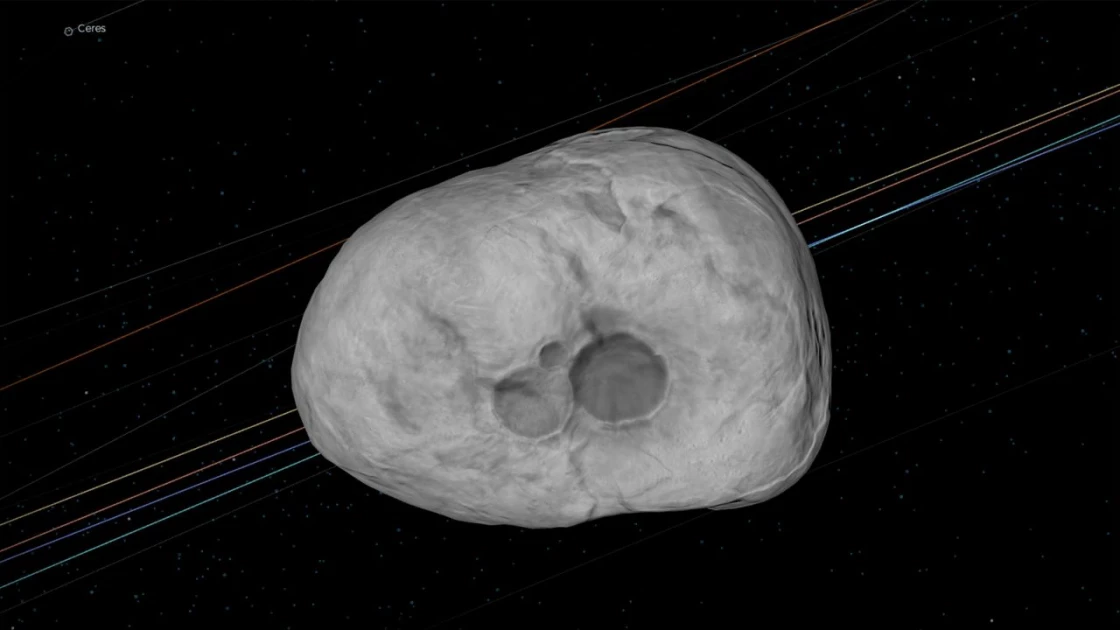
Astronomers recently spotted the 2023 DW asteroid, depicted in a rendering. The space rock is more than 11 million miles from Earth. | PHOTO: NASA

Audio By Vocalize
A newly discovered
asteroid roughly the size of an Olympic swimming pool has a “small chance” of colliding
with Earth in 23 years, with a potential impact on Valentine’s Day in 2046,
according to NASA’s Planetary Defense Coordination Office.
The asteroid has a 1 in 625 chance of striking Earth,
based on data projections from the European Space Agency, though NASA’s
Jet Propulsion Laboratory’s Sentry system calculated the odds closer to 1
in 560. The latter tracks potential collisions with celestial objects.
But the space rock — named 2023 DW — is the only
object on NASA’s risk list that ranks 1 out of 10 on the Torino
Impact Hazard Scale, a metric for categorizing the projected risk of an object
colliding with Earth. All other objects rank at 0 on the Torino scale.
Though
the 2023 DW tops the list, its ranking of 1 means only that “the chance of
collision is extremely unlikely with no cause for public attention or public
concern,” according to the Jet Propulsion Laboratory, while a 0 ranking means
the “likelihood of a collision is zero, or is so low as to be effectively
zero.”
“This
object is not particularly concerning,” said Davide
Farnocchia, a navigation engineer at the Jet Propulsion Laboratory in Pasadena,
California.
NASA
officials have warned that the odds of impact could be dramatically altered as
more observations of 2023 DW are collected and additional analysis is
performed.
“Often when new objects are first
discovered,” NASA Asteroid Watch noted Tuesday on Twitter, “it takes several weeks of
data to reduce the uncertainties and adequately predict their orbits years into
the future.”
Risk of asteroid impact
It’s common for newly
discovered asteroids to appear more threatening when first observed.
“Because orbits stemming
from very limited observation sets are more uncertain it is more likely that
such orbits will ‘permit’ future impacts,” the Center for Near Earth Object
Studies, located at the Jet Propulsion Laboratory, notes on its website.
“However, such early
predictions can often be ruled out as we incorporate more observations and reduce
the uncertainties in the object’s orbit,” it reads. “Most often, the threat
associated with a specific object will decrease as additional observations
become available.”
It may be a few days before new data can be collected
because of the asteroid’s proximity to the moon, Farnocchia noted in an email
to CNN. The last full moon was
two days ago, and it still appears bright and large in the sky, likely
obscuring 2023 DW from immediate observation, he said.
“But then the object will remain observable for weeks
(even months with larger telescopes) so we can get plenty of observations as
needed,” he added.
The asteroid measures
about 160 feet (about 50 meters) in diameter, according to NASA data. As 2023
DW orbits the sun, it has 10 predicted close approaches to Earth, with the
nearest landing on February 14, 2046, and nine others between 2047
and 2054. The closest the asteroid is expected to travel to Earth is about 1.1
million miles (1.8 million kilometers), NASA’s Eyes on Asteroids website
notes.
The space rock was first spotted in our skies on February
2.
It’s traveling about 15.5 miles per second (25 kilometers
per second) at a distance of more than 11 million miles (18 million kilometers)
from Earth, completing one loop around the sun every 271 days.
Farnocchia noted the success of NASA’s DART mission,
or the Double Asteroid Redirection Test, in September 2022 as evidence that
humanity can be prepared to confront space rocks on potentially disastrous
courses. DART intentionally collided a spacecraft into an asteroid to change
its trajectory.
“That’s the very reason why we flew that mission,” he
said, “and that mission was a spectacular success.”
Leave a Comment