
Rare skin fossil is oldest by 130 million years
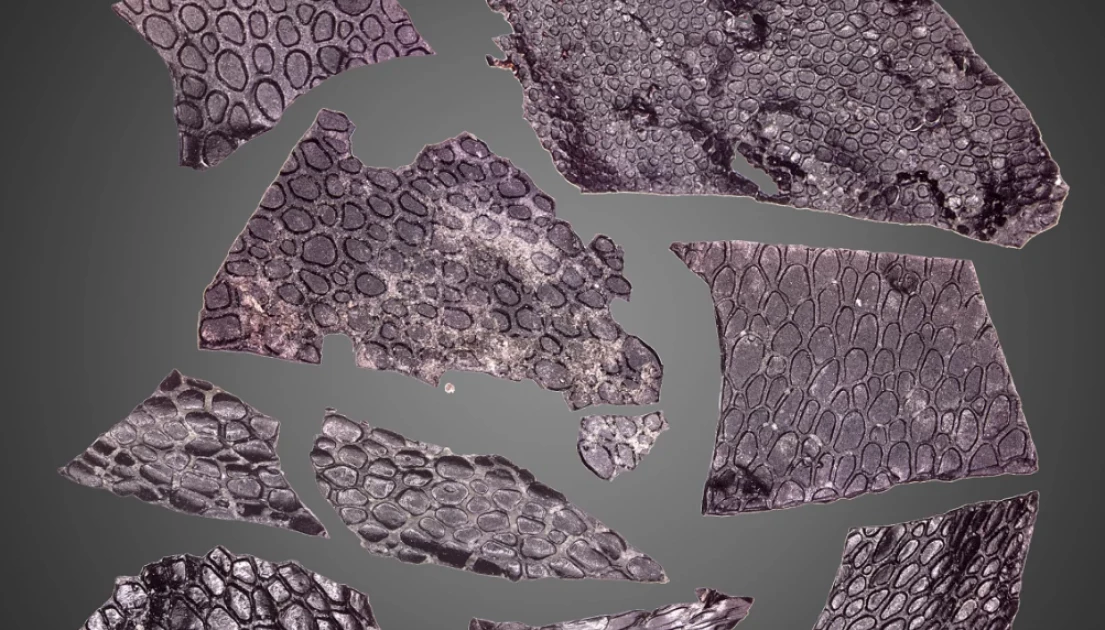
The skin fossil resembles crocodile skin.

Audio By Vocalize
The
world’s oldest known fossilized skin belonged to a species of reptile that
lived before dinosaurs roamed the Earth, a new study has found.
The fragment of fossilized reptile
skin was found in a limestone cave in Oklahoma, United States, and is at least
130 million years older than the oldest previously known skin fossil.
Researchers from the University of Toronto Mississauga identified
a skin fragment with a pebbled surface which is similar to crocodile skin,
according to a press release published Thursday.
Dating from around 289 million years ago, it is the oldest
known sample of a preserved epidermis, which is the outside layer of skin on
terrestrial reptiles, birds and mammals. The epidermis “was an important
evolutionary adaptation in the transition to life on land,” reads the release.
“Every
now and then we get an exceptional opportunity to glimpse back into deep time,”
said first author Ethan Mooney, a paleontology graduate student at the
University of Toronto, in the release.
“These types of discoveries can really enrich our understanding
and perception of these pioneering animals,” he added.
Study
coauthor Robert Reisz, a biology professor at the University of Toronto
Mississauga who researches vertebrate paleontology, told CNN that it’s “very
rare” to find fossilized skin “despite the fact that it’s actually the largest
organ in the body.”
“It decomposes very easily after the animal dies,” said Reisz, who
explained that this sample was preserved due to the unique features of the
Richards Spur limestone cave system, where many of the oldest examples of early
terrestrial animals have been found.
“The conditions in the cave were really very unusual,” Reisz told CNN,
citing the chemistry of the clay sediment, the water and the presence of
hydrocarbons.
Animals that fell into the cave system would have been buried in
fine clay sediments, slowing decomposition, and then interacted with
hydrocarbons in oil that seeped through the site, preserving the skin. The cave
was also likely an oxygenless environment, according to researchers.
The sample was one of thousands donated to the team by amateur
collector Bill May in 2018, Reisz told CNN. Most of the samples were bone and
easily recognizable. However, the “delicate” skin fossil was unique, measuring
about a quarter of a millimeter in thickness or less.
The team found epidermal tissues during microscopic examination of
the tiny skin fossil, which is smaller than a fingernail.
“We were totally shocked by what we saw because it’s completely
unlike anything we would have expected,” said Mooney. “Finding such an old skin
fossil is an exceptional opportunity to peer into the past and see what the
skin of some of these earliest animals may have looked like.”
Researchers say that the pebbled skin surface is
similar to crocodile skin, and that hinged regions between scales are similar
to those found in snakes and worm lizards.
Despite these features, it is not possible for
researchers to say what animal or body region the sample came from, because the
fossil is not associated with any other remains.
But Reisz told CNN that the skin would have
belonged to “a small little animal looking somewhat like a lizard.”
And
he believes that the skin could have belonged to a small reptile named
Captorhinus, fossils of which have been found in the cave system far more
commonly than any other such animal.
However, the fact that the sample shares some similarities with
living reptiles shows the importance of skin for animals living on land.
“The epidermis was a critical feature for vertebrate survival on
land,” said Mooney. “It’s a crucial barrier between the internal body processes
and the harsh outer environment.”
In addition, the sample may be an example of a skin structure that
eventually evolved into bird feathers and mammalian hair follicles, according
to the release.
Join the Discussion
Share your perspective with the Citizen Digital community.
No comments yet
This discussion is waiting for your voice. Be the first to share your thoughts!