
Relatives of Venezuela political prisoners begin hunger strike after 17 freed
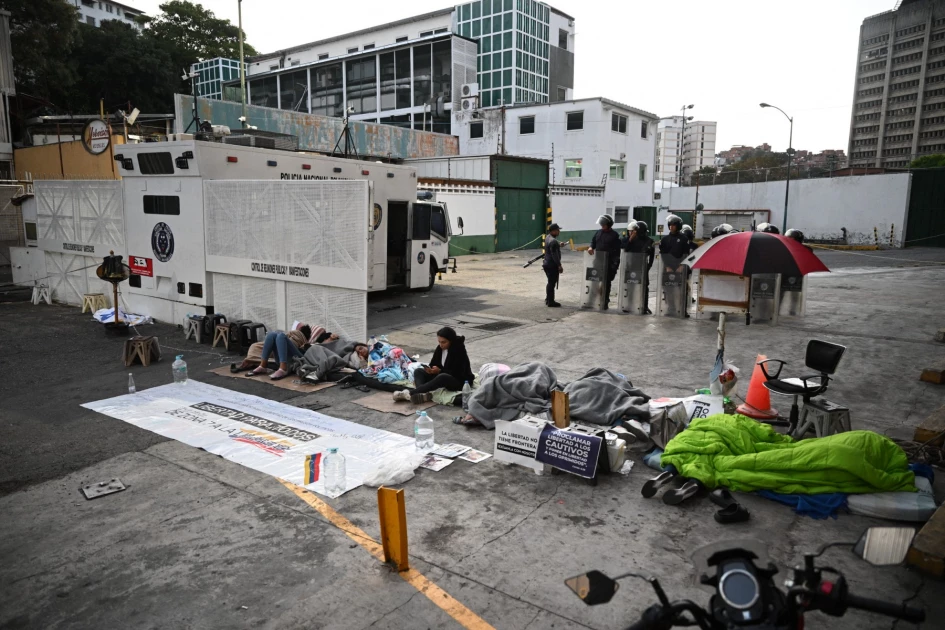
Relatives of political prisoners sleep on the ground during a protest outside the Bolivarian National Police (PNB) Zona 7 prison in Caracas on February 14, 2026.

Audio By Vocalize
Relatives of political prisoners in Venezuela launched a
hunger strike Saturday outside a prison in Caracas after 17 other detainees
were freed, as talks drag on over the adoption of a promised amnesty law.
Wearing face masks, the group of about 10 women lay down in
a line at the entrance to a national police facility known as Zone 7.
Many women were sleeping, with one telling AFP, on condition
of anonymity: "Sleeping eases the hunger."
"The pressure has worked; we hope to stay here until
everyone is released," Evelin Quiaro, 46, an immigration official and the
mother of a political prisoner, told AFP.
Quiaro, whose son has been in detention since November on
terror-related charges, said she had eaten her last meal at about 1:00 am.
In the early hours of the morning, National Assembly
President Jorge Rodriguez had announced the release of 17 prisoners in a post
on social media, without naming them.
He called for Venezuelans to "continue this path of
peace for the construction of democratic coexistence."
The historic amnesty is the centerpiece of the reforms
undertaken by acting President Delcy Rodriguez since the capture by US special
forces of the country's longtime leader Nicolas Maduro in a deadly January 3
raid on Caracas.
It aims to turn the page on nearly three decades of state
repression, and is expected to cover all charges brought against dissidents who
opposed the rule of Maduro and his predecessor Hugo Chavez over the past 27
years.
The amnesty legislation covers charges of
"treason," "terrorism" and spreading "hate" that
were used to lock up dissidents, according to the bill text.
But on Thursday, after backing the bill on a first reading,
lawmakers postponed the adoption of the amnesty bill after failing to reach an
agreement on how to apply it.
Pro-government and opposition lawmakers clashed over an
article requiring would-be beneficiaries to appear in court to request amnesty.
- US pressure -
Rodriguez, Maduro's onetime vice president, took his place
as the South American country's leader with the consent of US President Donald
Trump -- provided that that she toe Washington's line.
The United States has taken over control of Venezuela's oil
sales, with Trump vowing a share for Washington in the profits.
The Trump administration has also pressured Rodriguez to
release political prisoners.
The amnesty legislation under debate would potentially see
hundreds of activists still behind bars walk free.
As the post-Maduro transition takes hold, the fear once
instilled by the state is beginning to dissipate.
Thousands of opposition supporters poured into the streets
of Caracas ahead of the debate over the amnesty bill to demand the release of
all remaining political prisoners.
According to the NGO Foro Penal, which advocates for inmates
in Venezuela, 431 political prisoners have received conditional release and 644
remain behind bars.
Join the Discussion
Share your perspective with the Citizen Digital community.
No comments yet
This discussion is waiting for your voice. Be the first to share your thoughts!