
Ruto assents to Ksh.5T National Infrastructure Bill paving way for JKIA expansion
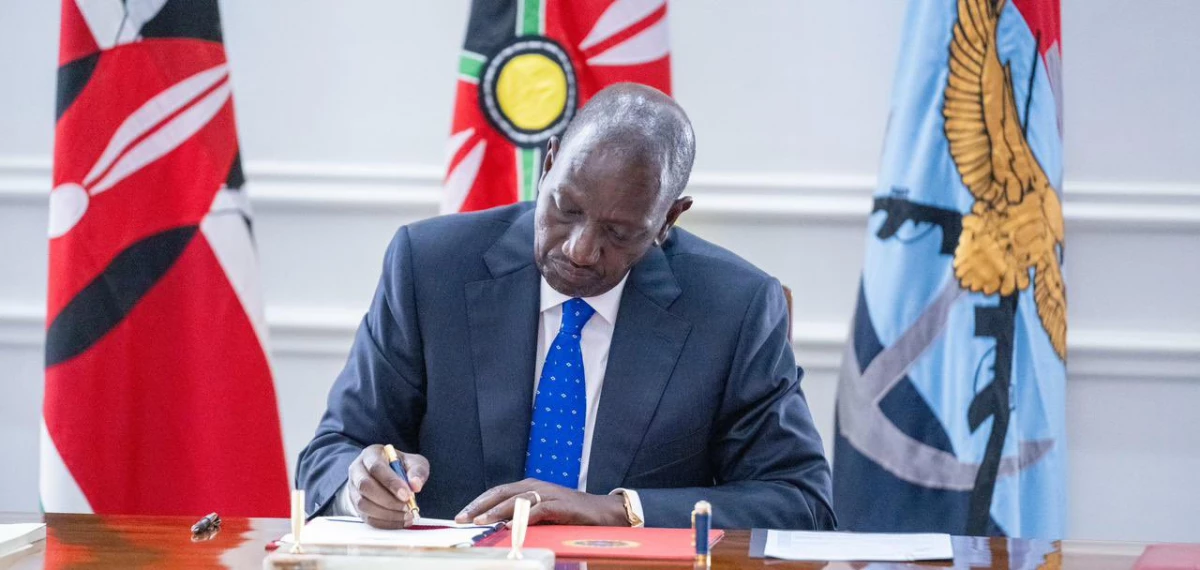
President William Ruto signs into law the Ksh.5 trillion National Infrastructure Bill, 2026, in State House, Nairobi on March 9, 2026.

Audio By Vocalize
The Bill, sponsored by National Assembly Majority Leader and Kikuyu Member of Parliament (MP) Kimani Ichung’wah, seeks to create a fund that will invest in key projects, including roads, railways, ports, irrigation and energy.
The National Assembly passed the Bill, which is intended to shift infrastructure financing towards an investment-led model that attracts private capital and will work as a corporate investment fund, not a traditional government fund.
This means that the government will maintain a key focus on reducing its reliance on borrowing and taxation. It plans to mobilize the budgeted Ksh.5 trillion over 10 years.
President Ruto stated that JKIA will be the first project to be undertaken under the fund, and will be structured with approximately Ksh.20 billion in equity participation from the NIF and domestic institutional investors.
"The Fund is not an experiment. It is a model that has been adopted successfully around the world. Examples include the Nigeria Infrastructure Fund established in 2011, the Ghana Infrastructure Investment Fund in 2014, India’s National Investment and Infrastructure Fund in 2015, the Canada Infrastructure Bank in 2017, the United Kingdom’s National Wealth Fund, and South Africa’s Infrastructure Fund," he said.
He added that Kenya's potential for domestic capital is immense, intimating that last year alone, Kenyan pension fund assets grew by Ksh. 700 billion, representing a 25 percent increase, bringing total pension assets to Ksh.2.81 trillion.
The fund will be managed by a board comprising eight persons: four independent directors to be competitively recruited by the governing council; three public officers appointed based on their expertise or position; and the chief executive officer, an ex officio member hired by the board of directors.
The board will be managed by a governing council comprising the Treasury Cabinet Secretary (CS) John Mbadi, Central Bank of Kenya Governor Dr. Kamau Thugge, the Attorney General and six other members who are not public officers.
The new organ will provide overall direction and counsel to the board, oversee the development of investment policy and be responsible for the recruitment of directors of the board.
Among projects listed as potential beneficiaries are the Loosuk–Lessos power transmission line, the Galana-Kulalu irrigation project, the Rironi–Naivasha–Mau Summit highway and the Standard Gauge Railway (SGR) extension to Malaba.
Join the Discussion
Share your perspective with the Citizen Digital community.
No comments yet
This discussion is waiting for your voice. Be the first to share your thoughts!