

Rwanda has reopened the border with Uganda but distrust could close it again
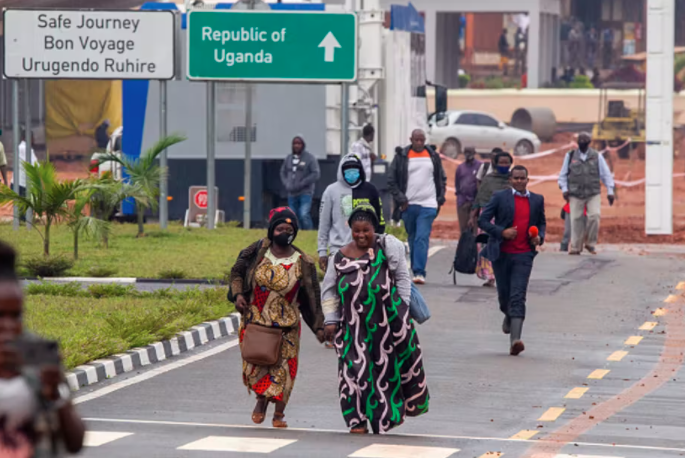
Rwanda has fully re-opened the Gatatuna-Katuna border with Uganda, ending a three-year impasse. Cyril Ndegeya/Anadolu Agency

Audio By Vocalize
Rwanda has now fully reopened the Gatuna border with Uganda, ending a three-year impasse on the Northern Corridor, one of East Africa’s key transport arteries that funnels goods from the Indian Ocean seaport of Mombasa to Uganda, Rwanda, Burundi and Democratic Republic of Congo. Rwanda abruptly closed the border in February 2019 after it accused Uganda of abducting its citizens and supporting rebels seeking to topple President Paul Kagame.
What’s
the brief history of Uganda-Rwanda relations?
The
presidents of Uganda and Rwanda, Yoweri Museveni and Paul Kagame, were close
allies during the civil wars of Uganda (1981 to 1986) and Rwanda (1990 to 1994). They were also on the same side in the first (Democratic
Republic of Congo) war that removed Mobutu Sese Seko, between 1996 and 1997.
But
the two leaders fell out during the second Congo war
(between 1998 and 2003). Uganda and Rwanda clashed over the exploitation of
Congolese resources and the management of the rebellion against Laurent Kabila, whose forces had deposed Mobutu
Sese Seko. Rwandan and Ugandan armies fought each other in the Democratic
Republic of Congo in 1999 and 2000.
A
semblance of peace was restored between the two leaders in the early 2000s but
trust never returned. A new round of hostile verbal exchanges erupted
in 2017, and they escalated considerably in early 2019. This time, Rwanda
accused Uganda of harbouring armed dissidents and victimising Rwandans.
A
2018 UN report found Uganda had provided support
to Rwandan dissidents. Uganda too claimed that Rwanda was engaging in acts of
espionage and attempts to destabilise Uganda.
Other
issues included air traffic rights, the construction of a standard gauge
railway, and energy projects.
In
March 2019, Rwanda’s closure of the Gatuna/Katuna border crossing sealed the
rupture. Influential opinion makers close to both countries’ regimes didn’t
rule out the possibility of direct war.
Later
that year, the two leaders signed an agreement brokered by the Angolan and
Congolese presidents. The Luanda Memorandum of Understanding called
on both countries to desist from “acts such as the financing, training and
infiltration of destabilising forces”. It also called for respect of rights, freeing of
each other’s nationals and resumption of cross-border activities.
But
there was very little progress. The two leaders continued to trade accusations.
It seemed unlikely that, as long as Museveni and Kagame were at the helm,
bilateral relations would ever improve.
How
important is the Gatuna border crossing?
Gatuna
is one of the most important borders in East Africa as it connects Kenya’s
Mombasa port to various cities in the region. On average, 2,518 trucks pass through the Gatuna
border every month (84 trucks per day) into Uganda, Rwanda, Burundi and eastern
Democratic Republic of Congo. The East African Community has since upgraded it into a one-stop border post.
Its
closure had choked off commerce in East Africa. Its
re-opening is set to spark social and economic activities and also
benefit the informal cross-border traders.
What’s
fuelling the border conflict now?
The
border stalemate is about two presidents who know each other well, and their
mutual dislike and distrust is deeply ingrained.
On
22 January, Kagame met Lt. General Muhoozi Kainerugaba, Museveni’s senior
presidential advisor on special operations and commander of the Uganda People
Defence Forces. Kainerugaba has no official function in Uganda’s foreign
affairs apparatus, but he is Museveni’s son.
Three
days after the visit, in a gesture of goodwill, Museveni replaced intelligence
chief Major General Abel Kandiho, who is considered in Kigali as “anti-Rwanda”.
Three days later, Rwanda announced a partial reopening of the Gatuna/Katuna
border crossing.
But
on 31 January, Rwandan deputy government spokesman Alain Mukuralinda told
Rwanda TV that Uganda had not yet addressed all of Kigali’s grievances.
Has
the East African region seen the last of this conflict?
The
border issue is not a settled matter. The initial border reopening, which took
place on 1 February, was made subject to COVID-19 protocols. Even with full
reopening on 7 March, the situation at the border remains confused over the
conflicting handling of the COVID-19 protocols by national agencies.
Ominously,
on 8 February, Kagame told Parliament that Rwanda was ready to respond to any
external threat. He said: “We wish everybody in the
region peace, but anyone who wishes us war, we give it to him”.
Kagame
referred to rebel forces in the DRC, but the Ugandan army has been deployed
there cooperating with the Congolese army against the Allied Democratic Forces,
and a Rwandan intervention would carry the risk of a new confrontation with the
Ugandan troops.
The
next day, Museveni appointed Kandiho as Chief of the Joint
Staff of the Uganda Police Force.
How
can this dispute be resolved?
The
mutual aversion between Museveni and Kagame is so deep that it has become hard
to expect a long lasting solution to a conflict that has poisoned relations for
over 20 years.
After
the 2015 constitutional amendment Kagame can potentially stay in power until
2034. Although Museveni is not bound by term limits, he will be 82 years old at
the time of the 2026 presidential election. Kainerugaba is often mooted as the anointed successor and he appears to want
to make peace with Rwanda.
In
the absence of initiatives by regional leaders, change will have to come from
inside Rwanda and Uganda.
Leave a Comment