
Sakaja secures Ksh.80B additional funding in deal signed with President Ruto

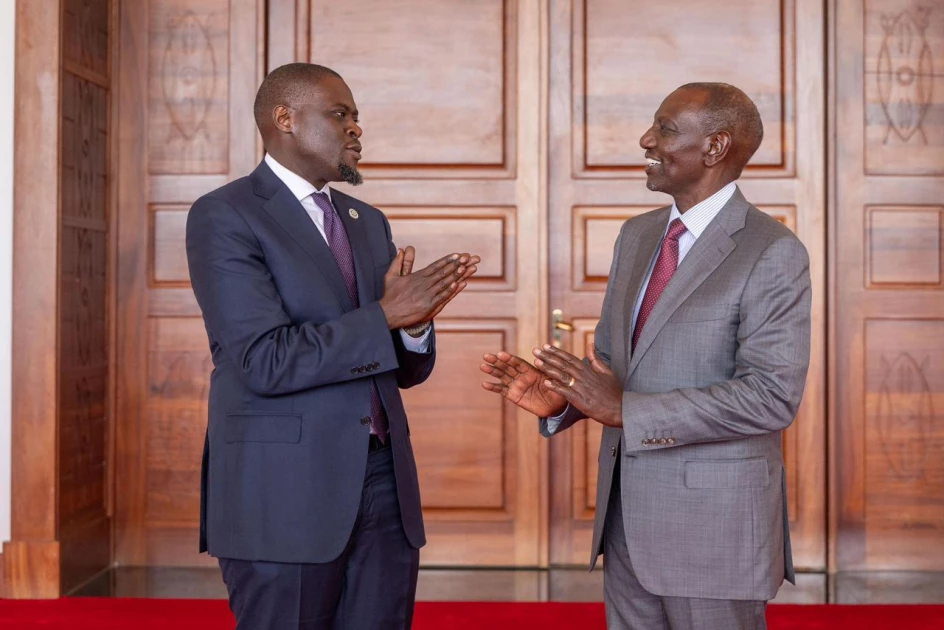
President William Ruto and Governor Johnson Sakaja at State House, Nairobi.

Audio By Vocalize
The agreement, concluded alongside President William Ruto, establishes a framework for joint planning, financing, and implementation of development programmes between the two levels of government. It is anchored in Section 6 of the Urban Areas and Cities Act, which permits intergovernmental cooperation in the management and development of urban areas, including the capital city.
Under the arrangement, the National and County Governments will jointly prioritise projects in infrastructure improvement, waste management, urban mobility, and the strengthening of essential public services. The framework also provides a legal structure for shared financing of large-scale urban investments that the county has struggled to fund independently.
Prime Cabinet Secretary Musalia Mudavadi signed the agreement on behalf of the National Government, while Sakaja signed for the county administration.
Speaking during the signing, President Ruto dismissed suggestions that the deal represents a transfer of county functions to the national level, stating that the arrangement is intended to support the capital rather than alter devolved responsibilities.
“What we are formalizing today is not a transfer of functions. Let me repeat there is no transfer of functions taking place. For the avoidance of doubt, I have no interest in running the city; my hands are already full. The Governor and his team must continue to run the city. However, as President, I have an obligation to support and assist the capital city,” the President said.
Sakaja similarly emphasised that the framework is designed to expand Nairobi’s fiscal capacity and improve project delivery through structured collaboration, not to reverse devolution. He noted that the capital’s financing needs have long exceeded county resources, slowing implementation of critical infrastructure and services.
“This is not an NMS takeover. That was a misadventure that left behind Sh16 billion in debt. This is not a transfer of function. This is a cooperation that recognizes Nairobi as the nation’s capital. The current financing of the capital is not sufficient, and this partnership is a way to secure more funds, achieve more projects, and demonstrate that, 13 years later, the President has heard us,” Sakaja said.
The partnership introduces joint oversight through a Steering Committee and an Implementation Committee, which will coordinate planning, budgeting, and monitoring of projects undertaken under the agreement. All initiatives are expected to follow existing national and county budget processes and public finance regulations.
Priority investments identified under the framework include rehabilitation and expansion of road networks, development of non-motorised transport infrastructure, modernisation of solid waste management systems, upgrading of markets, improvements in water and sanitation services, and enhancement of street lighting and public safety.
Government officials say the agreement is intended to address pressures created by rapid urbanisation, aging infrastructure, and rising service delivery demands in the capital, whose role as Kenya’s administrative, commercial, and diplomatic hub places unique strain on county resources.
The cooperation framework marks one of the most significant capital-focused funding arrangements since the introduction of devolution in 2013, and is expected to shape how large-scale urban projects in Nairobi are financed and coordinated going forward.
Join the Discussion
Share your perspective with the Citizen Digital community.
No comments yet
This discussion is waiting for your voice. Be the first to share your thoughts!