
Samsung Electronics union in South Korea stages first walkout
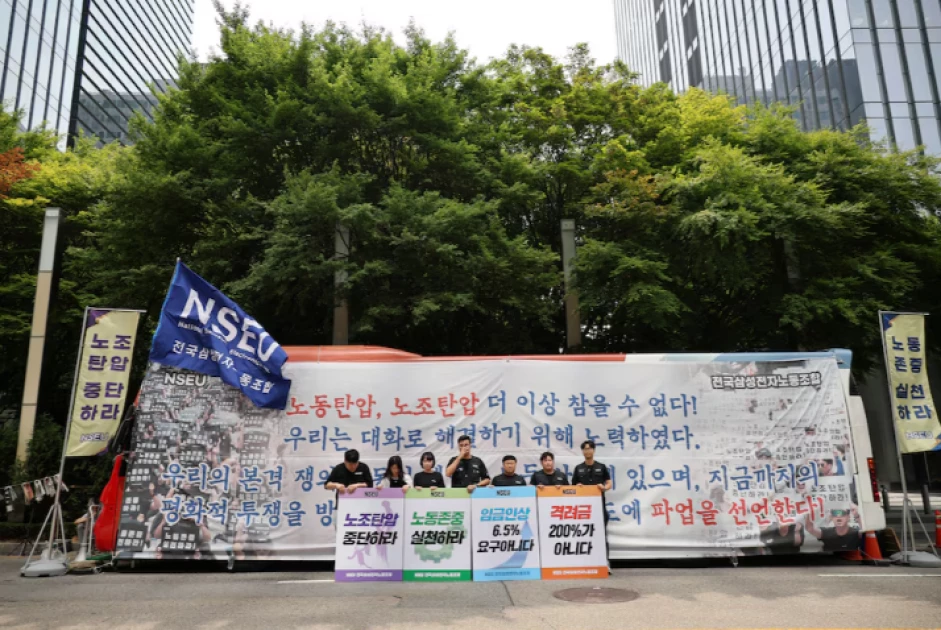
Members of National Samsung Electronics Union hold placards bearing their messages against the company in front of the company building while staging a walkout protest, in Seoul, South Korea, June 7, 2024. REUTERS/Kim Hong-Ji

Audio By Vocalize
A
workers' union at Samsung Electronics staged its first walkout on Friday,
signalling more assertiveness among employees just as South Korea's most
powerful conglomerate races to catch up in chips used in artificial
intelligence.
The National Samsung Electronics Union
(NSEU), whose roughly 28,000 members make up over a fifth of the firm's
workforce, said it would stop work for a day to demand better pay.
The
walkout is unlikely to immediately impact semiconductor production or shipments
but will add pressure on Samsung Electronics as it chases AI and narrows a gap
in contract chip manufacturing with Taiwan's TSMC analysts said.
"The
purpose of today's strike action is to have meaningful conversation with
management," NSEU official Lee Hyun-kuk told Reuters. He said the union
was preparing further action on Friday, without providing details.
Samsung
Electronics said there was no impact on production or business activity. The
strike fell a day after a public holiday and there were fewer employees on
annual leave than on the equivalent day last year, the firm said.
The
union did not disclose how many members participated in the strike through
annual leave.
"We
have sincerely engaged with the union and will continue talks with them,"
said a company official.
Samsung
Electronics' share price closed down 0.1%, versus a 1.2% rise in the benchmark
KOSPI.
The
walkout is unlikely to impact DRAM or NAND flash memory production or lead to
shipment shortages as manufacturing is highly automated, said market researcher
TrendForce.
Moreover,
the walkout appears to involve more workers from the firm's Seoul headquarters
than in production and was planned for a single day, TrendForce said.
The
strike follows other worker protests in recent weeks
outside offices in Seoul as well as outside a chip production site in Hwaseong,
south of the capital.
They
started after Samsung Electronics decided to increase wages this year by 5.1%.
The NSEU, the biggest of five unions at the firm, want further commitments such
as improvements to the performance-based bonus system and an extra day of
annual leave.
Last
week, a coalition of five unions at Samsung affiliates including another
smaller Samsung Electronics union called on the NSEU to pursue negotiation
rather than confrontation, indicating they would not join the strike.
Samsung
Electronics' run of success is being challenged in some areas, including in
some cutting-edge chips. It recently replaced the head of its semiconductor
unit to navigate what it called a "crisis" affecting the industry.
Any
larger scale or protracted industrial action would be a headache for the
world's biggest memory chip maker as it scrambles to catch up with rivals
making high bandwidth memory (HBM) chips used in AI applications.
SK
Hynix and Micron are already supplying HBM chips to Nvidia which
commands about 80% of the global graphic processing unit (GPU) market for AI
applications.
Nvidia
said this week that the three chip makers will provide HBM chips to the U.S.
firm, though SK Hynix remains its primary supplier.
Last
month, Reuters reported that
Samsung's HBM chips were yet to pass Nvidia's tests for use, which analysts see
as a crucial milestone both reputationally and in terms of profit momentum.
While
struggling in parts of its chip business, Samsung dethroned Apple to become the
top smartphone seller globally in the first quarter, accounting for 20% of
shipments, according to research firm Counterpoint.
Union
membership increased rapidly after Samsung in 2020 pledged to end to its
practice of discouraging the growth of organised labour.
Union
officials said, among younger employees, there is growing perception that
unions can help create a fairer workplace, whereas older generations felt
unions could disrupt productivity.
Overall,
South Korea's union membership rate has hovered around 10% since 2004, labour
ministry data showed.
Join the Discussion
Share your perspective with the Citizen Digital community.
No comments yet
This discussion is waiting for your voice. Be the first to share your thoughts!