
SHA enrolment hits 29.4 million as Treasury urged to release Ksh.2B for free maternal care
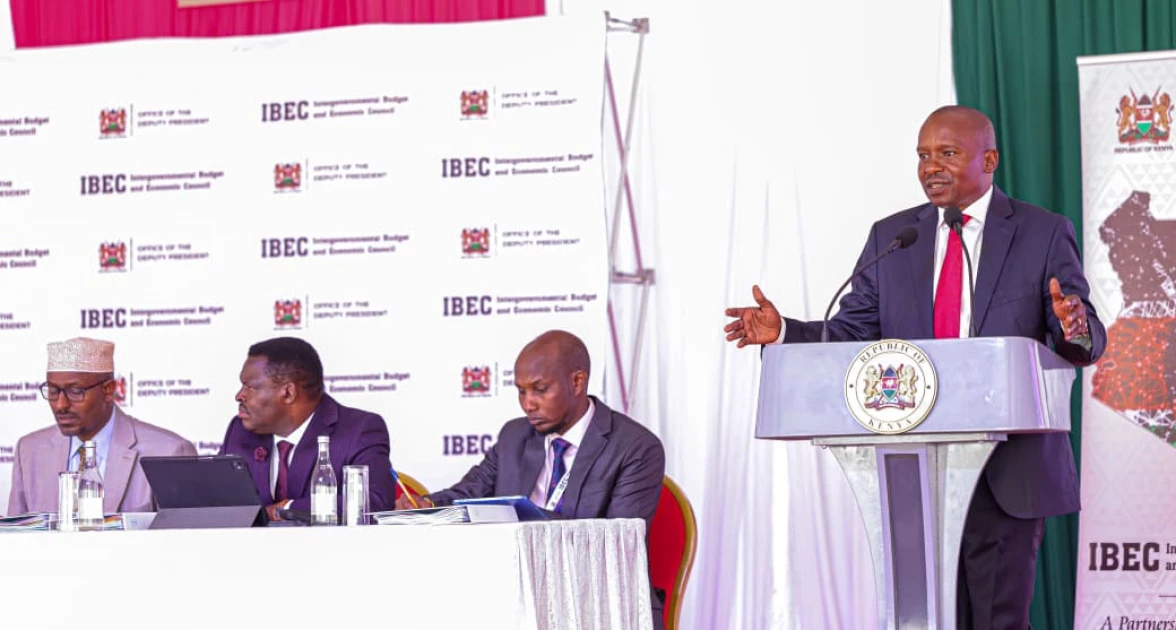
Deputy President Kithure Kindiki speaks during the 29th Ordinary Session of the Intergovernmental Budget and Economic Council (IBEC), Karen, Nairobi on Friday, February 13, 2026. PHOTO | DPCS

Audio By Vocalize
The DP said the focus now is on making it perfect to ensure access to healthcare services is seamless and without hitches.
“The SHA programme has reached a level of irreversibility. We have to perfect it. With all these millions of Kenyans on board, we cannot imagine this programme not working. It will amount to letting the whole country down on such an important issue,” he reiterated.
The Deputy President spoke on Friday when he chaired the 29th Ordinary Session of the Intergovernmental Budget and Economic Council (IBEC) at the Official Residence in Karen, Nairobi.
“Taifa Care is becoming universal because one of the aspects of universality is in the numbers. From 7 million NHIF beneficiaries to now 29.4 million Kenyans under SHA. We are keeping on towards 40 million and above, then we can truly say we have a Universal Healthcare programme,” DP said.
Prof. Kindiki asked all the stakeholders to work closely to smoothen delivery of healthcare services, promising government support to push for continued enrollment and acquisition of medicine and medical equipment.
“IBEC encourages the Ministry of Health, the Council of Governors and all stakeholders to keep the engagement and streamline all the outstanding issues,” DP noted.
A latest report by the Ministry of Health indicated that over 142 billion shillings has so far been collected in SHA premiums, and 102.3 billion shillings disbursed to health facilities in payment for medical services rendered to patients.
Health Cabinet Secretary Aden Duale informed the meeting that 1, 287 health facilities presented inaccurate details and their claims are pending.
“We urge the 1, 287 health facilities to urgently provide accurate bank details to clear pending payments by the end of the month. We cannot pay them because of inaccurate bank details,” the CS said.
IBEC resolved that the County Governments hasten the signing up for the installation of medical equipment under the National Equipment Service Programme (NESP). They were also urged to facilitate the signing of NESP addendums for the funding of equipment maintenance.
Further, the Council resolved that the National Treasury should immediately release 2 billion shillings to kick-start free maternal services in Level 2 and 3 health facilities across the country.
The devolved units were also challenged to emulate Murang’a, Migori, Trans Nzoia and Mombasa that pay SHA premiums for vulnerable people and indigents in their counties.
The Ministry of Lands was also directed to work with the Council of Governors and other relevant government agencies to support construction of affordable houses through fast-tracking approval of plans and transfer of title deeds.
Lands and Housing Cabinet Secretary Alice Wahome called for better cooperation with the county governments saying it will ensure faster completion of housing projects being implemented collaboratively.
“Titling is a critical enabler of affordable housing. It ensures legal certainty and investor confidence. We know that over 50 percent of the houses in the counties will be owned by residents. Let’s work together. The collaboration has been better and stronger and we are seeing better results,” said CS Wahome.
At the same time, the Deputy President assured governors from drought-affected counties that the government is keen on mitigating its impact through supply of food and livestock feed.
“We are doing everything possible to make sure we don’t lose human life and livestock. The National Treasury has been fully supportive. In November, it allocated 3.5 billion, December 2.5 billion, January, 3.5 billion and February 4 billion shillings to support affected families,” DP noted.
Present at the IBEC meeting were respective Cabinet Secretaries, Principal Secretaries, Governors, Chairpersons of Commissions and Independent Offices and other stakeholders.
Join the Discussion
Share your perspective with the Citizen Digital community.
No comments yet
This discussion is waiting for your voice. Be the first to share your thoughts!