

Somalia rolls out US-backed biometric border system to tackle human trafficking
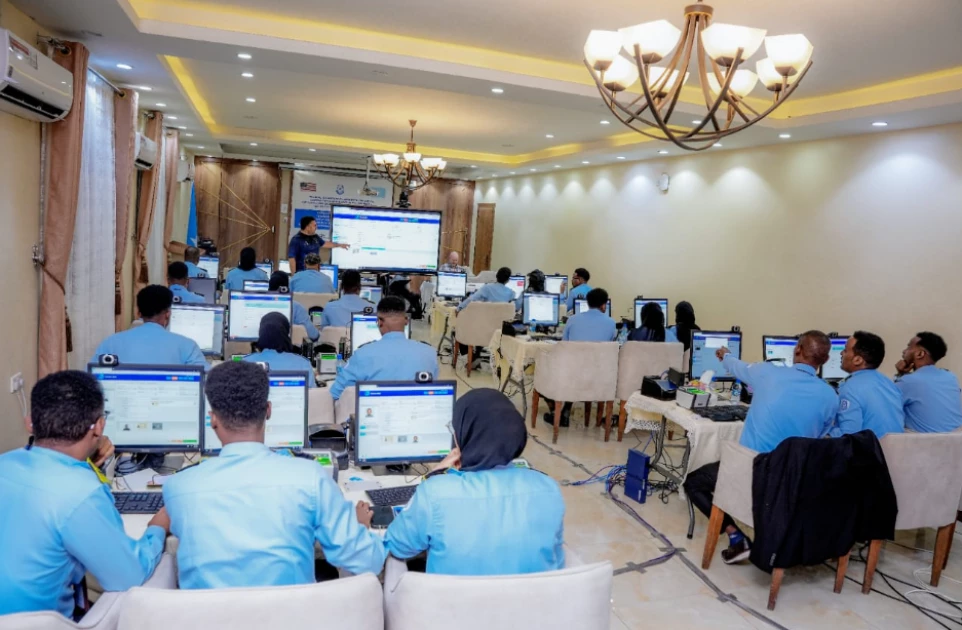
Somalia's immigration team is appraised on use of the new screening system that aims to detect identity fraud and track suspicious travel patters. PHOTO | COURTESY

Audio By Vocalize
Somalia has launched a new U.S.-backed biometric border control system aimed at curbing human trafficking, preventing irregular migration, and enhancing international travel security.
The system, known as Personal Identification Secure Comparison
and Evaluation System (PISCES) screening platform will be fully operational at
Somalia’s major ports of entry in an initiative that is part of a broader
package of reforms supported by the U.S. government to strengthen Somalia’s
border security and migration management capabilities.
The announcement came at the close of a four-day technical
training program in Mogadishu, led by U.S. experts and supported by the U.S.
Embassy.
The training equipped Somali immigration officers with skills
to operate PISCES, manage real-time traveler data, and flag identity fraud,
watchlist matches, and suspicious movement patterns.
“This is not just about technology—it’s about protecting our
citizens and rebuilding public trust,” said Mustafa Duhulow,
Director General of Somalia’s Immigration and Citizenship Agency (ICA).
“Thanks to the support of the U.S. Government, Somalia is now
using one of the world’s most advanced border systems to detect threats,
prevent trafficking, and manage migration with dignity and security.”
The PISCES system allows Somali authorities to screen
travelers against global watchlists, verify documents, and track cross-border
movements in real time.
Officials say it significantly enhances Somalia’s ability to
intercept terror suspects, identify traffickers, and dismantle smuggling networks
operating in the Horn of Africa.
Further, Somalia has processed a third-generation
polycarbonate e-passport embedded with a biometric chip and advanced
anti-forgery features.
In addition, a new e-Visa platform now enables foreign
nationals to apply online for visas, ensuring pre-screened and secure entry
into the country.
“These upgrades mark Somalia’s entry into the global identity
and mobility framework,” said DG Mustafe. “They benefit not only our citizens
but also our international partners who rely on credible, secure systems.”
The deployment of PISCES marks an expansion of the
longstanding U.S.–Somalia partnership, which has included counter-terrorism,
intelligence, and military cooperation. The new civilian-focused collaboration
is led by the U.S. State Department and implemented in partnership with ICA
Somalia.
“Somalia joins the global community in embracing one of the
most effective border security mechanisms available today,” said a U.S. Embassy
official in Mogadishu.
“These systems save lives, stop crimes, and build resilient
institutions. This is what meaningful partnership looks like.”
Strategically located at the crossroads of Africa and the
Middle East, Somalia has long been vulnerable to exploitation by traffickers
and militant networks. The new systems aim to close those vulnerabilities by
enabling a real-time, integrated response to cross-border threats.
The reforms are also part of Somalia’s broader national agenda
to digitize public services, professionalize border institutions, and align
with international standards on migration and human rights.
ICA Somalia is already working closely with INTERPOL, IOM, and
UNODC, and recently signed an MoU to integrate Interpol’s systems into national
immigration controls.
Leave a Comment