

South Africa's Ramaphosa asked to mediate Russia-Ukraine talks
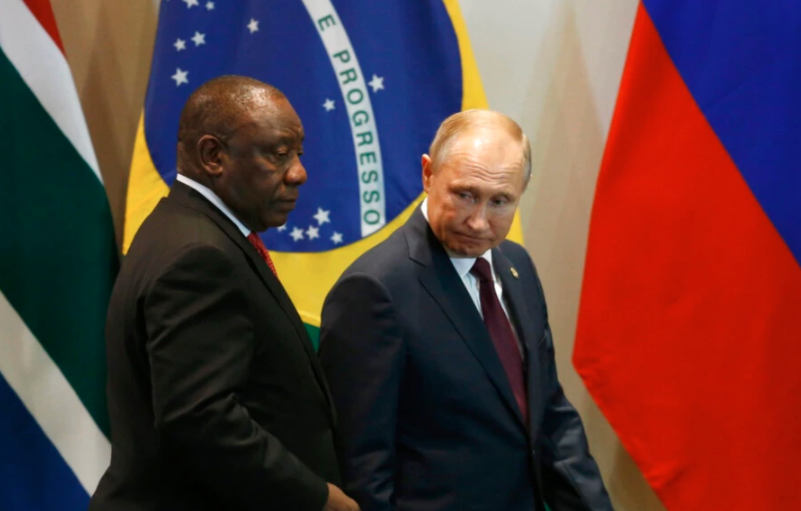
FILE - South Africa's President Cyril Ramaphosa, left, and Russia's President Vladimir Putin arrive for the Leaders Dialogue with BRICS Business Council and the New Development Bank, at the Itamaraty Palace in Brasilia, Brazil, Nov. 14, 2019.

Audio By Vocalize
South Africa President Cyril Ramaphosa says
he has been asked to help mediate peace between Russia and Ukraine, after
having spoken to his counterpart Vladimir Putin. But some analysts are
questioning whether South Africa's ties to Russia could impact its neutrality.
The prospective role of mediator comes after
the country abstained from a United Nations vote to reprimand Russia over its
invasion of neighboring Ukraine.
Bheki Mngomezulu, a professor of political
science at the University of the Western Cape, said the request shouldn't come
as a surprise.
"It's a very tricky situation, because
South Africa, by the way, has ties with both countries," Mngomezulu said.
"But in principle, I think that South Africa did the right thing on this
Russian-Ukrainian issue by not siding with either side. South Africa is being
looked at as a country that does not believe the use of force, but believes in
negotiation."
The presidency did not specify whether it was
Russia or another party that made the request. This lack of clarity is just one
instance contributing to questions about South Africa's neutrality.
The country has also flip-flopped on its
position on the conflict.
South Africa's international relations
department issued a statement last month calling on Russia to withdraw its
forces from Ukraine. Since then, the call has been removed from official
statements, and Ramaphosa has taken a softer stance.
"Putin was very happy that he had what
Putin regards as an even-handed, balanced approach to the situation," said
Piers Pigou, a senior consultant on Southern Africa for the International Crisis
Group. "That's certainly not the perspective from many other people. It's
inexplicable for some people why South Africa cannot take a firmer stance on
calling for cease-fire."
South Africa does have a reputation for
conflict mediation.
That stems from the peaceful transition out
of its own racist apartheid regime to supporting other African nations in
conflict, like Sudan.
But the ruling African National Congress
party that led those negotiations also has decades-old ties to Russia.
"The ANC historical ties to the old
Soviet Union and currently, Russia, may pose questions for the Ukrainians as to
whether South African leader, like Ramaphosa, could be regarded as an honest
broker," said Charles Nupen, an attorney and executive chairman of the
consulting firm StratAlign. "But I've got no doubt that if he were
acceptable to all parties, he's certainly got the skillset, and the right
approach and experience to lead a mediation delegation."
However, Pigou is not as certain of South
Africa's current expertise.
"I think that there is a tendency to
kind of try and live off the legacy of a post-apartheid South Africa that was
birthed in negotiations. The question, though, remains whether South Africa
really has the competencies and capacities to deliver on mediation," Pigou
said.
Regardless of who mediates negotiations,
Nupen said there remain other questions on how it will play out.
"Under whose auspices would this
mediation take place? Where would it be held? How would the table be set? And,
you know, what would the mediation agenda be?" he asked.
Nupen said he imagines the first priority
would be to get a cease-fire in place.
Leave a Comment