

South Korea court paves way for President Yoon's release from jail
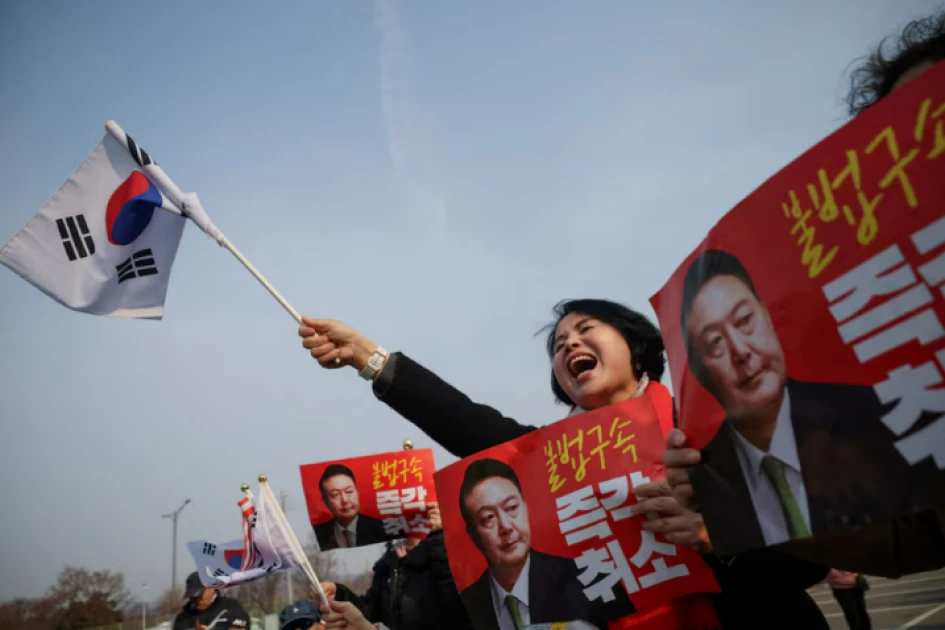
A supporter of South Korean impeached President Yoon Suk Yeol cheers after the court decided to release him, in front of the Seoul detention center in Uiwang, South Korea, March 7, 2025. REUTERS/Kim Hong-ji

Audio By Vocalize
A South Korean court cancelled impeached President Yoon Suk
Yeol's arrest warrant on Friday, potentially paving the way for his release
from jail while he faces trial on insurrection charges over a brief imposition
of martial law.
The Seoul Central District Court said in a statement that
its ruling was based on the timing of the indictment that came after the
initial detention period had expired, and noted "questions about the
legality" of the investigation process that involved two separate
agencies.
The ruling did not dismiss the criminal charges that led to
Yoon's arrest on January 15, and the case is separate from his impeachment,
which is still pending before the Constitutional Court.
Both were triggered by his December 3 martial law
declaration that also led to the impeachment of the prime minister, who had
taken over as acting president.
South Korea's Finance Minister Choi Sang-mok is now acting
head of state, and has sought to calm economic markets and reassure
international partners amid chaos in government leadership.
Yoon's lawyers and his presidential office welcomed the
district court decision, saying it showed the case against Yoon had been
pursued for political purposes with no legal justification.
"The court's decision to cancel the arrest showed this
country's rule of law is still alive," Yoon's lawyers said in a statement.
Yoon's lawyers called for his immediate release, though
conceded he may not be immediately freed because prosecutors could appeal. The
prosecutors' office did not immediately comment on the ruling.
Protesters, both in support of and against Yoon, soon
gathered in Seoul following the court decision.
"It will move the hearts of the public. Our president
has suffered so much," Lee Yoon-nam, a 44-year-old pro-Yoon protester,
told Reuters.
Yoo Seong-min, a 31-year-old anti-Yoon protester, said he
came out to protest because "anger shot through" his head.
Yoon's defence team had argued that a warrant issued on
January 19 that extended Yoon's detention was invalid because the request filed
by prosecutors was procedurally flawed.
It has also claimed that the Corruption Investigation Office
for High-ranking Officials, which conducted the first stage of the criminal
investigation against Yoon, had no legal authority to do so on insurrection
charges.
Legal experts said that, while Friday's decision by the
district court was not a vindication for Yoon, it did raise questions about the
integrity of the indictment and touched on legal issues that do not have a
clear precedent.
If "questions about the legality of the investigation
process" are not cleared up, it may become grounds for a higher court to
overturn any trial court ruling, the Seoul Central District Court said in its
statement.
Arguments ended in the separate impeachment trial last week
and the court was expected to issue a decision in the next few days on whether
to remove Yoon from office permanently or reinstate him.
If Yoon is removed, a new presidential election will be held
within 60 days to elect a new leader.
"This court decision has nothing to do with the
Constitutional Court's impeachment trial of Yoon Suk Yeol," opposition
Democratic Party spokesman Han Min-soo said. "There will be no
impact."
Yoon said his martial law declaration was needed to root out
"anti-state" elements but lifted the decree six hours later after
parliament voted to reject it. He has said he never intended to fully impose
emergency military rule.
Weeks later he was impeached by the opposition-led
parliament on accusations he had violated his constitutional duty by declaring
martial law.
Leave a Comment