

Sudan looks towards truce amid unrelenting bleeding
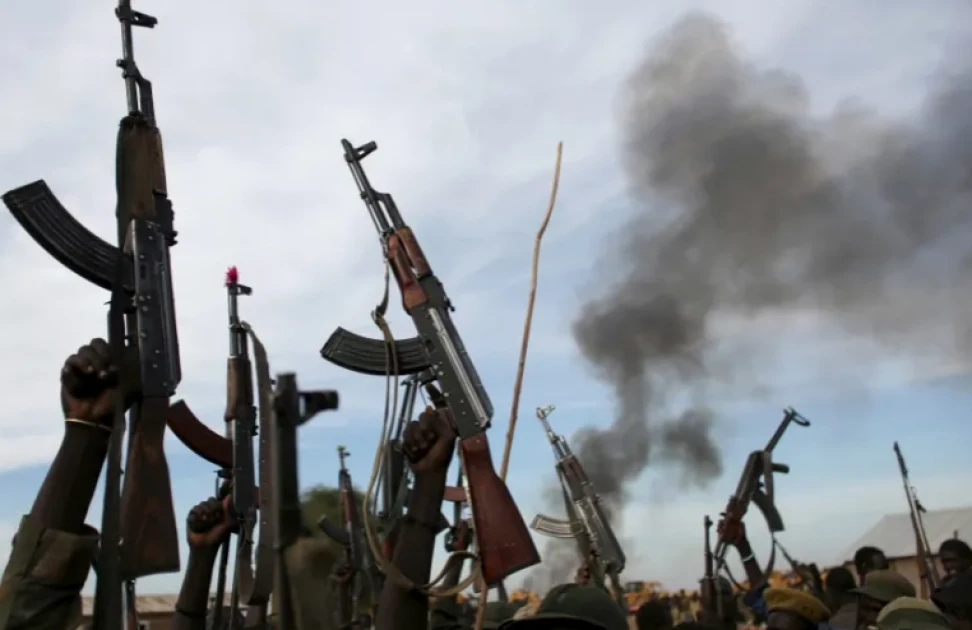
Sudan has been riven by violence since 2013 [File: Goran Tomasevic/Reuters]

Audio By Vocalize
There is neither calm nor psychological stability in Sudan after nearly two years of war. Reports speak daily of civilian deaths and injuries, and of the destruction of vital facilities.
Famine
has gripped several areas, displacement continues unabated, and fear haunts
citizens in their gatherings and daily shopping, amid an alarming humanitarian
deterioration and indiscriminate air raids that do not hesitate to bombard
civilian gatherings.
While
United Nations data indicate that 33.7 million people across Sudan today require humanitarian assistance,
international and UN calls are escalating daily for the declaration of a
humanitarian truce during the war that has continued since mid-April 2023.
In this
context, the administration of U.S. President Donald
Trump is preparing to send the final draft of a proposed UN mechanism to
monitor a humanitarian truce in Sudan to the two parties to the conflict,
according to what the U.S. President’s Special Adviser for Middle East Affairs,
Massad Boulos, revealed.
Boulos
stated, during a session on Sudan at the Munich
Security Conference, that work on preparing a mechanism to monitor a
truce—seen as an entry point to a path that ultimately leads to a political
process—has been ongoing for weeks in coordination with the United Nations.
He
affirmed that President Donald Trump is determined to end the war in Sudan and
put an end to the suffering of Sudanese living through what he described as the
world’s largest humanitarian catastrophe today.
He
noted that the effort comes within the framework of the “international
quartet,” comprising the United States, Saudi Arabia, Egypt,
and the United Arab Emirates.
He
explained that, in his capacity as a U.S. envoy, he maintains equal distance
from both sides and does not favor one party over the other.
A
Necessary Truce
Amid
the deteriorating humanitarian situation, Sudanese activist Al-Shafie Khidir says that “experience shows
that a truce in wars is not an end in itself, but achieves two objectives:
responding to the humanitarian catastrophe and serving as a necessary and
decisive gateway to building a bridge towards a comprehensive and permanent
ceasefire.”
He
added that “with regard to the first objective, since the outbreak of the war
in 2023, the lives of millions of Sudanese have turned into an unbearable hell.
The first and most urgent function of a truce is to make space for saving
lives. Hospitals are operating outside service or have entirely ceased functioning,
and they lack personnel, medicines, and surgical supplies.”
He
continued: “A truce allows the passage of medical relief convoys, the
evacuation of the wounded and sick, and the temporary rehabilitation of health
facilities, at the very least, so they can receive critical cases. A truce is
the only means to prevent a comprehensive food catastrophe that could claim the
lives of millions, particularly in areas affected by fighting.”
He
affirmed that “a truce provides a window of safety enabling international
organizations to reach them and provide psychological and social support and
protection from risks of violence and exploitation. It also allows families
separated by the fighting to be reunited.”
No
Change in Positions
Since
the outbreak of war, more than ten international and humanitarian mediation
efforts have been presented to the parties to the conflict in Sudan, but they
have not achieved the desired results due to Port Sudan’s insistence on a
military resolution.
In this
regard, Africa Intelligence magazine
revealed that the army commander in Port Sudan,
Lieutenant General Abdel Fattah al-Burhan,
has submitted his remarks to U.S. negotiators regarding the peace plan proposed
by the U.S. presidential adviser for African affairs, Massad Boulos, without
agreeing to any concessions or showing readiness for a political settlement
thus far.
It
indicated that al-Burhan responded to the initiative with official remarks
without demonstrating willingness to make concessions or accept any settlement
formula, while the Rapid Support Forces affiliated with the government of the
Sudan Founding Alliance “Tasees,” led by Mohamed
Hamdan Dagalo (Hemedti), insist on removing Islamists and figures
associated with the former regime of President Omar
al-Bashir from the army and the regular military and security
institutions.
Other
Proposals
In
another context, Kamel Idris Al-Tayeb, prime minister in Port Sudan, had put
forward a proposal for a humanitarian truce in Sudan, but that initiative did
not receive a welcome among Sudanese circles.
Commenting
on it, Sudanese activist Al-Fadil Saeed Sanhouri
said that without delving “into the texts of this initiative spoken of by Kamel
Idris, prime minister of the de facto government in Port Sudan, we find that it
does not go beyond a draft that can be called an initiative.
In
truth, it is not of his own making but rather an initiative of the Islamic
Movement regime that has returned to power anew following the coup of Abdel
Fattah al-Burhan against the transitional government of the glorious December
Revolution led by Dr. Abdalla Hamdok and
the war of April 15, 2023.”
He
indicated that “the initiative is a draft to legitimize the retention of the
other face of the National Congress Party and the Islamists and the military of
the Islamic Movement, entrusted to Kamel Idris to market it. They seek to
promote it despite its being stale and unsellable merchandise, deceiving the
Sudanese people and the international community into believing that they seek
to achieve peace in Sudan and end the war they ignited deliberately and with
prior intent and planning.” He continued: “Kamel Idris presents the vision of
the Islamic Movement and its military cadres on how to buy time and dilute
positions for the government of al-Burhan in the face of regional and
international efforts and proposed initiatives. All that occupies the mind of
the prime minister of the de facto government in Port Sudan now is to continue
spreading falsehoods and flimsy justifications to ensure the longest possible
continuation and retention of his position.”
Negotiations
for Maneuvering
Meanwhile,
Sudanese observers speak of maneuvers carried out by the Sudanese army during
its participation in negotiations, while simultaneously focusing on military
mobilization to continue escalation.
In this
context, a journalistic investigation revealed a similar case during the Jeddah
negotiations. At a time when the Kingdom was mediating peace, 17 tons of toxic
gas were transported through its territory, with the vessel unloading its cargo
at Port Sudan on August 9, 2024.
The
investigation described the operation as a “diplomatic betrayal” of Saudi Arabia through the exploitation of its
ports to smuggle materials used for military purposes without the knowledge of
the authorities.
It
explained that the case began when the director of the importing company,
Colonel Anas Younes—an active-duty armed forces officer appearing in civilian
attire to sign contracts and in military uniform on official assignments—used
the name “Engineering Ports Company” as a civilian front, claiming
specialization in water treatment to legally justify the import of “chlorine”
before customs.
According
to the investigation, the material was shipped in 17 massive cylinders
(Tonners), containers designated for military or heavy industrial use rather
than civilian cleaning purposes, noting that such cylinders are the preferred
military option for conversion into improvised bombs or chemical explosive
barrels.
The
operation was carried out in the summer of 2024 beyond international scrutiny,
in parallel with peace negotiations at the Jeddah platform. Containers were
transported from India to the Jeddah Islamic Port, where they remained for 18
days to arrange their transfer as transit goods.
The
Sudanese army exploited facilities granted to Sudanese goods in Saudi Arabia to
pass the shipment without thorough inspection of its military contents. On
August 8, 2024, the cargo was loaded onto the vessel “ALAHMED,” belonging to
the Baaboud company, to ensure reliable commercial cover, following the route
India–Jeddah–Sudan, at a time when international observers did not imagine that
the Sudanese army would dare to use the ports of the intermediary state, Saudi
Arabia, to smuggle chemical weapons.
Upon
the arrival of the vessel Alahmed in Port Sudan, “the deception operation was
crowned with success, and the weapon reached the army’s hands, leaving Saudi
Arabia in the position of a state whose infrastructure was exploited to support
an illegitimate war effort without its knowledge.”
Leave a Comment