
Sweden and Denmark consider ban on Quran-burning protests as security fears rise
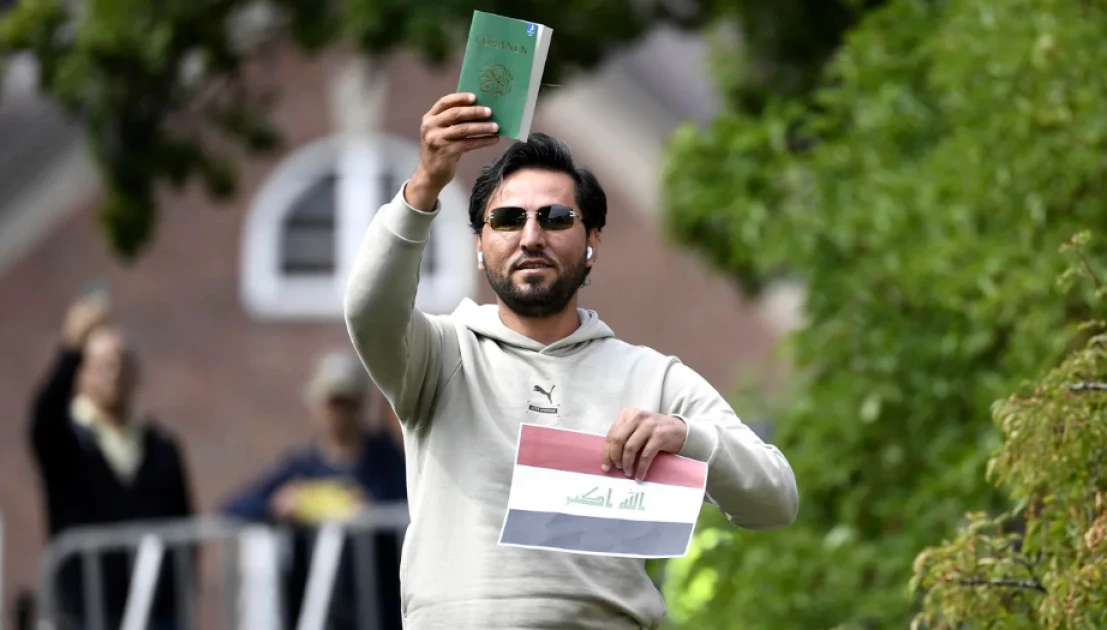
Salwan Momika burned a copy of the Quran outside the Iraqi embassy in Stockholm, Sweden, in June 2023. PHOTO/COURTESY: CNN

Audio By Vocalize
A spate of Quran-burning
protests in Sweden and Denmark has caused angry demonstrations in
Muslim-majority countries, heightened security fears at home and left both
Scandinavian nations questioning whether they need to review their liberal laws
on freedom of speech.
Sweden sparked an international spat after allowing a protester to burn a copy of the Quran outside a mosque in Stockholm in June.
The incident coincided with the Muslim holiday of Eid-al-Adha, one
of the most significant events in the Islamic calendar – an incident that
angered Turkey and jeopardized Sweden’s bid to join NATO.
Several Qurans have also been
burned outside foreign embassies in the Danish capital Copenhagen over recent
weeks.
While some of the protests
have been staged by individuals, a number have been carried out by far-right
groups that are growing in influence in the two countries.
The Organization of Islamic
Cooperation (OIC), which comprises 57 Muslim states, held an emergency meeting
on Monday, where it “condemned” Sweden and Denmark for allowing the protests to
continue “under the garb of freedom of expression.”
The right to freedom of
expression has been enshrined in the Swedish and Danish constitutions for
centuries.
But both countries signaled
Sunday that they are exploring legal ways to prevent such protests, amid security
and geopolitical concerns.
Swedish Prime Minister Ulf
Kristersson said he was in “close dialogue” with his Danish counterpart over
the weekend and that the two nations “share the same analysis: The situation is
dangerous and measures are needed to strengthen our resilience.”
As a result of the protests,
the Danish government said that Denmark “is being viewed as a country that
facilitates insult and denigration of the cultures, religions, and traditions
of other countries.”
In recent weeks, 15
governments have issued condemnations of Denmark.
Sweden was also condemned
after allowing Salwan Momika, an Iraqi Christian immigrant, to burn a copy of
the Quran in Stockholm. Momika has staged several such protests in recent
months.
The day after that protest,
demonstrators broke into the Swedish embassy in Baghdad, demanding the
expulsion of the Swedish ambassador to Iraq.
Demonstrators had previously
clashed with security forces outside the embassy in January for a separate
incident of Quran burning in Stockholm.
Sweden and Denmark are among the most liberal, secular countries in the world.
Freedom of speech is
enshrined in their constitutions and neither nation has blasphemy laws, meaning
it is not illegal to insult religion or desecrate religious texts like the
Quran.
“Sweden’s protection, under
the Swedish constitution, for freedom of expression, is the strongest
protection in the world – even more so than the first amendment in the United
States,” Marten Schutlz, a law professor at Stockholm University, told CNN.
“Freedom of speech is almost
always the first priority in all conflicts of interests or values.”
In order for a protest to go
ahead, Swedes must apply for a permit from the police under the Public Order
Act.
The police can only refuse a
permit on safety grounds.
When the Swedish police
authority attempted to prevent Momika from staging his protest by denying him a
permit in February, its decision was overturned by Sweden’s Court of Appeal.
“The police are by law only
allowed to say no in case of them not being able to guarantee safety at the
demonstration itself. They can’t take into account the wider political
perspective,” Sofie Blomback, a political scientist at Mid Sweden University,
told CNN.
While freedom of speech has
long been a constitutional right in Sweden and Denmark, the scrapping of
blasphemy laws was a more recent development.
Sweden abolished them in the
1970s, while Denmark ditched such laws in 2017, after they had been on the
statute books since the 17th century.
“Religion should not dictate
what is allowed and what is forbidden to say publicly. It gives religion a
totally unfair priority in society,” said Bruno Jerup, a member of Denmark’s
Parliament, at the time.
Under existing laws, neither
government is able to legally ban the protests. Instead, both are simply trying
to discourage them.
Blomback described the Swedish
government’s stance on the issue as “it’s legal, but we don’t like it.”
In a statement, the Danish
government said it “has clearly distanced itself from and condemned the
burnings of the holy Quran.
The burnings are deeply
offensive and reckless acts committed by few individuals. These few individuals
do not represent the values the Danish society is built on.”
But, over the weekend, both
countries signaled that they are exploring legal mechanisms to limit the
demonstrations.
“We will find a legal tool
that allows us to prevent the Koran burnings in front of foreign embassies,”
Danish Foreign Minister Lars Lokke Rasmussen said.
Sweden’s Kristersson also
announced that his government has “already started analyzing the legal
situation – including the Public Order Act – with the purpose of exploring the
scope for measures that would strengthen our national security.”
Both countries have faced
crises surrounding freedom of speech before. In 2005, the Danish newspaper
Morgenavisen Jyllands-Posten published caricatures of the Prophet Mohammed
wearing a turban made out of a bomb, sparking a wave of violence.
Swedish cartoonist Lars Vilks
was also the object of an attempted attack after publishing similar cartoons of
Mohammed in 2007.
But neither country tightened
their free speech laws in response to these attacks.
The diplomatic row comes at a
precarious moment – for Sweden especially.
“We are currently in the most
serious security situation since the Second World War, and as for Sweden, we
are aware that states and state-like actors are actively exploiting the
situation,” Kristersson said in a statement posted Sunday.
Sweden formally applied for
NATO membership last year, in response to Russia’s invasion of Ukraine.
However, its accession to the
bloc was for months obstructed by Turkey, which objected to, among other
things, what it alleged to be Sweden’s complicity in Quran-burning protests.
Turkey finally gave the
green-light to Sweden’s bid on the eve of NATO’s summit in Vilnius in June,
although Stockholm cannot formally join the alliance before its membership is
ratified by a vote in the Turkish parliament due to be held this fall.
Carl-Oskar Bohlin, Sweden’s
Civil Defense Minister, claimed in a statement last week that
Russian-affiliated actors were attempting to capitalize on the situation.
“Sweden is right now the
target of influence campaigns, supported by states and state-like actors, whose
purpose is to harm Sweden and Swedish interests,” said Bohlin.
“These events are then retold
in an inaccurate way, sometimes with direct calls to hurt our country.”
Bohlin also claimed that
“Russia-backed actors are amplifying incorrect statements such as that the
Swedish state is behind the desecration of holy scriptures.”
“It’s a very sensitive time
for Sweden because we are trying to become members of NATO, so this has really
had an effect on these negotiations,” Schulz told CNN.
Join the Discussion
Share your perspective with the Citizen Digital community.
No comments yet
This discussion is waiting for your voice. Be the first to share your thoughts!