

Tales from the morgue: I suffered nightmares after a body fell on me, now ending stigma on TikTok
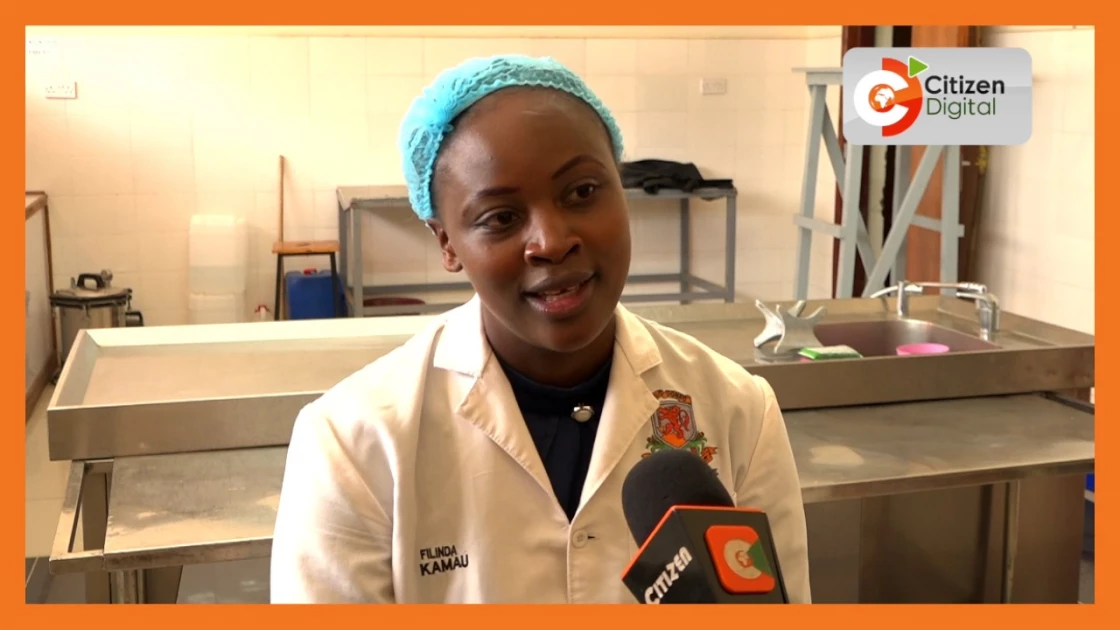
Filinda Kamau, a mortician at the Egerton University Funeral Home, Nakuru.

Audio By Vocalize
She does not shy away from showcasing what she does at the Egerton University Funeral Home, where she is employed as a mortician.
Most activities in morgues are considered inhumane, but Filinda has taken it upon herself to humanize the work, which she says has cost her friendships and relationships.
Citizen Digital visited her at the funeral home where we found her busy cleaning the cold room.
As she welcomes us to her place of work, Filinda says she enjoys doing what she does and she doesn’t see herself doing anything else in life.
“I like my work because here you are not in collision with anyone. You are handling people who can’t respond. It’s up to you to decide on the best thing to do.”
She shows us the trolley where bodies are placed when they are brought into the morgue, taking us through her typical working day.
“When a body comes in, the first thing I do is to observe the family members. People grieve differently, so I take my time to observe them and know how to handle them,” she says.
After that, Filinda wheels the body on a trolley, disinfects it and then confirms death. She insists that confirmation of death is important as there could be an instance where someone slipped into a comma and they are not dead.
When confirmed dead, the next stage of her work involves embalming. This includes massage that aims at putting every organ in shape; closing eyes and mouth.
When this is done and the body well labelled using tags, it is then slid into one of the cold cabinets, awaiting burial.
As she narrates this process, there is a set of knives, scissors sewing thread and beauty products on the table.
“The knives are used during the post-mortem, when it is needed. The make-up is used on bodies when family members want their loved one to look dolled up. There are people who loved make-up when they were alive. So we apply it even in their death.”
Filinda says when she decided to become a mortician, her family was opposed to the idea. They advised her to pick another profession but she remained adamant.
Today, they have all accepted what she does. Her husband, who she met while working as a mortician, is supportive too, but has not informed his family of what she does. He only says she is a nurse.
“This job has cost me friendships. I have lost friends who think this is a dirty job, but that is life. Even in women groups, there are those who look down upon me for what I do. But this is a job like any other.”
How she overcame the fear of the dead, Filinda narrates of an incident that happened to her while she was interning at Chiromo Funeral Home.
On that day, she was with a colleague when they pulled one of the drawers where a body was lying. In the process, the drawer broke and the body fell on them.
“I ran away thinking the man had woken up from the dead. I suffered nightmares for a week and that is the last time I had nightmares. Today, once I woke out of that door, I forget everything about the mortuary,” she recalls.
On sharing her content on Tiktok, Filinda says she has received immense support from her online family, safe for a few individuals who criticise her.
“Many ladies are now coming out and want to become morticians like me. This has really encouraged them and they see this job like any other job.”
Filinda looks forward to establishing her own funeral home and continuing offering the services she is offering at the Egerton University Funeral Home.
For now, she hopes that her continued presence on social media will enlightened the public on the need to accept that mortuary work is just work like any other and end stigma.
Leave a Comment