
The making of Singapore: How Asian Tiger came to be and why Ruto’s dream is a fantasy for Kenya
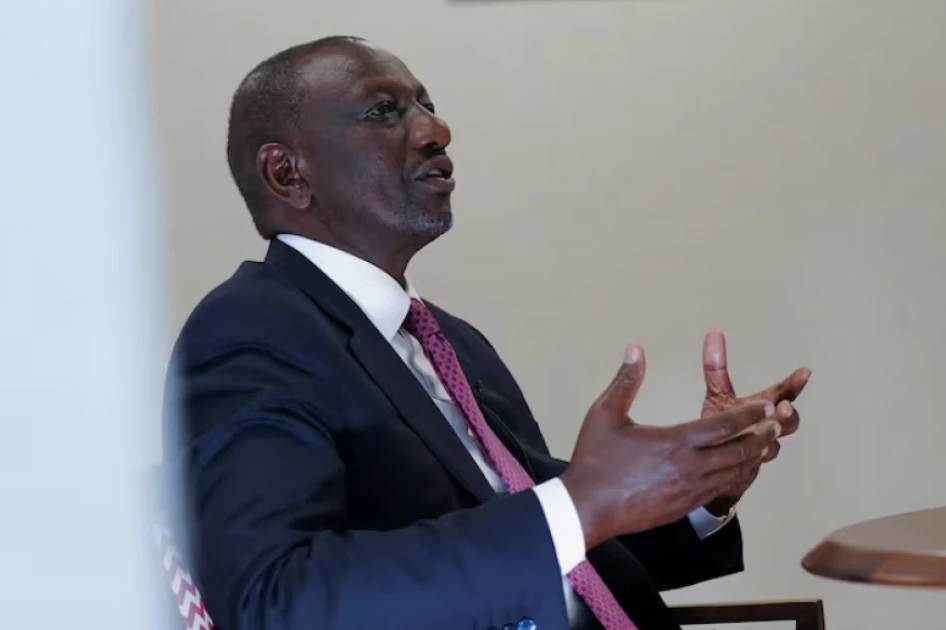
William Ruto, President of Kenya, speaks during an interview with Reuters at the Permanent Mission of the Republic of Kenya to the United Nations, during the 80th United Nations General Assembly (UNGA) in New York, U.S., September 24, 2025. REUTERS/Bing Guan/ File Phot

Audio By Vocalize
If you are to ask a random Kenyan about the country’s vision, they are likely to say it is “to be like Singapore” or “to be the Singapore of Africa”. The leading proponent of this mantra today is President William Ruto.
You must have heard the saying that “Rome wasn’t built in a day”, so was Singapore. The Singaporean dream is meant to be backed by a litany of proposed mammoth infrastructure development plans. The huge infrastructure plans will come at eye-popping expenditures, which Ruto’s government says will be borne by the novel National Infrastructure Fund and the Sovereign Wealth Fund.
Ruto has issued public speeches and presentations - one of them being the State of the Nation Address to the joint sitting of the Kenyan parliament - about mega-infrastructure plans that he believes will be achieved during his tenure. The dream of becoming the new Singapore is alive and achievable, President Ruto says.
Tiny city at the tip of the Malay Peninsula
Singapore, a tiny city in Southeast Asia at the southern tip of the Malay Peninsula, has become a peculiar reference for Kenya’s journey to be a developed nation. A country that was once a part of the wider Malaysian nation for 2 years after independence, but chose to walk its own path.
Kenya, measuring 580,367 square kilometres, is about 807 times bigger than Singapore in size. To contextualize this, the city-state of Singapore, at 719 square kilometres, is roughly the same size as the City of Nairobi, which is 709.3 square kilometres has a population, in 2025, of around 5.8 million people.
The population of Singapore is around 5.9 million people, while Kenya’s population is around 54 million people. If a comparison were apt, then it would probably be between the City of Singapore and the City of Nairobi. Then, like in the vintage novel by Charles Dickens, it would be called “A Tale of Two Cities.” But it is not; it is a comparison between Kenya and Singapore. Is there anything to compare? Or is it that there are only a thing or two to contrast?
Singapore has become the pet economic status-desire of our political class. It sits at the apex as the adorable rags-to-riches story that any wannabe would look up to for motivation or to emulate. Singapore is the single ideal state whose status and clout Kenya would want to achieve and glory in.
As much as there could be similarities between Kenya and Singapore, such as the relative date of independence, very little remains comparative along the way to date.
But Singapore predates Kenya by many centuries. In the 14th century, Singapore was already a center for a vast trading network and actively engaged in commerce with neighboring ports and regions way back in time. Then, it was known as “Temasek,” an old Malay name meaning “Sea Town,” in the 14th Century was renamed “Singapura,” or “Lion City.”
Singapore’s rise to become an Asian Tiger
The term “Asian Tigers” is a reference to the economies of four prosperous and highly developed South East Asia nations, namely Singapore, Hong Kong, South Korea and Taiwan.
They rose from low-income societies and went on a rapid path of industrialization and achieved high export-led economic growth beginning in the late 60’s all the way to the 90’s. They are symbols of what the ‘mighty tiger,’ fabled in Asia, achieves as an apex hunter, single-minded focus, discipline and purpose-led.
Over 300 years before modern Singapore came to be, like Mombasa on Kenya’s coast, the island was already a hub of international cultures and trade. It was a melting pot for traders and international powers way beyond its immediate borders. This factor, although not much exploited back then, would come to be its saving grace once it began the walk to economic advancement in 1965.
It is also irrefutable that the choice of the British colonial administration to pitch camp therein helped propel Singapore’s rise into the bustling port-city and ultimately the State it is today. By 1897, there were around 200,000 inhabitants on the Island of Singapore. Among them was the great-grandfather of the man who was to become the first prime minister of independent Singapore, Lee Kuan Yew.
Singapore’s merger with the Federation of Malaya happened in September 1963 on the occasion of Malaysia gaining its independence. However, Singapore and Malaysia went their separate ways soon after, and Singapore regained its sovereignty (independence) in 1965 as a city-state. On a comparative note, Singapore, just like Kenya, was rife with British-inspired ethnic profiling, which resulted in tensions pitting the Chinese, Malay and Tamil ethnic groups against each other.
Singapore gained formal independence on August 9, 1965. Yusof Ishak took office as the first president, and the highly influential Lee Kuan Yew was her prime minister. After independence, Singapore continued to experience socio-economic problems as a majority of the city-state's 3 million people were unemployed. More than two-thirds of its population was living in slums and informal settlements on the fringe of the city.
The young country was sandwiched between two large and unfriendly states, Indonesia and Malaysia. To add to its woes, Singapore lacked natural resources, had poor sanitation, almost no infrastructure, and an inadequate water supply. Her visionary Premier, Lee Kuan Yew, turned to international partners for help but was disregarded.
Lee Kuan Yew and his colleagues had a change of tact; they rushed through laws and policies to position the country as having business-friendly laws to appeal to savvy and discerning international business outfits. The result was instantaneous; the government-driven image of a safe, stable, and business-friendly environment attracted foreign investors.
Singapore's economy grew rapidly, supported by foreign investments and a strategic focus on education. The Island’s administration went on to maximize on its advantageous location and established solid port system. It also portrayed itself as the ideal location to manufacture goods for global consumption.
Singapore contrasted itself to its two volatile neighbours, Indonesia and Malaysia, where political and economic climates were unpredictable, in contrast to Singapore, where things looked very stable.
Just before Kenya’s independence in 1963, the GDP was approximately $926.59 million, and its GDP per capita was $107 US dollars. This could be comparable to Singapore's GDP in 1963, which was about $917.61 million with a GDP per capita of around U.S. $320. Over 40 per cent of Kenya’s GDP was from agricultural produce, while Singapore’s economy was bolstered by its trade and service industry. Today, Singapore is one of the world's fastest-growing economies.
Today, its GDP per capita has risen to an incredible U.S. $60,000, making it one of the strongest economies in the world. For a small country with few natural resources, Singapore's economic rise is nothing short of outstanding. Meanwhile, Kenya's projected GDP for 2025 is $136.01 billion. None of these countries arrived where they are accidentally; both have realized the fruit of leadership that took very different paths, and their citizens are subject to the attendant consequences.
As international investors flocked to Singapore, it turned to its other priorities, mainly education and infrastructure. The country built many technical schools and collaborated with multinationals in training their unskilled citizens in information technology, petrochemicals, and electronics.
Others were trained in service segments of the economy, such as in tourism and transportation. By the 1970s, Singapore had begun exporting textiles, garments, and basic electronics.
By the 1990s, they were engaging in manufacturing food products, logistics, biotech research, pharmaceuticals, integrated circuit design, and aerospace engineering. Its tourism industry was also thriving, attracting over 10 million visitors annually.
Within the service sector, Singapore’s banking grew considerably over the years, and many assets formerly held in Switzerland were moved to Singapore, partly due to new, higher taxes imposed by the Swiss.
The biotech industry is flourishing, with drug makers such as GlaxoSmithKline, Pfizer, and Merck & Co. all manufacturing from the Island, as oil refineries continue to produce oil products for the global market despite Singapore not producing any crude oil. Singapore has a strong oil, gas, equipment and services industry.
What Singapore did to succeed
Singapore, once a resource-poor island-nation, deliberately altered its fortunes to become a global economic powerhouse in under three decades through a chain of strategic and disciplined decisions. It employed a policy of zero tolerance for corruption as the government regarded corruption as a danger to its long-term objectives. It deliberately established a strict rule of law and established an efficient, clean civil service, which built public trust and attracted foreign investment.
The trail-blazing nation consequently embarked on a visionary and pragmatic leadership focus when one of the founding fathers of modern Singapore, Lee Kuan Yew, and subsequent leaders preferred long-term, data-driven solutions rather than ideology. They made tough but necessary choices for the nation's survival and growth as they shunned ethnic divisions that the British had used to divide them.
The leadership of Singapore was single-minded in achieving strategic economic development as it shifted, shortly after independence, from an import-led economy to an export-oriented economy, chose rapid and aggressive industrialization, actively attracted multinational corporations (MNCs) with policies and other incentives and at the same time developed world-class infrastructure, including it a new port and airport.
Knowing where its biggest competitive advantage lay, Singapore immediately embarked on a huge investment in its human capital. By recognizing its people as its core resource, the government consequently invested in a high-standard education system that produced a skilled workforce relevant to the industries being set up, and vigorously promoted a culture of meritocracy in business, the workplace and in life.
Lastly, the leaders of the Island-state carefully chose social cohesion and stability, knowing very well it had a multi-ethnic population that needed to be more closely knit and not torn in various directions. Its leadership fostered social harmony and an orderly society, which they knew would be essential for sustained economic development and investor confidence.
How Kenya went off tangent
Kenya, a country that at independence had fertile agricultural land alongside a number of natural resources and a greater land area, over the years faced persistent leadership challenges that derailed its development trajectory.
Chief among them was the existence of endemic corruption and embezzlement, embraced by the top leadership in government from the very start in 1963. It was not lost on Kenyans within and the international community that corruption was immediately widespread and institutionalized as high-level government officials diverted public funds meant for development into private hands, leading to a lack of essential services and infrastructure development.
On the other hand, the government entertained divisive political rhetoric and ethnic divisions in its ranks and in the wider public. This resulted in political instability, more often than not, along ethnic lines, and the ultimate result has been a volatile and unpredictable environment devoid of peace and stability.
Political instability discourages long-term investment and sporadically erupts into political violence, as witnessed elections in 1992 but more so during the post-election violence of 2007.
To the detriment of the country to date, the government of Kenya has pursued inconsistent economic policies that, at best, have achieved little. The government has struggled with debts which have piled higher, and the annual budget policy, running through a one-year cycle, has remained at best an instrument of unstable and inconsistent fiscal policies.
Heavy borrowing to finance budget deficits and a reliance on a few export crops have made the economy vulnerable to external shocks and an ensuing debt distress.
Kenya has, due to political expediency, set up weak public institutions and instituted poor governance measures, all in a bid to consolidate political power.
Unlike Singapore's strong and efficient public administration, Kenya has faced challenges with weak institutional laws and a lack of accountability, leading to poor service delivery and a general lack of trust in government.
Lastly, Kenya has strangely majored in misplaced priorities, as its critics point out. It prefers utilizing funds on recurrent expenditures and other non-priority issues rather than addressing fundamental needs like unemployment, universal health care, manufacturing, agriculture and education, contributing to high unemployment and poverty rates.
Kenya’s unique placement
Kenya is a country with a very young median age, which is around 20 years and therefore holds the demographic advantage of a young population. But then again, a highly distinguishable factor is that as high as 70% of its population resides in rural areas.
To develop swiftly, Kenya would need to set up targeted rural-based interventions to hasten the skills-set of such a high and varied population, boost the rural infrastructure, especially in water, energy and transport and then ensure trust and discipline in public institutions. Even so, it would be a tall order for all this to happen in a generation or less.
Similar to Singapore, Kenya’s old sea ports of Mombasa and Lamu, if sufficiently upgraded, would gift it the opportunity to become the gateway into eastern Africa’s landlocked nations by providing quality port services.
Kenya’s experience with airport and airline management would create a natural strong point too, as it serves the region. Other locally strong sectors, including banking, finance and Information Technology, would need strong placement and support by the government to grow more and reach further beyond the eastern African seaboard.
If Kenya were to purposely capture and make the best of such prospects as a forerunner of international trade and logistics provision at the regional level, it would be well on its way to high economic achievements.
The Singaporean pipe dream
As Singapore leads by becoming the standard for visionary ethical leadership, strategic planning, strong governance, economic openness, Kenya lags by enduring poor leadership over time, corruption, skewed ethnicity and development, non-descript education policies and a dwindling manufacturing sector.
Kenyan leaders’ overt and specific admiration for the economic performance of the Asian Tigers, and specifically Singapore, cannot pass unnoticed. In presentations and speeches, Kenya’s political leaders attest to the fact that the accomplishments of the Asian Tigers are worth emulating and indeed within reach.
President Ruto fondly cites how countries like China and Singapore had transitioned from lowly developed nations to highly developed nations. He believes that with good planning and combating corruption, the Singaporean dream is achievable for Kenya.
“We can make this country greater than what we have today. I am confident, and I believe in the potential of this nation. Countries like Singapore, China, and Malaysia were where we were years ago, but they made the right decisions and are now in the first world, and we are still where we were. I want to tell the people of Kenya, we can change this country if we work together. If we have a plan and if we eliminate ethnic and political divisions. If we eliminate corruption and theft of public property,” Ruto once stated.
The Kenya Kwanza government, just as every other past administration, have been given more to talk than to do. Flashier and bigger budgets in succession, and a lack of fidelity to budget lines, have ensured the country is always living beyond its means, courtesy of debt.
Lately, the government is pursuing an ambitious and big-spending avenue to reach the status of Singapore. As yet untested, it could turn out to be fool’s gold. For it is not in the funding that lies the answer to rapid sustainable development but in a solid pragmatic vision, consistency, integrity, persistence and consistent review. This way, Kenya might fit into the metaphor of the soon-to-be ‘Singapore in Africa.’
What divides Kenya from Singapore is as wide as the sea, but even the sea can be bridged if need be. A critical look at Singapore's success reveals some core factors, such as the indispensable visionary, incorruptible leadership during its formative years.
This was backed by pragmatic policies focused on human capital and a supportive business environment, while Kenya's development has been hindered by persistent corruption, political instability, and inconsistent economic policies. Is Kenya ready to embrace the core values that took Singapore to the pinnacle?
Join the Discussion
Share your perspective with the Citizen Digital community.
No comments yet
This discussion is waiting for your voice. Be the first to share your thoughts!