
The tough balancing act as Parliament seeks to entrench NG-CDF in the Constitution
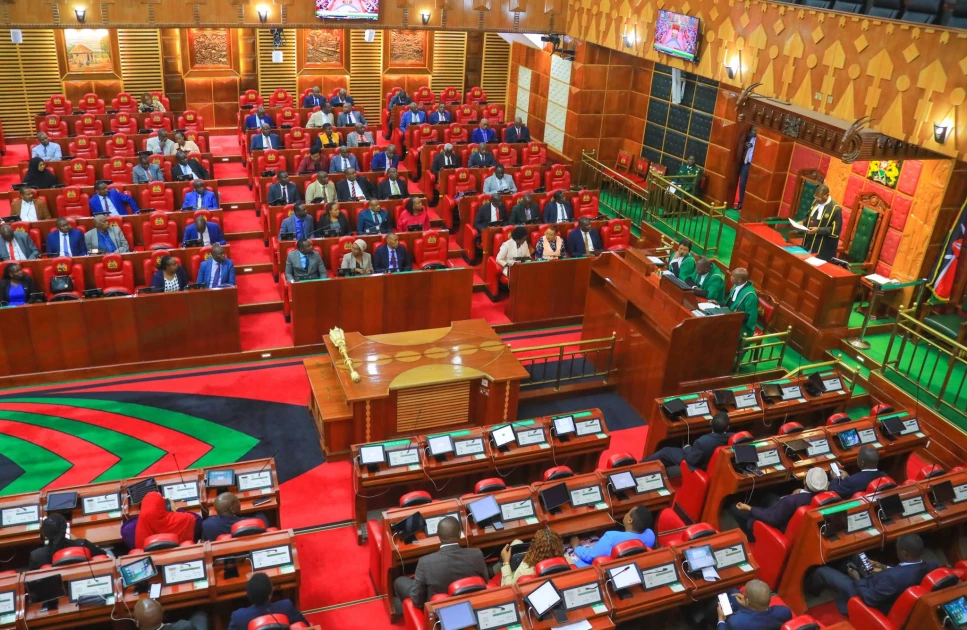
Speaker Moses Wetangula addresses the National Assembly on February 11, 2025.

Audio By Vocalize
The Constitutional Amendment Bill 2025 is now headed to the Senate for concurrence after the National Assembly unanimously approved the Bill.
The Bill garnered the support of all 304 members who voted, surpassing the minimum threshold of 233 members while.
Senate is expected to soon debate and vote on the Bill which if passed and receives the Presidential assent, will set it beyond the legal hurdles it has faced.
In September 2024, the Supreme Court in Kenya declared the NG-CDF unconstitutional as it violates the principles of devolution and the NG-CDF Act has caused a duplication of roles.
The Court went ahead to give the government until June 30, 2026 to wind up on all programs under implementation by the NG-CDF.
Earlier, in August 2022, the Supreme Court had declared the NG- CDF precursor, the Constituency Development Fund illegal and unconstitutional.
In its verdict, the Apex Court found that the law allowing MPs to manage funds offends division of revenue and public finance law was unconstitutional.
"A declaration is hereby made that the Constituency Development Fund Act, 2013 is unconstitutional," the verdict given by the five-judge bench read in part. Back then this brought to a close a nine-year court battle between Parliament and civil society groups.
The NG-CDF has been a noteworthy source of grassroots development funding for the past two decades in Kenya.
From roads to schools, hospitals to markets, the fund has driven putting up public sector facilities in many constituencies in Kenya. At its center has always been the sitting member of parliament, running the show with very few checks and balances which have always resulted in murmurs and genuine concerns.
Many Kenyans remember seeing politicians faces looming large on construction site-boards or bill boards on infrastructure projects, taking credit for implementing projects which are funded by public money. But this has been the personalization and laughable part of it.
The real challenge has been the governance concerns it has raised. Once the funds reach the constituency level, the chosen projects are normally opaque processes right from the design, implementation and evaluation.
The one-million-dollar question has always been ‘does it deliver value for money?’, in many instances it has been anyone’s guess.
However, the fund’s waterloo has been the legal hurdles it faced which culminated in being declared illegal by the Supreme Court in September 2024. The current proposed constitutional amendment seeks to address these concerns by formally establishing the fund within the constitution.
The Constitution of Kenya (Amendment) Bill, 2025, seeks to formally entrench the NG-CDF, the Senate Oversight Fund, and the NGAAF into the Constitution.
By so doing, the Bill seeks to amend the Constitution to explicitly define and authorize these funds. The Bill has already undergone public participation exercises, gathering input from Kenyans across the country.
Entrenching the funds in the Constitution would provide them with greater legal protection and stability, making them less vulnerable to changes in legislation or court decisions. They would not have to suffer the shocks as they did when the courts declared the funds illegal last year.
Those who support the fund, argue that formalizing it, plus the two new funds, would ensure their continued operation and prevent any potential disruptions to ongoing development projects at the grassroots level.
Those in support of the fund claim that the NG-CDF, in particular, enjoys widespread public support due to its tangible impact on communities. This is a debatable assertion based on whose side of bread is battered by such funds. In Kenya, there are probably no funds abused and misused as the NG-CDF where the MPs hold total sway and where they lord it over their constituents.
Some MPs’ have acknowledged some of its legal challenges. They believe that formalizing the funds within the Constitution will address its governance concerns by clarifying the roles and responsibilities of different entities involved in its management.
Those critical of the fund argue that entrenching the legislative funds could further blur the lines of separation of powers by involving MPs in the administration of public funds.
This would go against a core tenet of the set-up of the government of Kenya, separation of powers between the executive, the legislature and the judiciary.
There are valid concerns about ensuring the proper utilization of public funds and holding those involved in fund management accountable. These has not been particularly addressed and many fear the MPs’ will continue having their ‘free-lunch’ undisturbed, even as the citizens continue languishing in poverty.
Many still fear the funds will still be used for leverage by MPs’ to peddle influence and used for political manipulation and patronage at the needed time among the electorate. The money has always been used as a political tool to reward those who stand with him and punish those who question him through partial approach to development projects in the constituencies.
The Parliament of Kenya is set up to carry out three main responsibilities, to represent the people, to make laws governing the people and to oversight the government.
This push to entrench the NG-CDF and other related funds in the Kenyan Constitution is a significant step with potential far-reaching implications for development and on the other hand, cement poor governance models.
The debate surrounding the funds highlights the complexities of balancing the need for grassroots development with constitutional principles of separation of powers and accountability.
Some critics are of the opinion that the Senate Oversight Fund proposed by the National Assembly in the proposed bill, is meant to whip the Senate into place to support the bill without question as the Senate will for the first time have a kitty that they will use within their counties. But is this Bill all about the interests of parliamentarians to the exclusion of the law or is it about fulfilling the needs of Kenyans, constitutionally?
This move, entrenching the funds in the constitution, aims to ring-fence its legal standing and protect it from potential future legal challenges or alterations.
But a good number of nay-sayers are of the opinion that although some good has come from these funds, there is a superior need to conform to the constitution and thereby uphold wisdom in separating the arm that implements from the arm that oversights.
Some observers are talking of the need to change the constitution first, through a popular vote, such as through a referendum, to ensure the legality of the legislature disbursing such funds.
Will this see parliament come to the people to conduct a referendum or will it be part of the questions during the next general elections?
Other Kenyans fear that if the Bill gets presidential assent, it will load more financial burden on Kenyans at a time when many decry a bloated and inefficient government creating more channels.
The outcome of this process will be crucial for shaping the future of such funds and their impact on Kenyan society.
Join the Discussion
Share your perspective with the Citizen Digital community.
No comments yet
This discussion is waiting for your voice. Be the first to share your thoughts!