

The war on terror feeds on Somalia’s blood
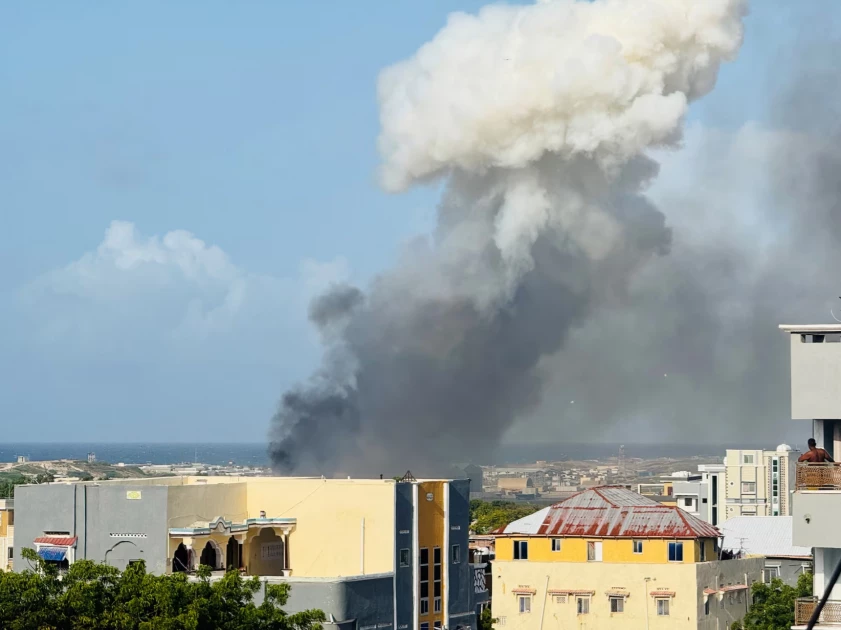
Smoke rises in the direction of Aden Adde airport in Mogadishu, Somalia, July 2, 2025, in this picture obtained from social media, Abdirahman Mohamed Arab/via REUTERS

Audio By Vocalize
In early February 2026, the city of Baidoa in Somalia’s South West State was gripped by a bloody day following clashes that left numerous dead and wounded.
The city, home to more than 800,000 people, occupies a
strategic position and ranks as Somalia’s third-largest city. Fierce fighting
erupted between South West State forces and rival armed groups amid a
long-standing land dispute.
Officials and residents said the fighting, which began near a
local market, spread to other parts of the city, resulting in casualties. The
Minister of Information for South West State, Mohamed Ibrahim Bilal, described
the opposing fighters as “bandits” seeking to destabilize security, affirming
that state forces intervened swiftly and restored control.
“These were bandits attacking civilians and looting homes. All
groups involved have now been neutralized,” Mohamed Ibrahim Bilal told local
media.
The clashes have once again drawn attention to the
deteriorating security situation across various regions, particularly as armed
movements advance in this fragile African nation.
Somalia faces significant security challenges, especially with
the expansion of Al-Shabaab in several areas and its success in carrying out
suicide operations in the capital, Mogadishu.
In this context, researcher Saeed Nada says the administration
of President Hassan Sheikh Mohamud is grappling with multiple internal crises,
the most dangerous of which is the increased activity of terrorist
organizations.
He explained: “Two main terrorist organizations operate in
Somalia. The first, the oldest and most active and influential, is Al-Shabaab
(‘Harakat al-Shabaab al-Mujahideen’), affiliated with Al-Qaeda. The second,
more recent and less active and influential, is ISIS in Somalia, or ‘Somalia
Province,’ affiliated with ISIS.”
He pointed out that on March 5, 2025, Al-Shabaab militants
attacked Somali army bases in the area of Awdeegle in the Lower Shabelle region
of South West State. In a separate assault, the group’s fighters targeted the
areas of Hawaa Abdi and Lafole, located 15 kilometers from Mogadishu.
“Three days later, on March 18, 2025, the motorcade of
President Hassan Sheikh Mohamud was struck by a roadside bomb as it passed
through the El-Gabta junction near the presidential palace in the Hamar Jajab
district of central Mogadishu.
The explosion, claimed by Al-Shabaab, killed at least eight
civilians and injured others, while the president and his entourage survived.”
On April 6, 2025, the researcher added, Al-Shabaab militants
seized the town of Aden Yabal in central Somalia, which had served as a
principal launching base for government operations against the group. In a
statement, the organization announced that its forces had taken control of ten
military installations after intense clashes with government troops.
Somalia’s fragility is reflected in its security sector, which
faces numerous challenges preventing it from fully carrying out its
duties—whether in confronting Al-Shabaab or in extending security across the
country’s territory—according to Abdelkader Mohamed Ali.
The most prominent manifestation of the weakness of Somali
security and military institutions, Mohamed Ali says, lies in the persistent
need for the African mission supporting the Somali army in its fight against
the movement since 2007.
Under its various names, the mission has undertaken tasks
related to supporting government structures, training security forces, and
helping create a secure environment for the delivery of humanitarian aid.
Another indicator of institutional fragility in Somalia, he
notes, is the government’s inability to combat entrenched corruption within
state institutions, as clearly reflected in the rankings of Transparency
International, where Mogadishu has consistently ranked at the bottom of the
annual index for more than a decade.
“This reality casts a heavy shadow over Mogadishu’s capacity
to eliminate Al-Shabaab,” he added, explaining that tribal and political
connections often pave the way for individuals to assume sensitive military and
security posts, negatively affecting institutional capabilities at both the
planning and field levels, due to the neglect of standards such as competence,
professionalism, and capability.
For his part, Somali journalist Al-Shafi’i Abtadoon said that
the results of the war announced by the federal government were “disappointing
and contrary to expectations of delivering a military defeat to Al-Shabaab
within a year,” as the Somali president had declared on more than one occasion.
However, the movement, employing guerrilla warfare tactics,
has managed to dispel these repeated announcements heard by Somalis at home and
abroad.
He stressed that “the war Somalia is waging against
ideologically driven armed organizations will be long and of unpredictable
outcome,” particularly after leaks from U.S. military officials reinforced the
hypothesis of growing ISIS influence in Puntland Federal State.
“The desire promoted by supporters of President Hassan Sheikh
Mohamud to achieve a rapid military victory over Al-Shabaab has not
materialized, and the president’s speeches now carry little weight in the
balance of battles or in tipping the scales in his favor,” he added.
Meanwhile, observers point out that internal instability
within the Somali army has been one of the principal reasons why a military
defeat of Al-Shabaab has proven impossible.
The United States suspended food rations to Somalia’s elite
Danab forces—trained under its partnership with Mogadishu in counterterrorism
efforts—after informing Somali authorities that some members were stealing
rations and reselling them.
According to Sudanese reports, this reflected the scale of
corruption permeating Somali forces, further increasing allies’ skepticism
toward counterterrorism strategies.
In this context, the Somali government acknowledged that food
rations allocated to the elite forces trained and supported by the United
States had been diverted.
On January 8 of this year, the United States announced the
suspension of all aid provided to Somalia following allegations that a World
Food Programme warehouse at Mogadishu port had been destroyed and food
assistance seized.
The U.S. State Department said in a statement: “All U.S.
assistance programs that directly or indirectly benefit the Federal Government
of Somalia have been paused.” It added: “The Administration of President Donald
Trump applies a zero-tolerance policy towards waste, theft, or diversion of
assistance.”
It indicated that the measure was taken due to “unacceptable
actions” by the Somali government, affirming that the continuation of aid
depends on Somalia taking the necessary corrective steps.
In 2017, Washington suspended some military assistance to Somalia after the army failed to provide reports on allegations of corruption related to its use of food and fuel supplies.
Leave a Comment