

Trump gets key wins at Supreme Court on immigration, despite some misgivings
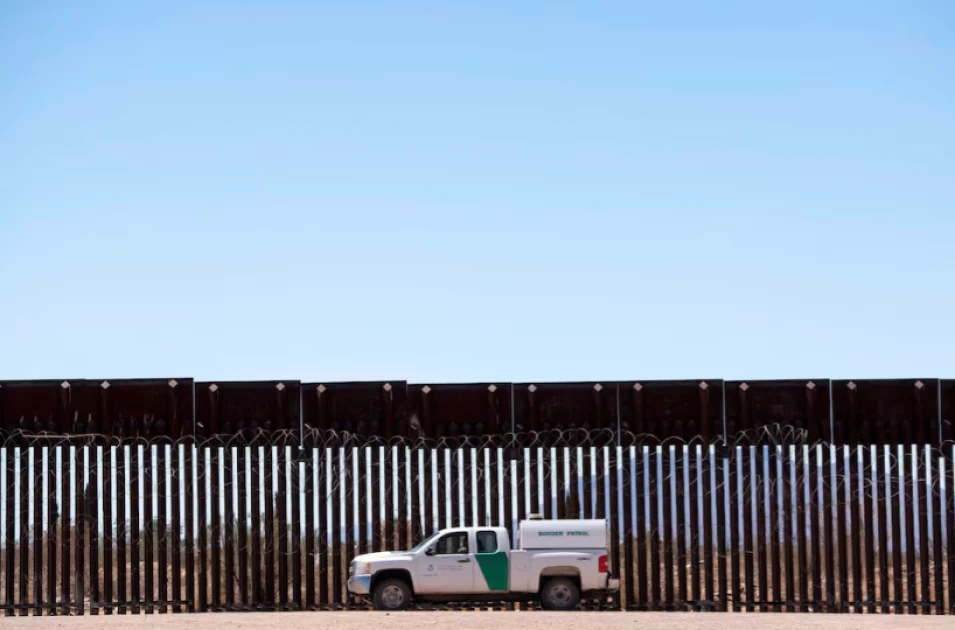
A U.S. Border Patrol agent sits in a vehicle while surveilling a section of the U.S.-Mexico border fence in Douglas, Arizona, U.S., April 20, 2025. REUTERS/Rebecca Noble

Audio By Vocalize
The U.S. Supreme Court swept away this week
another obstacle to one of President Donald Trump's most aggressively
pursued policies - mass deportation - again showing its willingness to back his
hardline approach to immigration. The justices, though, have signalled some
reservations with how he is carrying it out.
Since Trump returned to the White House in January, the
court has already been called upon to intervene on an emergency basis in seven
legal fights over his crackdown on immigration. It most recently let Trump's
administration end temporary legal status provided to hundreds of thousands of
migrants for humanitarian reasons by his Democratic predecessor, Joe Biden, while
legal challenges in two cases play out in lower courts.
The Supreme Court on Friday lifted a judge's order that had
halted the revocation of immigration "parole" for more than 500,000
Venezuelan, Cuban, Haitian and Nicaraguan migrants. On May 19, it lifted
another judge's order preventing the termination of "temporary protected
status" for more than 300,000 Venezuelan migrants.
In some other cases, however, the justices have ruled that
the administration must treat migrants fairly, as required under the U.S.
Constitution's guarantee of due process.
"This president has been more aggressive than any in
modern U.S. history to quickly remove non-citizens from the country," said
Kevin Johnson, an immigration and public interest law expert at the University
of California, Davis.
No president in modern history "has been as willing to
deport non-citizens without due process," Johnson added.
That dynamic has forced the Supreme Court to police the
contours of the administration's actions, if less so the legality of Trump's
underlying policies. The court's 6-3 conservative majority includes three
justices appointed by Trump during his first term as president.
"President Trump is acting within his lawful authority to
deport illegal aliens and protect the American people. While the Supreme Court
has rightfully acknowledged the president's authority in some cases, in others
they have invented new due process rights for illegal aliens that will make
America less safe. We are confident in the legality of our actions and will
continue fighting to keep President Trump's promises," White House
spokesperson Abigail Jackson told Reuters.
The justices twice - on April 7 and on May 16 -
have placed limits on the administration's attempt to implement Trump's
invocation of a 1798 law called the Alien Enemies Act, which historically has
been employed only in wartime, to swiftly deport Venezuelan migrants who it has
accused of being members of the Tren de Aragua gang. Lawyers and family members
of some of the migrants have disputed the gang membership allegation.
On May 16, the justices also said a bid by the
administration to deport migrants from a detention center in Texas failed basic
constitutional requirements. Giving migrants "notice roughly 24 hours
before removal, devoid of information about how to exercise due process rights
to contest that removal, surely does not pass muster," the court stated.
Due process generally requires the government to provide
notice and an opportunity for a hearing before taking certain adverse actions.
The court has not outright barred the administration from
pursuing these deportations under the Alien Enemies Act, as the justices have
yet to decide the legality of using the law for this purpose. The U.S.
government last invoked the Alien Enemies Act during World War Two to intern
and deport people of Japanese, German and Italian descent.
"The Supreme Court has in several cases reaffirmed some
basic principles of constitutional law (including that) the due process clause
applies to all people on U.S. soil," said Elora Mukherjee, director of
Columbia Law School's immigrants' rights clinic.
Even for alleged gang members, Mukherjee said, the court
"has been extremely clear that they are entitled to notice before they can
be summarily deported from the United States."
A WRONGLY DEPORTED
MAN
In a separate case, the court on April 10 ordered the
administration to facilitate the release from custody in El Salvador of Kilmar
Abrego Garcia, a Salvadoran migrant who was living in Maryland. The
administration has acknowledged that Abrego Garcia was wrongly deported to El
Salvador.
The administration has yet to return Abrego Garcia to the
United States, which according to some critics amounts to defiance of the
Supreme Court. The administration deported on March 15 more than 200 people to
El Salvador, where they were detained in the country's massive anti-terrorism
prison under a deal in which the United States is paying President Nayib
Bukele's government $6 million.
Ilya Somin, a constitutional law professor at George Mason
University, said the Supreme Court overall has tried to curb the
administration's "more extreme and most blatantly illegal policies"
without abandoning its traditional deference to presidential authority on
immigration issues.
"I think they have made a solid effort to strike a
balance," said Somin, referring to the Alien Enemies Act and Abrego Garcia
cases. "But I still think there is excessive deference, and a tolerance
for things that would not be permitted outside the immigration field."
That deference was on display over the past two weeks with
the court's decisions letting Trump terminate the grants of temporary protected
status and humanitarian parole previously given to migrants. Such consequential
orders were issued without the court offering any reasoning, Mukherjee noted.
"Collectively, those two decisions strip immigration
status and legal protections in the United States from more than 800,000
people. And the decisions are devastating for the lives of those who are
affected," Mukherjee said. "Those individuals could be subject to
deportations, family separation, losing their jobs, and if they're deported, possibly
even losing their lives."
Trump also pursued restrictive immigration policies in his
first term as president, from 2017-2021. The Supreme Court gave Trump a major
victory in 2018, upholding his travel ban targeting people from
several Muslim-majority countries.
In 2020, the court blocked Trump's bid to end a
program that protects from deportation hundreds of thousands of migrants -
often called "Dreamers" - who entered the United States illegally as
children.
Other major immigration-related cases are currently pending
before the justices, including Trump's effort to broadly enforce his January
executive order to restrict birthright citizenship - a
directive at odds with the longstanding interpretation of the Constitution as
conferring citizenship on virtually every baby born on U.S. soil. The court
heard arguments in that case on May 15 and has not yet rendered a decision.
Another case concerns the administration's efforts to
increase the practice of deporting migrants to countries other than their own,
including to places such as war-torn South Sudan.
Boston-based U.S. District Judge Brian Murphy required that
migrants destined for so-called "third countries" be notified and
given a meaningful chance to seek legal relief by showing the harms they may
face by being send there.
Murphy on May 21 ruled that the administration had violated his
court order by attempting to deport migrants to South Sudan. They are now being
held at a military base in Djibouti.
The administration on May 27 asked the justices to lift Murphy's
order because it said the third-country process is needed to remove migrants
who commit crimes because their countries of origin are often unwilling to take
them back.
Johnson predicted that the Supreme Court will side with the
migrants in this dispute.
"I think that the court will enforce the due process
rights of a non-citizen before removal to a third country," Johnson said.
Leave a Comment