
Trump wins as Supreme Court curbs judges, but may yet lose on birthright citizenship
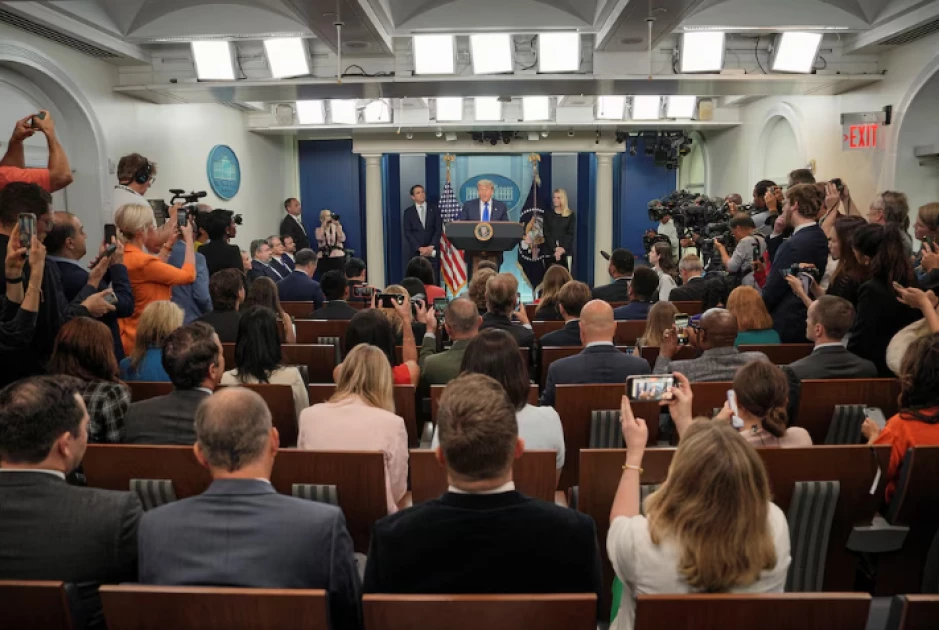
U.S. President Donald Trump speaks to the media, after the U.S. Supreme Court dealt a blow to the power of federal judges by restricting their ability to grant broad legal relief in cases as the justices acted in a legal fight over President Donald Trump's bid to limit birthright citizenship, in the Press Briefing Room at the White House in Washington D.C., June 27, 2025. REUTERS/Ken Cedeno

Audio By Vocalize
The U.S. Supreme Court's
landmark ruling blunting
a potent weapon that federal judges have used to block government policies
nationwide during legal challenges was in many ways a victory for
President Donald
Trump, except perhaps on the very policy he is seeking to enforce.
An executive order that the Republican president signed on his first day back in office in January would restrict birthright citizenship - a far-reaching plan that three federal judges, questioning its constitutionality, quickly halted nationwide through so-called "universal" injunctions.
But the Supreme Court's ruling on Friday, while announcing a
dramatic shift in how judges have operated for years, deploying such relief,
left enough room for the challengers to Trump's directive to try to prevent it
from taking effect while litigation over its legality plays out.
"I do not expect the president's executive order on
birthright citizenship will ever go into effect," said Samuel Bray, a
Notre Dame Law School professor and a prominent critic of universal injunctions
whose work the court's majority cited extensively in Friday's ruling.
Trump's executive order directs federal
agencies to refuse to recognise the citizenship of children born in the United
States who do not have at least one parent who is an American citizen or a lawful
permanent resident, also called a "green card" holder.
The directive remains blocked while lower courts reconsider
the scope of their injunctions, and the Supreme Court said it cannot take effect
for 30 days, a window that gives the challengers time to seek further
protection from those courts.
The court's six conservative justices delivered the majority
ruling, granting Trump's request to
narrow the injunctions issued by the judges in Maryland, Washington and
Massachusetts. Its three liberal members dissented.
The ruling by Justice Amy Coney Barrett, who Trump appointed
to the court in 2020, emphasized the need to hem in the power of judges,
warning against an "imperial" judiciary. Judges can provide
"complete relief" only to the plaintiffs before them, Barrett wrote.
That outcome was a major victory for Trump and his allies,
who have repeatedly denounced judges
who have impeded his agenda. It could make it easier for the administration to
implement its policies, including accelerating deportations of migrants,
restricting transgender rights, curtail diversity and inclusion efforts, and
downsize the federal government, many of which have tested the limits of
executive power.
In the birthright citizenship dispute, the ruling left open
the potential for individual plaintiffs to seek relief beyond themselves
through class action lawsuits targeting a policy that would upend the long-held
understanding that the Constitution confers citizenship on virtually anyone
born on U.S. soil.
Bray said he expects a surge of new class action cases,
resulting in "class-protective" injunctions.
"Given that the birthright-citizenship executive order
is unconstitutional, I expect courts will grant those preliminary injunctions,
and they will be affirmed on appeal," Bray said.
Some of the challengers have already taken that path.
Plaintiffs in the Maryland case, including expectant mothers and immigrant
advocacy groups, asked the presiding judge who had issued a universal
injunction to treat the case as a class action to protect all children who
would be ineligible for birthright citizenship if the executive order takes
effect.
"I think in terms of the scope of the relief that we'll
ultimately get, there is no difference," said William Powell, one of the
lawyers for the Maryland plaintiffs. "We're going to be able to get
protection through the class action for everyone in the country whose baby
could potentially be covered by the executive order, assuming we succeed."
The ruling also sidestepped a key question over whether
states that bring lawsuits might need an injunction that applies beyond their
borders to address their alleged harms, directing lower courts to answer it
first.
The challenge to Trump's directive also included 22 states,
most of them Democratic-governed, who argued that the financial and
administrative burdens they would face required a nationwide block on Trump's
order.
George Mason University constitutional law expert Ilya Somin
said the practical consequences of the ruling will depend on various issues not
decided so far by the Supreme Court.
"As the majority recognises, states may be entitled to
much broader relief than individuals or private groups," Somin said.
New Jersey Attorney General Matthew Platkin, a Democrat who
helped lead the case brought in Massachusetts, disagreed with the ruling but
sketched out a path forward on Friday. The ruling, Platkin said in a statement,
"recognised that nationwide orders can be appropriate to protect the
plaintiffs themselves from harm, which is true, and has always been true, in
our case."
Platkin committed to "keep challenging President
Trump's flagrantly unlawful order, which strips American babies of citizenship
for the first time since the Civil War" of 1861-1865.
Legal experts said they expect a lot of legal manoeuvring in
lower courts in the weeks ahead, and the challengers still face an uphill
battle.
Compared to injunctions in individual cases, class actions
are often harder to successfully mount. States, too, still do not know whether
they have the requisite legal entitlement to sue. Trump's administration said
they do not, but the court left that debate unresolved.
Meanwhile, the 30-day clock is ticking. If the challengers
are unsuccessful going forward, Trump's order could apply in some parts of the
country, but not others.
"The ruling is set to go into effect 30 days from now
and leaves families in states across the country in deep uncertainty about
whether their children will be born as U.S. citizens," said Elora
Mukherjee, director of Columbia Law School's immigrants' rights clinic.
Join the Discussion
Share your perspective with the Citizen Digital community.
No comments yet
This discussion is waiting for your voice. Be the first to share your thoughts!