
Ugandan farmers using bees to keep elephants away and life sweet from honey sales
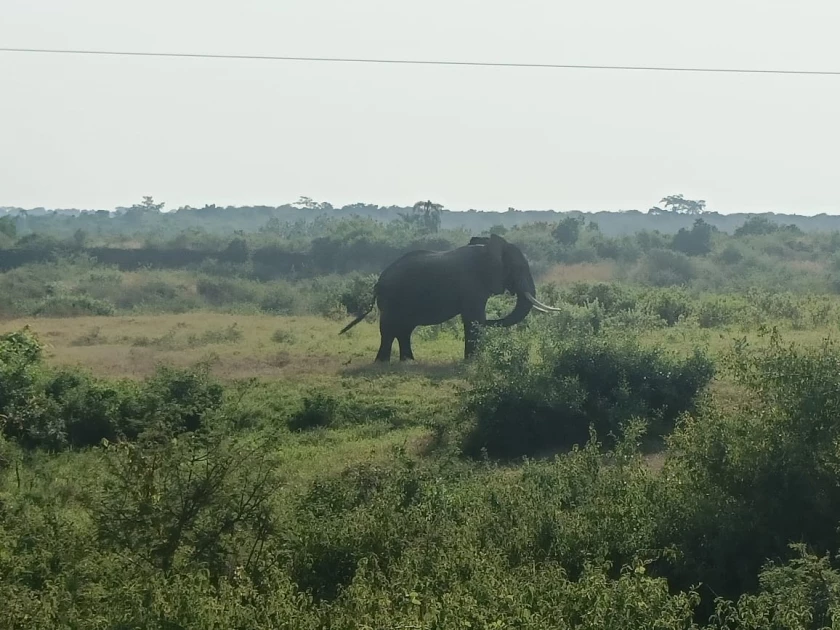
An elephant in the Rwenzori Mountains. Photo by Emily Chebet

Audio By Vocalize
More than 300 kilometers west of Entebbe International Airport in Uganda, lies Kibale National park.
The 776 km² park is located in Kamwenge district, which is part of the Kingdom of Toro, one of the ancient traditional monarchies in Uganda. The kingdom is led by King Oyo Rukidi IV, who was crowned as the world's youngest king at three years of age in 1995 following the demise of his father King Patrick Olimi III Kaboyo popularly known as King Omukama.
Kibale National Park is strategically placed less than 30 kilometers from the beautiful city of Fort Portal also known as the city of tourism at the foothills of Rwenzori mountains.
As you approach the tourism city, the scent of freshness, beautiful landscape, tea plantations, banana farms and lots of trees slaps you with much needed cool temperatures.
The scenic view of Rwenzori mountains ushers you into the city as the road further leads you to the Kibale national park. This park boasts of a vast range of animal species, birds and reptiles, and is mainly known for holding the largest primates’ empire with over 13 species.
With its astounding and pristine flora and fauna, the park is said to have been a hunting ground for the king in the pre-colonial period, before the Ugandan national government took over making it one of its biggest sources of revenue.
Human wildlife conflict
The Western part of the country, termed by Winston Churchill as the Pearl of Africa is a home to the predominant Banyankole, Batooro and Bakiga communities among other ethnic groups who solely depend on farming for their livelihoods and education of their children.
Like a number of African countries, the increase in human population and decrease in natural habitat, the human wildlife conflict over space is unavoidable. Elephants with their stubborn nature and being the biggest animals in the park pose more danger to crops as well as lives.
The community surrounding the protected area says they have suffered uncountable loses due to the invasion of elephants for as long as they can remember. Women are forced to accompany their children to school on a daily basis for fear of encountering the elephants on the road and they equally have to pick them up in the evening.
This tiresome routine generally reduces the number of hours they are supposed to work on the farms which in the long run affects the yields, offering such a steady crack for poverty to slowly creep in.
Men on the other hand must spend their nights out guarding their homes and crops to ensure they are not destroyed but on the other hand, they actually risk their lives. A number of them have lost their lives in the process since their tactic of beating iron-made drums to scare the elephants proves futile.
Beehive fence
(Photo beehive fence) With no need to invent a complicated wheel, the tiniest insect has brought relief to farmers living around the Kibale National Park in what can be equated to a David and Goliath fight.
The community has ventured into bee keeping but not just for your obvious and primary reason of getting the best honey to soothe their throats and warm their taste buds.
Here, a systematic model of bee keeping is employed where beehive fences are set up. These fences are connected with a rope from one beehive to another and placed strategically such that if an elephant tries to cross over from the park, the sound of it footsteps will cause a vibration on the ropes or when it comes in contact with the rope, they will torment the bees in the hives.
Like clockwork, the angry bees will come out and scare the elephants away.
A bee’s sting obviously cannot penetrate the thick skin of an elephant but it’s that sound of hundreds of bees in a swarm, that scares the elephants away. Also the elephants have vulnerable parts on their bodies like trunk, mouth and eyes that these bees target.
The Uganda Wildlife Authority (UWA) is working closely with the community that has played a critical role in conservation. In the past, the elephants would be killed by locals if found wandering in their farms, but the deterrence of this practice has resulted in the increase in the number of elephants.
Double profit from the sting
(Photo harvested honey) Immaculate Kamushaba, 37 says their men no longer sleep in the cold and they have more time to work on the farms which are giving them double yields for their families.
Apart from increasing their harvest from the farm, the community is earning big from the sale of honey that is harvested almost three times a year.
Kamushaba says the Uganda Wildlife Authority supports them by donating the hives as well as training them on how to manage the hives in groups and they are now minting thousands through the sale of honey.
“A liter goes for 10,000 Ugandan Shillings (Ksh.310) and we have two seasons. In February we got 46 liters but now in June we know it will increase,” she says.
Trenches and Boardwalks
The Wildlife Authority has also adopted a complimentary tactic of digging trenches and use of boardwalks to keep the elephants away from the locals. The 6 feet by 5 inches boardwalks are constructed to work in ancillary to the trenches especially in an area where they cannot dig trenches.
Boardwalks connect from one trench to another. Ricky Tumusiime, a community conservationist ranger at the Kibale National Park says trenches are very effective as long as they are done up to standard which is 6 feet by 5 just like the boardwalks. The idea works because elephants cannot jump through the trenches.
“The idea of boardwalks came out of the tourism sites where there are boardwalks, there is nowhere an elephant has ever stepped on the boardwalk, so that’s why we said, if it is not stepping on that shorter one, what if we construct a firm one in the swamp. In the all sites we’ve put boardwalks, elephants have never crossed there, first of all they fear, they think it is a trap, second, they cannot break it,” Tumusiime said.
During a visit by East African Journalists attending a conservation workshop organised by Internews through Earth Journalism Network, questions arose on the sustainability of the boardwalks in terms of durability and cost implications bearing in mind that they are constructed using cement and steel which can be expensive.
But for now, the community is happy and better financially at least for now.
Join the Discussion
Share your perspective with the Citizen Digital community.
No comments yet
This discussion is waiting for your voice. Be the first to share your thoughts!