
US embassy reassures Kenyans on data safety, says Ksh.208B health deal is not a loan
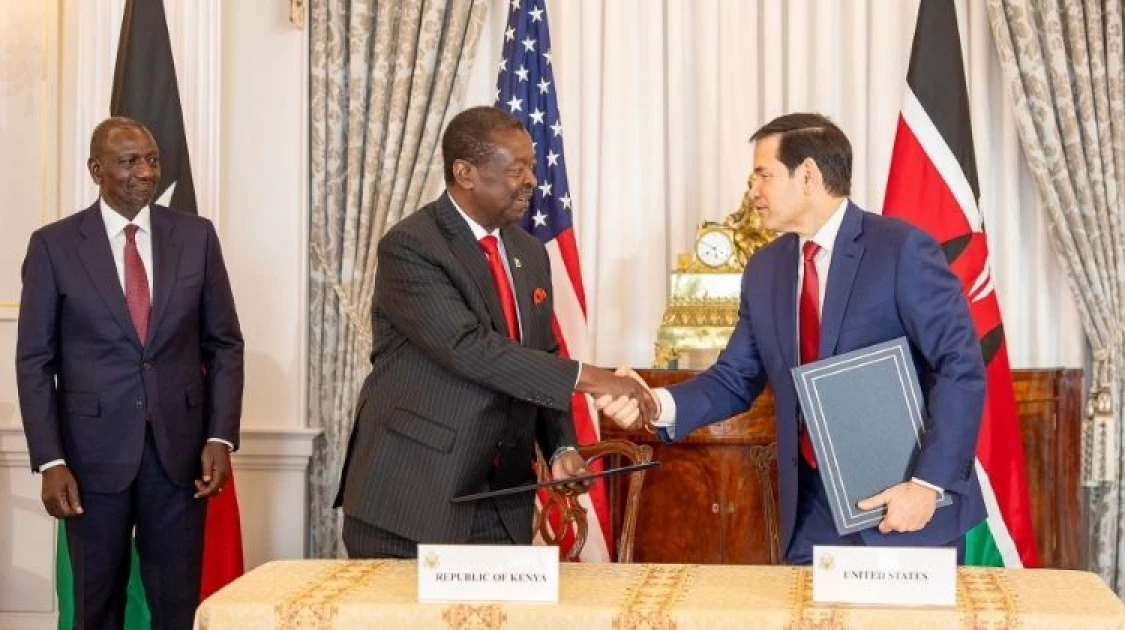
President William Ruto (left) witnesses the signing of Kenya-USA health deal signed by Prime CS Musalia Mudavadi and US Secretary of State Marco Rubio on December 4, 2025. Photo/PCS

Audio By Vocalize
According to the embassy, the framework is designed to support Kenya’s priority health programs while strengthening the long-term sustainability of the country’s health systems.
The agreement also requires the Kenyan government to increase its domestic health expenditure by Ksh.850 million over the five years.
Kenya is the first African country to sign a government-to-government health agreement with the United States of America.
The 2.5 billion dollar framework will see the U.S. government invest Ksh.208 billion directly into Kenya's health institutions in the next five years.
The U.S. Embassy in Nairobi has dismissed claims of data sharing with the U.S. and unauthorized specimen collection, saying strict safeguards are in place.
"We are just putting on paper the many policies we have had for years, so any data sharing will be aggregated data, in other words, not personally identifiable data," said Susan Burns – Head of Diplomatic Mission, U.S. Embassy Kenya.
"We would test some of the specimens where they do not have their own labs, so we will continue with that moving forward. Also, that agreement is building up their lab network so that they have those capabilities themselves, so it’s really a change but recognizing how we have worked together," said Brian Rettmann, PEPFAR Country Coordinator, Kenya.
The U.S. Embassy says the money is not a loan, but direct government-to-government assistance aimed at strengthening Kenya’s health system and reducing reliance on fragmented donor-led programs.
"There are a lot of questions about should we be getting assistance, Kenya should be self-reliant, what about our sovereignty and our rights. I think this is an investment in Kenya’s sovereignty and self-reliance and a move away from reliance to a dependent country. We would love to see a Kenya that is not receiving assistance but perhaps working to assist other countries," said Susan Burns, Head of Diplomatic Mission, U.S. Embassy Kenya.
"It would be a phased transition over time to try to make sure that the government has the systems to do this and that we have the oversight mechanisms to ensure that, as was said by President Ruto, every dollar and every shilling is spent correctly, and that is both U.S. government dollars and Kenya shillings," said Brian Rettmann – PEPFAR Country Coordinator, Kenya.
According to the agreement, Kenya must incrementally raise national and county health budgets over the five-year period from Ksh.10 billion in 2026/27 to Ksh.50 billion in 2029/30.
Procurement of health commodities will shift gradually from the U.S. government to the Government of Kenya during the five-year period.
Frontline health workers funded by the U.S. will be mapped and transitioned onto the Kenyan government payroll.
On top of that, Kenya can earn over 100 million dollars in performance incentives if it improves key health outcomes according to the framework.
Join the Discussion
Share your perspective with the Citizen Digital community.
No comments yet
This discussion is waiting for your voice. Be the first to share your thoughts!